
The seller says 'fully tested, excellent condition.' Those five words have never once told a buyer anything useful. Here's what actually does.
Every used robot listing claims good condition — it's the least informative phrase in the entire market. What actually protects a buyer is a systematic, physical inspection covering the arm, the controller, the data, and the paperwork, not a seller's adjectives. Skilled buyers work from a checklist every time, precisely because memory and trust are unreliable substitutes for verification.
This post lays out the core of the inspection checklist KeyLeer Kart runs on every unit we source, organised into the four areas that actually determine whether a used robot is a smart purchase.
Overview
A thorough used-robot inspection covers roughly forty distinct checkpoints across the mechanical arm, the electrical controller, the robot's stored data, and its documented history and provenance. No single checkpoint is disqualifying on its own, but the pattern across all forty tells you whether you're looking at a well-maintained machine with an honest seller, or a problem being dressed up in favourable language.
Key Factors to Consider
Arm Inspection
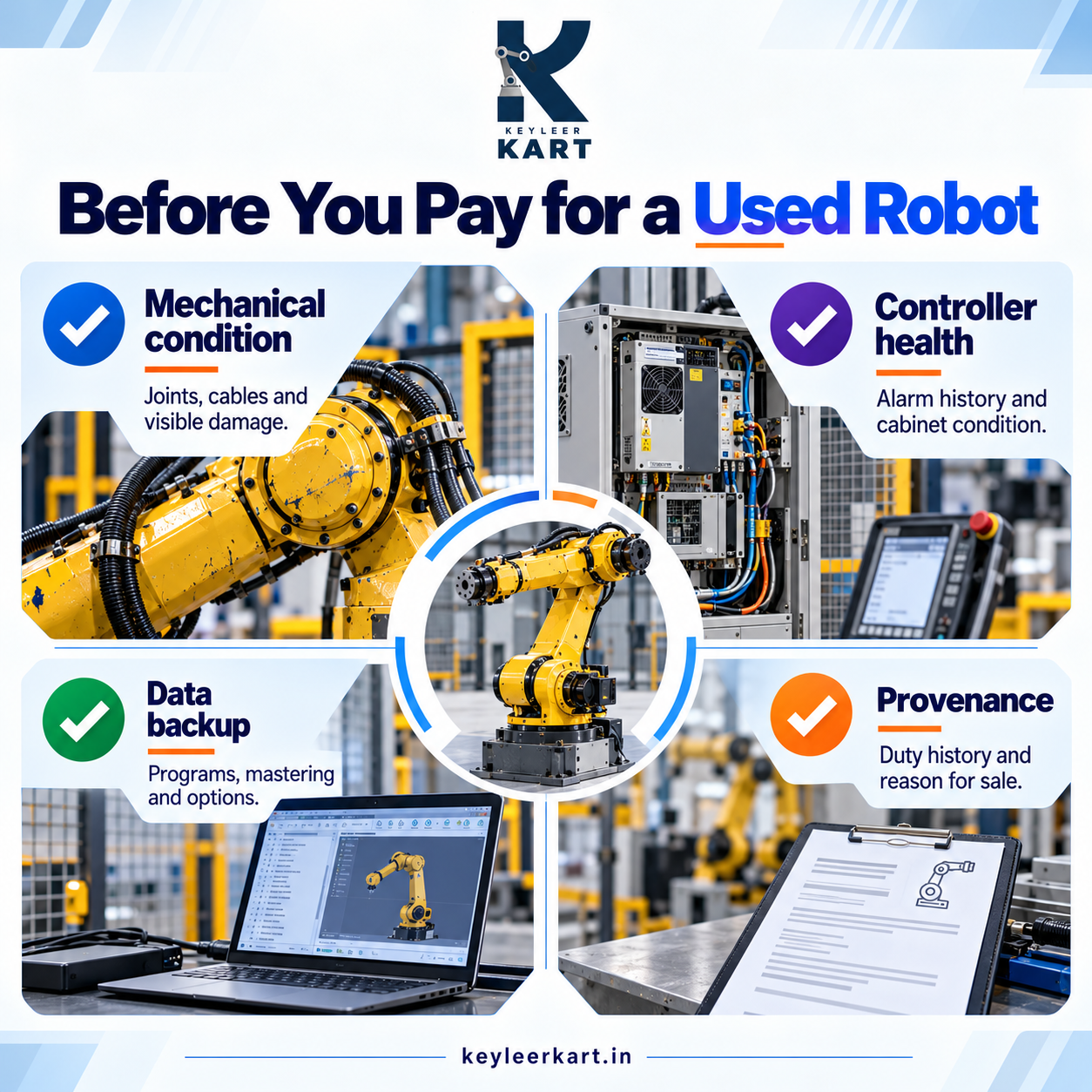
Check for grease leaks at each joint (especially J2/J3), backlash by jogging each axis and watching for lost motion, a proper brake test with the arm extended and power cut, cable dress-pack condition, wrist play, and any signs of a past crash such as a bent flange or mismatched repaint.
Controller Inspection
Power up the unit and read the complete alarm history, check for battery-low warnings, inspect servo amplifier condition and cabinet cleanliness, listen for contactor chatter, and confirm the teach pendant matches the controller generation and functions correctly.
Data Verification
Take a full backup of mastering data, programs, and the option list before the robot is moved from its current location — this data is often harder to recover than any physical component if it's lost in transit.
Provenance and History
Establish what plant and application the robot came from, why it's being sold, and whether it operated in a corrosive, dusty, or high-heat environment — all of which affect real remaining service life beyond what a single inspection visit can reveal.
Benefits
Prevents Costly Post-Purchase Surprises
A systematic inspection catches the issues that turn a good deal into an expensive dispute months after delivery, when recourse is far more difficult.
Gives You Real Negotiating Leverage
Specific, documented findings — not vague concerns — are what actually move price in a negotiation with a seller.
Protects Against Missing Mastering Data
Confirming mastering data and backups exist before purchase avoids an expensive and sometimes difficult re-mastering process after the fact.
Builds a Documentation Trail for Resale
A robot purchased with a thorough inspection record is easier to resell later with full confidence, since you can pass that documentation forward to the next buyer.
Industrial Applications
Any used robot purchase, regardless of brand or application
Complete production line acquisitions requiring multi-unit inspection
Cross-border imports where physical re-inspection isn't easily repeated
High-value heavy-payload robot purchases
Robots being purchased for safety-critical applications
Auction or time-limited sale purchases requiring rapid but thorough evaluation
Buying Guide
Insist on being present for, or receiving documented video of, the physical power-up and inspection — never accept a purely written condition summary for any meaningful purchase. Request the full alarm history printout and option-list screenshot as standard, non-negotiable parts of any transaction. Treat a seller's reluctance to power up the unit or provide these specifics as a serious red flag, not a minor inconvenience.
Maintenance Tips
Keep your own copy of every inspection finding, backup file, and photograph as part of your permanent equipment records — this documentation becomes essential for future maintenance planning and eventual resale. Schedule a follow-up inspection after the robot is re-installed and running, since some issues (subtle backlash, connector wear) only become apparent under real operating conditions.
Industry Trends
As the used robot market grows alongside global installations, professional, standardised inspection practices are becoming a genuine competitive differentiator for reputable resellers — buyers increasingly favour sellers who can demonstrate rigorous inspection processes over those offering unverifiable assurances alone.
Frequently Asked Questions
Q: Can I do a used robot inspection myself without technical expertise? A: Basic visual checks are accessible to most buyers, but a full technical inspection — alarm history interpretation, backlash assessment, controller diagnostics — is best done by or with an experienced technician or a specialist reseller.
Q: What's the single most important item on a used robot inspection checklist? A: Confirming mastering data and controller documentation are intact is often cited as the most consequential single check, since lost mastering data with no backup can be genuinely expensive to recover.
Q: Does KeyLeer Kart provide inspection reports with its listings? A: Yes — every unit we source and list is inspected against our full checklist, with documented findings provided to buyers as part of the transaction.
Conclusion
'Fully tested, excellent condition' means nothing on its own — a systematic, documented inspection across the arm, controller, data, and provenance is what actually protects your investment. Whether you inspect it yourself or rely on a trusted partner, never skip this step for the sake of a faster transaction. KeyLeer Kart inspects every unit against this full checklist before it's ever listed — contact us for verified, documented used robots.
#UsedRobots #InspectionChecklist #IndustrialAutomation #KeyLeerKart #ManufacturingIndia #DueDiligence



