
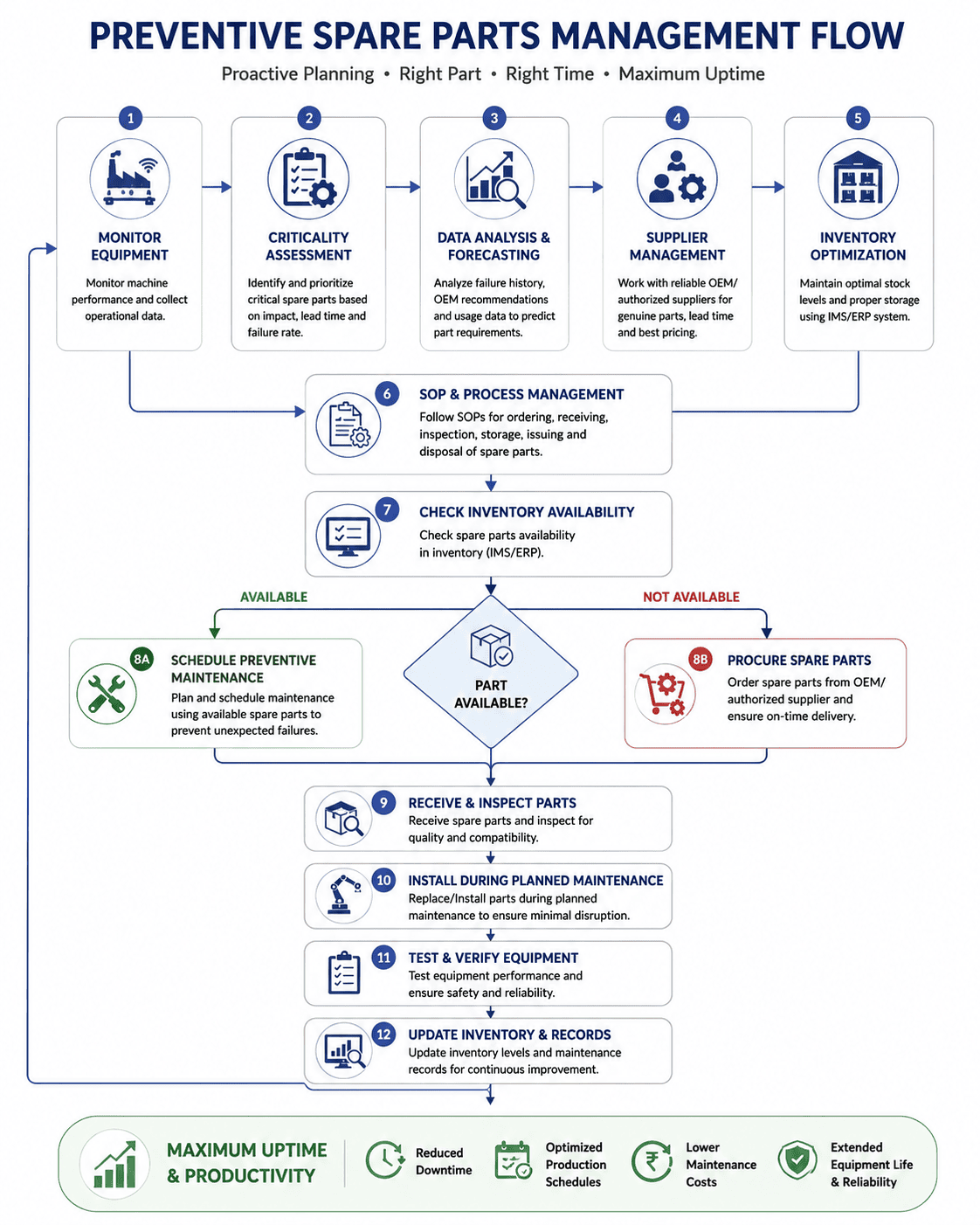
In the high-speed world of modern manufacturing and industrial automation, unforeseen equipment breakdowns are productivity killers. Implementing a robust preventive spare parts management strategy is no longer optional but a critical operational imperative, safeguarding continuous production cycles and optimizing overall factory efficiency across SMT lines, robotics cells, CNC machinery, and semiconductor fabrication.
Overview
Preventive spare parts management is a proactive strategy focused on identifying, procuring, and stocking critical components before they fail, ensuring their immediate availability for scheduled maintenance or unexpected repairs. This systematic approach leverages historical data, OEM recommendations, and predictive analytics to forecast component lifespan and ensure that the right part is available at the right time. By having essential spares on hand, manufacturing facilities can drastically cut down Mean Time To Repair (MTTR) and minimize costly downtime, maintaining seamless operation of complex equipment like SMT pick-and-place machines, industrial robots, precision CNC lathes, and semiconductor wafer processing tools. It is crucial for any industry reliant on complex, interconnected machinery where even a minor component failure can halt an entire production line.
Key Factors to Consider
1. Criticality Assessment and Prioritization
Identifying which spare parts are most vital to production continuity is paramount. A criticality assessment categorizes parts based on their impact on operations, lead time, and failure rate, allowing for a focused inventory strategy on components that, if failed, would cause significant downtime or safety risks.
2. Data-Driven Forecasting and Analytics
Leveraging historical maintenance records, equipment performance data, and predictive analytics tools helps forecast part demand accurately. This data-driven approach minimizes overstocking or understocking, ensuring optimal inventory levels for efficient factory automation and electronics manufacturing.
3. Supplier Relationship Management
Establishing strong relationships with reliable OEM and authorized third-party suppliers is essential. This ensures access to genuine parts, favorable lead times, and competitive pricing, particularly crucial for specialized components in semiconductor equipment or robotics.
4. Inventory Optimization and Storage
Implementing advanced inventory management systems (IMS) allows for real-time tracking of spare parts. Proper storage conditions, including climate control for sensitive electronics or semiconductor components, prevent degradation and ensure parts are ready for deployment.
5. Standard Operating Procedures (SOPs) for Management
Developing clear SOPs for ordering, receiving, inspecting, storing, issuing, and disposing of spare parts creates consistency and efficiency. This includes defining roles and responsibilities, which is vital for smooth operations in a complex PCB assembly or CNC machining environment.
Benefits
1. Reduced Unplanned Downtime
By having critical spare parts readily available, factories can quickly address equipment failures or perform scheduled replacements, significantly reducing the duration and frequency of unexpected production halts across all industrial automation segments.
2. Optimized Production Schedules
Predictable maintenance and minimized downtime enable manufacturers to adhere to strict production schedules, enhancing throughput and meeting delivery deadlines, which is crucial for high-volume electronics manufacturing and semiconductor production.
3. Lower Overall Maintenance Costs
Preventive spare parts management avoids costly expedited shipping fees for emergency parts, reduces overtime pay for urgent repairs, and minimizes production losses, leading to substantial long-term savings compared to reactive maintenance.
4. Extended Equipment Lifespan and Reliability
Timely replacement of worn components prevents cascading failures that can damage other parts of the machine. This proactive approach extends the operational life of valuable assets such as SMT machines, industrial robots, and CNC equipment, improving their overall reliability.
Industrial Applications
Electronics Manufacturing (SMT, PCB Assembly)
Semiconductor Fabrication
Automotive Manufacturing (Robotics, CNC Machining)
Aerospace and Defense Production
General Industrial Automation and Packaging
Buying Guide
When evaluating industrial machinery or automation solutions, buyers must critically assess not only the machine's condition, specifications, and performance metrics but also the supplier's commitment to after-sales support. Key considerations include the availability of a comprehensive warranty, the supplier's reputation for reliability, the ready supply and lead times for genuine spare parts, and ensuring seamless compatibility with existing factory infrastructure and production lines to prevent future operational bottlenecks.
Maintenance Tips
Effective maintenance of industrial equipment hinges on a proactive approach. Implement a rigorous preventive maintenance schedule that includes regular cleaning to remove debris, precise lubrication of moving parts, routine inspection for wear and tear, and periodic calibration of sensors and precision components. Comprehensive operator training on daily checks and minor adjustments further empowers teams to identify potential issues early, contributing to sustained machine health and minimizing unexpected failures.
Industry Trends
The landscape of industrial maintenance is rapidly evolving, driven by Industry 4.0 paradigms. The integration of AI and IoT enables smart manufacturing environments where predictive maintenance, powered by real-time data from connected equipment, anticipates part failures before they occur. Digital Twins offer virtual replicas for simulating spare parts inventory needs, while advanced automation streamlines procurement and inventory management. This shift not only enhances efficiency but also supports sustainability goals by optimizing resource use and extending equipment lifecycles.
Frequently Asked Questions
What is the main difference between preventive and reactive spare parts management?
Preventive spare parts management is a proactive strategy where parts are identified, stocked, and replaced based on scheduled maintenance or predictive analytics, aiming to prevent failures before they occur. In contrast, reactive management only addresses spare part needs after an equipment breakdown has already happened, leading to unplanned downtime and often higher costs.
How does predictive maintenance integrate with spare parts management?
Predictive maintenance uses real-time data, sensors, and AI algorithms to monitor equipment condition and forecast potential failures. This intelligence directly informs spare parts management by accurately predicting when a specific component will likely need replacement, allowing procurement and stocking to be precisely timed, minimizing inventory costs while ensuring availability.
What challenges are associated with implementing a preventive spare parts strategy?
Key challenges include accurately forecasting demand, managing optimal inventory levels to avoid excessive carrying costs or stockouts, establishing reliable supplier relationships, and integrating data from various systems. Furthermore, initial investment in inventory and the need for skilled personnel to manage the system effectively can also pose hurdles for organizations.
Conclusion