
Buying one used robot is a transaction. Buying an entire secondhand production line is a relationship — and it starts long before the trucks show up.
Every year, factories across India and abroad relocate, restructure, or shut down entire production lines — and with them go complete, functioning cells: robots, conveyors, fixtures, PLCs, safety fencing, and sometimes even the overhead cranes. Buying this as a unit can be dramatically cheaper than building from scratch. It can also go wrong in ways that buying a single machine never does.
Here is what actually matters when you are evaluating a whole line, not just one asset.
Overview
A production line sale is really the sale of a system, not a collection of parts. The value is not just in each robot or conveyor — it is in whether the system as a whole can be relocated, re-commissioned, and made to run at your facility, on your power supply, for your product.
What Changes When You Buy a Whole Line
System Documentation
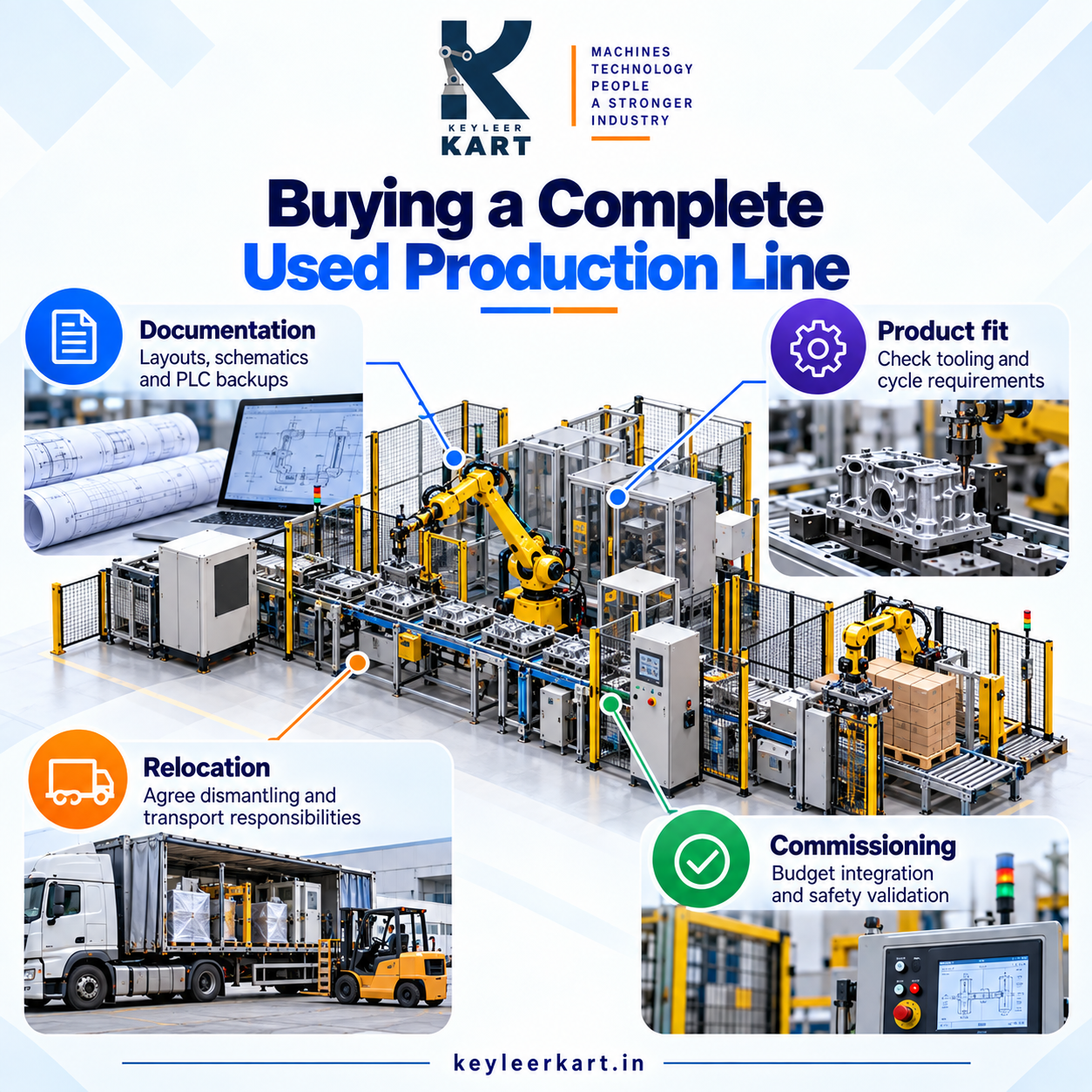
A single robot needs a manual. A line needs the layout drawing, the cycle-time sheet, the PLC program backup, the electrical schematic, and ideally the original commissioning report. Without these, re-integrating the line at your site becomes reverse-engineering, not installation.
De-installation and Rigging Responsibility
Who disconnects, tags, and crates each component matters enormously. A line de-installed by people who understand the system (ideally the original integrator or the seller's own maintenance team) arrives in far better shape than one broken down by a generic rigging crew working from a parts list alone.
Compatibility With Your Facility
Many lines built for export or for a different plant run on 400V three-phase European power, different conveyor widths, or floor-mounting patterns that don't match your building. Get the electrical and mechanical specifications before you commit, not after the trucks arrive.
Product Fit
A line built for one part geometry, cycle time, or material may need significant re-tooling for your product. Ask what the line was actually producing and compare it honestly against your own part.
Benefits
Speed to Production
A proven, previously running system can be re-commissioned faster than designing and integrating a new one from individual components.
Capital Efficiency
Buying a complete line secondhand is typically a fraction of new-build cost, freeing capital for tooling, training, or working capital instead.
Reduced Integration Risk
A line that has already run in production has already had its early-life bugs worked out — assuming it is re-commissioned correctly.
Industrial Applications
Automotive component manufacturers scaling up a body-in-white or sub-assembly line.
MSMEs entering welding, palletizing, or material handling automation without a from-scratch integration budget.
Contract manufacturers taking on a new customer program that matches an available secondhand line's capability.
Buying Guide
Request the full documentation package (schematics, PLC backups, cycle sheets) before committing — treat its absence as a serious red flag, not a minor inconvenience.
Insist on seeing the line run, if at all possible, before de-installation begins.
Get an independent assessment of rigging and transport cost for the full line — this is frequently underestimated and can change the economics significantly.
Budget for a commissioning engineer's time at your facility, even for a line that ran perfectly at the seller's site — recalibration after a move is normal, not exceptional.
Confirm which safety systems (fencing, light curtains, interlocks) are included and whether they meet current standards at your location.
Maintenance Tips
Re-master every robot axis after relocation rather than assuming pre-move calibration data still holds.
Test every safety interlock and emergency stop independently after re-installation, not just the automation logic.
Keep the line's documentation package as a living document, updated as you make changes at your facility.
Industry Trends
With ongoing restructuring in several export-oriented manufacturing hubs, complete used lines are becoming more available to Indian buyers, often at a fraction of new-build cost — but the winners are buyers who budget properly for de-installation, transport, and re-commissioning rather than just the line's sale price.
Frequently Asked Questions
Q: Is buying a whole line riskier than buying individual machines? A: It carries different risks — mainly around documentation, rigging, and re-commissioning — but when handled properly it is often lower risk than assembling a line from unrelated individual purchases, because the components have already proven they work together.
Q: How much should I budget beyond the line's sale price? A: Plan for rigging and transport, site preparation, re-commissioning labour, and a contingency for parts that don't survive the move — treat the sale price as roughly half of your total project budget until you have firm quotes.
Q: Can KeyLeer Kart help source and evaluate whole lines, not just single robots? A: Yes — line and cell sourcing is part of what we help MSME and mid-size manufacturers evaluate, including documentation review and rigging coordination.
Conclusion
A secondhand production line can be one of the smartest capital decisions a growing manufacturer makes — or one of the most expensive mistakes, depending entirely on documentation, rigging discipline, and honest facility-fit assessment before the deal closes.
Talk to KeyLeer Kart before you commit to a line purchase — a short conversation before the contract is far cheaper than a surprise after the trucks leave.
#1 red flag



