
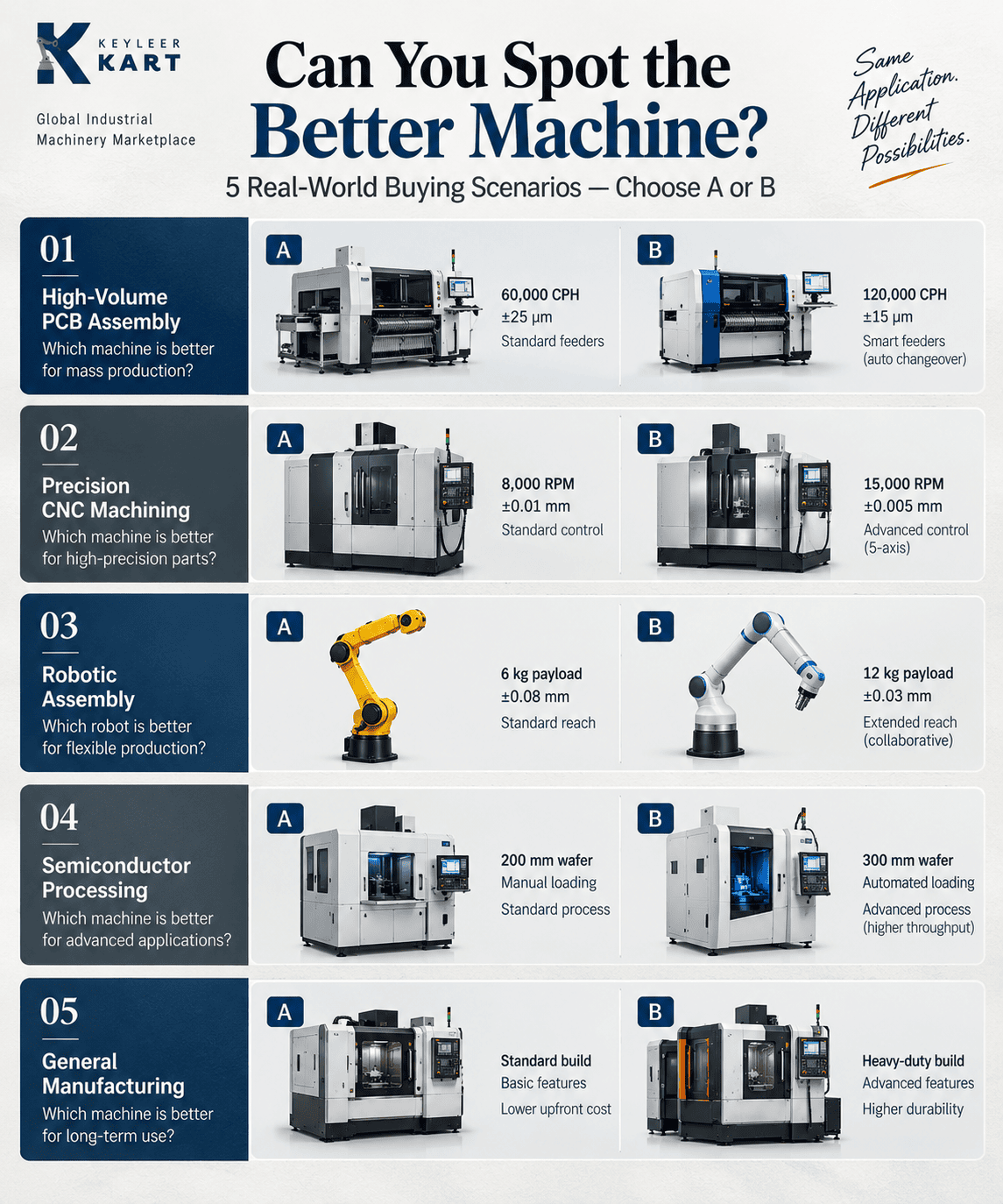
In the rapidly evolving landscape of modern manufacturing and industrial automation, selecting the right machinery is not merely a purchase; it's a strategic investment that dictates productivity, quality, and ultimately, a company’s competitive edge. With countless options available, the ability to discern the optimal equipment for specific operational needs is paramount for ensuring efficiency and driving innovation.
Overview
Industrial machinery encompasses a broad spectrum of equipment, from sophisticated CNC machines and advanced SMT lines to collaborative robots and specialized semiconductor fabrication tools. These machines are the backbone of contemporary manufacturing, designed to automate and streamline complex processes. They operate by executing predefined sequences, utilizing various technologies like precision mechanics, advanced sensors, control systems, and often artificial intelligence to perform tasks with high accuracy and repeatability. The importance of these machines cannot be overstated; they enable mass production, enhance product quality, reduce human error, and accelerate time-to-market. Industrial machinery is commonly used across diverse sectors including automotive, electronics manufacturing, aerospace, medical device production, consumer goods, and general fabrication, forming the core of any high-volume or precision-intensive production environment.
Key Factors to Consider / Key Features
1. Performance Metrics & Throughput
Evaluate the machine's stated performance against your production targets. This includes speed, accuracy, repeatability, and overall throughput. A machine might promise high speed, but if its precision is lacking for your specific application, it could lead to increased scrap rates and rework, diminishing overall efficiency.
2. Integration Capabilities & Connectivity
Consider how seamlessly the new machine integrates with your existing factory automation systems, MES (Manufacturing Execution Systems), and ERP (Enterprise Resource Planning) platforms. Modern equipment should support Industry 4.0 protocols, offering robust data exchange capabilities for real-time monitoring and control.
3. Total Cost of Ownership (TCO)
Beyond the initial purchase price, assess the long-term costs associated with the machine. This includes energy consumption, required consumables, maintenance parts, labor costs for operation and maintenance, software licenses, and potential upgrade pathways over its lifespan. A cheaper initial investment can often translate to higher operational expenses.
4. Serviceability & Support
Understand the manufacturer's or supplier's commitment to after-sales support, including warranty terms, availability of spare parts, technical assistance, and training programs. Reliable support ensures minimal downtime and a faster resolution of any operational issues, which is critical in time-sensitive production environments.
5. Scalability & Future-Proofing
Evaluate the machine’s capacity to adapt to future production demands or technological advancements. Can it be easily upgraded, reconfigured, or integrated into larger production lines as your business grows or product specifications change? Investing in a scalable solution mitigates the risk of obsolescence.
Benefits
Enhanced Productivity
The right industrial machine significantly increases production output, automating tasks that would otherwise be slow or labor-intensive, thereby optimizing cycle times and maximizing operational throughput.
Improved Product Quality
Precision-engineered machinery ensures consistent quality, reducing defects and variances in the final product. This leads to higher customer satisfaction and fewer costly reworks or returns.
Optimized Resource Utilization
Efficient machines often require less energy, raw material, and manual intervention, leading to substantial cost savings and a more sustainable manufacturing footprint.
Increased Operational Flexibility
Advanced equipment, particularly those with quick changeover capabilities, allows manufacturers to adapt rapidly to changing product demands, small batch production, and custom orders, enhancing market responsiveness.
Industrial Applications
Electronics Manufacturing & PCB Assembly
Semiconductor Equipment Fabrication
Automotive Production & Component Machining
Medical Device Manufacturing
Aerospace & Defense Precision Engineering
Buying Guide
Before committing to an industrial machine, thoroughly evaluate its condition, ensuring it meets all specified operational requirements. Scrutinize technical specifications, understand the warranty coverage, and research the supplier's reputation for reliability and support. Confirm the availability of spare parts and assess the machine's compatibility with your existing infrastructure and future expansion plans to avoid costly integration challenges.
Maintenance Tips
Proactive maintenance is vital for maximizing machine lifespan and performance. Implement a rigorous preventive maintenance schedule, including regular cleaning, precise lubrication of moving parts, routine inspections for wear and tear, and periodic calibration of sensors and actuators. Investing in comprehensive operator training also ensures correct usage and early detection of potential issues.
Industry Trends
The manufacturing sector is profoundly influenced by Industry 4.0, which integrates physical and digital technologies. This includes AI-driven analytics for process optimization, IoT sensors for real-time monitoring, and smart manufacturing platforms for seamless data flow. Predictive maintenance, enabled by machine learning, is minimizing downtime, while automation and robotics enhance production flexibility. Digital twins are revolutionizing simulation and process optimization, all contributing to more sustainable and efficient global supply chains.
Frequently Asked Questions
What is the most critical factor when choosing between two seemingly similar industrial machines?
While specifications are crucial, the most critical factor is often the total cost of ownership (TCO). This encompasses not just the purchase price but also energy consumption, maintenance, spare parts availability, required consumables, and potential downtime costs over the machine's entire lifecycle. A lower initial price can often be misleading if the operational costs are significantly higher.
How does a machine's connectivity impact its value in a modern factory setting?
A machine's connectivity is fundamental in an Industry 4.0 environment. Robust connectivity allows for seamless data exchange with other equipment, MES, and ERP systems, enabling real-time monitoring, remote diagnostics, predictive maintenance, and overall process optimization. Machines lacking advanced connectivity can create data silos, hindering efficiency and informed decision-making across the production floor.
Is it always better to choose the machine with the highest throughput?
Not necessarily. While high throughput is often desirable, it must be balanced with factors such as precision, quality requirements, and the capacity of upstream and downstream processes. An ultra-fast machine might overwhelm subsequent stages or produce defects if not properly synchronized, leading to bottlenecks or quality issues rather than improved overall efficiency. The ideal choice is often a machine that optimally balances speed, accuracy, and integration within your specific production ecosystem.



