In the high-stakes world of modern manufacturing and industrial automation, the reliability and performance of every component are paramount. The integrity of your Programmable Logic Controllers (PLCs) and Human-Machine Interfaces (HMIs) directly impacts operational efficiency, safety, and ultimately, your bottom line. Understanding how to identify genuine PLC and HMI parts is not just a best practice; it's a critical strategy for mitigating risks, preventing costly downtime, and safeguarding the future of your automated systems.
Overview
Programmable Logic Controllers (PLCs) and Human-Machine Interfaces (HMIs) are the foundational pillars of industrial automation. A PLC acts as the "brain" of an automated system, executing pre-programmed logical instructions to control machinery and processes based on inputs from sensors and other devices. It continuously monitors inputs, processes logic, and updates outputs, ensuring precise and repeatable operations across a factory floor. The HMI, on the other hand, serves as the "face" – a crucial interface that allows operators to monitor, control, and interact with the complex machinery and processes managed by the PLC. It displays real-time data, alarms, and controls, providing an intuitive visual representation of the industrial process.
Together, PLCs and HMIs enable intelligent control, data visualization, and operational flexibility within automated environments. They are vital for maintaining product quality, enhancing production efficiency, improving worker safety by automating hazardous tasks, and facilitating rapid adjustments to production parameters. These critical components are ubiquitous across a vast spectrum of industries, from discrete manufacturing and process control to robotics and factory automation, forming the backbone of smart manufacturing facilities worldwide.
Key Factors to Consider
1. Packaging and Labeling Authenticity
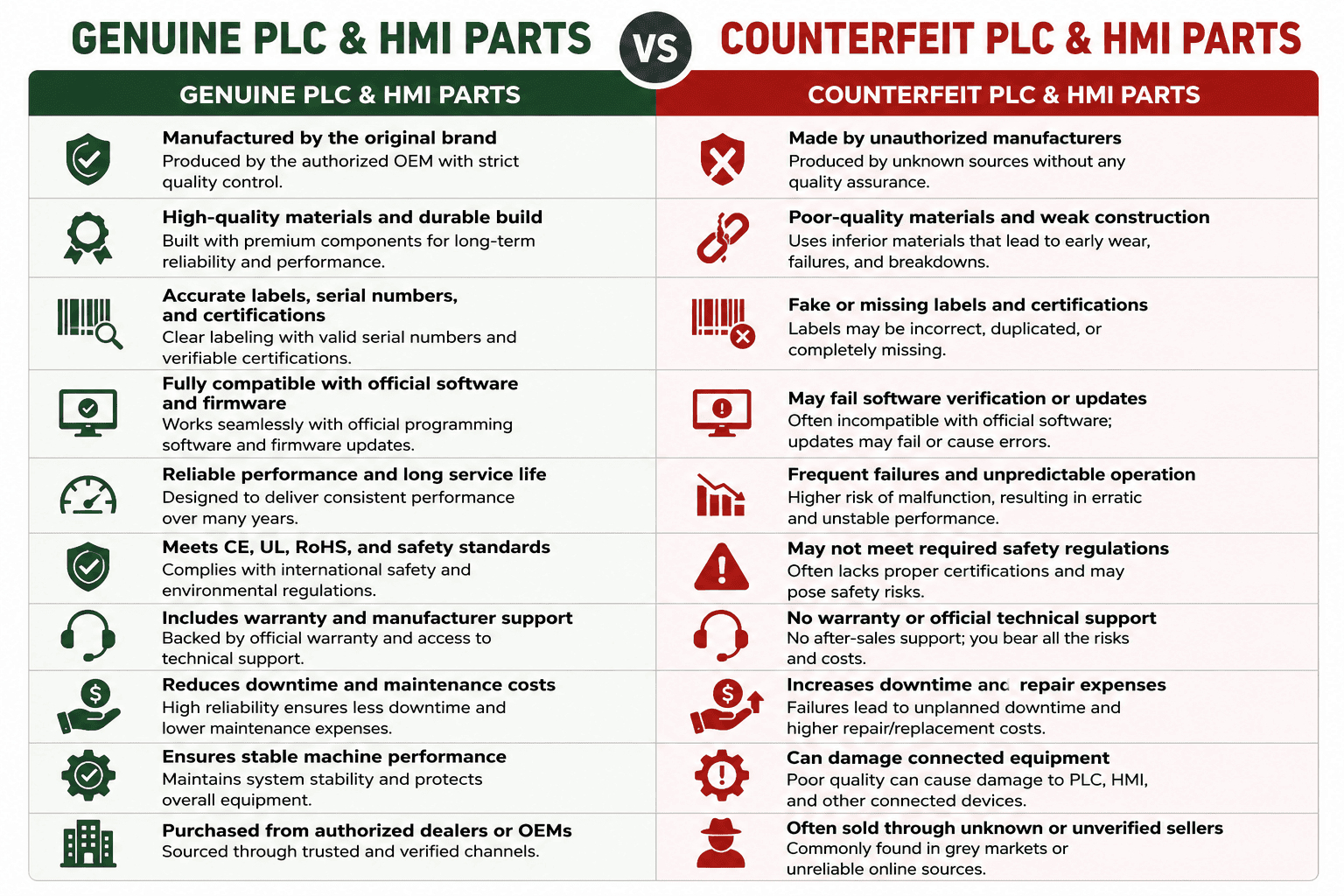
Genuine PLC and HMI parts always come in official, high-quality packaging with clear branding, manufacturer logos, and accurate product information. Look for holograms, tamper-evident seals, and specific serial numbers or batch codes that can be cross-referenced with the manufacturer's database. Counterfeit packaging often exhibits poor print quality, misspellings, or inconsistent branding.
2. Build Quality and Material Integrity
Examine the physical construction of the component. Authentic parts are manufactured with high-grade materials, exhibiting precise molding, robust connectors, and a solid feel. Counterfeit items frequently show inferior plastics, loose connections, uneven finishes, or signs of cheap components, which can compromise durability and electrical performance.
3. Documentation and Certification Verification
Legitimate PLC and HMI parts are accompanied by comprehensive user manuals, data sheets, and compliance certificates (e.g., CE, UL, RoHS). These documents should be professionally printed, accurate, and readily available on the manufacturer's official website. Absence of proper documentation or the presence of generic, poorly translated, or incorrect information is a significant red flag.
4. Firmware and Software Authentication
Genuine PLC and HMI units typically require proprietary software and firmware for configuration and operation. Manufacturers often embed digital signatures or unique identifiers that can be verified through their official programming software. Attempts to load official firmware onto a non-genuine part often fail, or the device may exhibit unstable behavior or compatibility issues.
5. Authorized Supplier Sourcing
The most reliable method to ensure authenticity is to purchase directly from the original equipment manufacturer (OEM) or their network of authorized distributors. These suppliers guarantee the genuineness of their products, offering warranties, technical support, and access to the latest product revisions. Avoiding grey market channels or unverified online sellers significantly reduces the risk of acquiring counterfeit parts.
Benefits
Enhanced Reliability and Uptime
Utilizing genuine PLC and HMI parts ensures consistent performance, adherence to design specifications, and a significantly lower risk of premature failure. This translates directly into higher operational reliability, reduced unplanned downtime, and sustained production efficiency in critical manufacturing environments.
Optimal Performance and Accuracy
Authentic components are engineered to precise specifications, guaranteeing accurate data processing, responsive control, and seamless integration within existing automation architectures. This precision is vital for maintaining product quality, optimizing process parameters, and achieving the intended performance benchmarks for industrial machinery and robotic systems.
Improved Safety and Compliance
Genuine parts meet stringent industry safety standards and regulatory compliance (e.g., CE, UL), ensuring that your industrial automation systems operate safely for personnel and equipment. Counterfeit parts often lack these certifications, posing significant electrical, functional, and operational risks that can lead to accidents or non-compliance penalties.
Long-Term Cost Savings and Support
While genuine parts might have a higher initial cost, they offer long-term savings by reducing maintenance frequency, preventing catastrophic system failures, and eliminating the need for frequent replacements. Furthermore, purchasing genuine components provides access to manufacturer warranties, technical support, and crucial software updates, protecting your investment and ensuring operational longevity.
Industrial Applications
Automotive Manufacturing and Assembly
Electronics and Semiconductor Production Facilities
Food and Beverage Processing and Packaging
Pharmaceutical and Medical Device Manufacturing
CNC Machining and Robotics Integration
Buying Guide
When procuring PLC and HMI components, buyers should meticulously evaluate several key aspects to ensure a sound investment. Beyond assessing the machine condition and ensuring specifications align perfectly with operational requirements, prioritize products backed by robust warranties. Thoroughly research the supplier's reputation, opting for authorized distributors to guarantee authenticity and reliable after-sales support. Confirm the availability of genuine spare parts and accessories, and critically, verify compatibility with your existing automation architecture to avoid costly integration challenges.
Maintenance Tips
Proactive maintenance is crucial for the longevity and reliability of PLC and HMI systems. Implement a strict preventive maintenance schedule that includes regular environmental cleaning to prevent dust and debris accumulation, especially around cooling vents. Periodically inspect all wiring and connections for signs of wear, corrosion, or looseness. For mechanical components, ensure proper lubrication where applicable. Conduct routine calibration checks for integrated sensors and input modules, and keep firmware and software updated to the latest stable versions. Comprehensive operator training on proper usage and basic troubleshooting can also significantly extend system lifespan and prevent errors.
Industry Trends
The landscape of industrial automation is rapidly evolving, driven by Industry 4.0 paradigms where PLCs and HMIs are central to smart manufacturing ecosystems. The integration of Artificial Intelligence (AI) and the Internet of Things (IoT) is transforming these devices into intelligent data hubs, enabling advanced analytics, real-time decision-making, and predictive maintenance capabilities. Digital Twins are increasingly replicating physical PLC/HMI setups virtually for simulation and optimization. Furthermore, a growing emphasis on sustainability is prompting manufacturers to develop more energy-efficient and modular PLC/HMI solutions, fostering greater automation flexibility and resource optimization across the factory floor.