
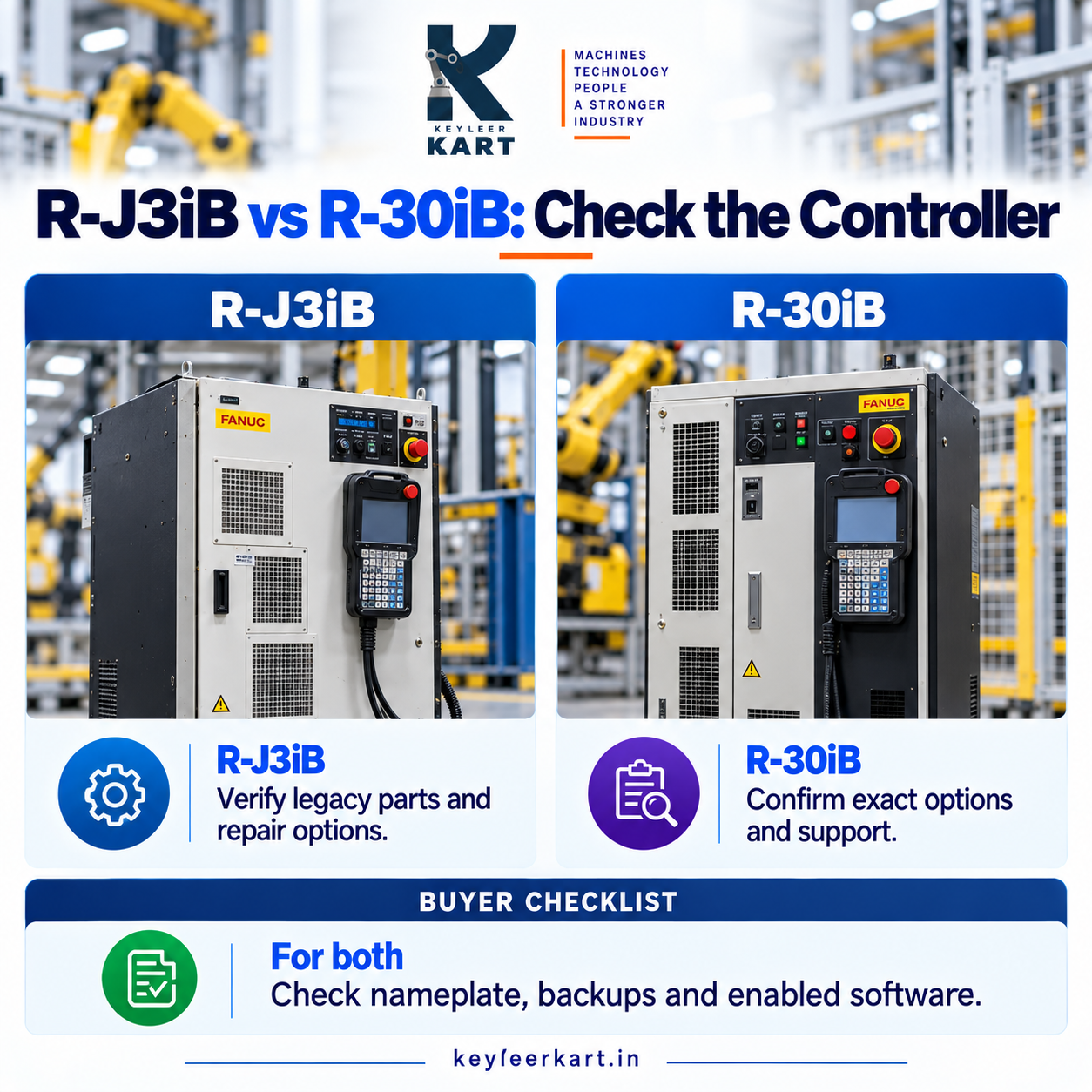
Two FANUC robots can look identical on the outside. The box bolted to the wall next to them decides whether you're buying a bargain or a ticking time bomb.
Ask an experienced used-robot buyer what they check first, and the answer is rarely the arm — it's the controller. FANUC's controller lineage runs RJ-2, RJ-3, R-J3iB, R-30iA, R-30iB, R-30iB Plus, and now R-50iA, and where a specific used robot falls on that list matters more to its real remaining value than the arm's age or cosmetic condition ever will.
This post breaks down exactly what separates an R-J3iB from an R-30iB, why that difference decides whether a robot is a smart used purchase or a parts-availability gamble, and what to check before you commit.
Overview
The controller, not the mechanical arm, is where a robot's electronics live — and electronics reach end-of-service life far sooner than well-maintained castings, gearboxes, and motors do. An R-J3iB-controlled robot, even paired with a perfectly healthy arm, is generally considered a parts-risk purchase today, since that controller generation predates FANUC's current supported lineup. An R-30iB (or the newer R-30iB Plus), by contrast, remains within FANUC's actively supported range, with better spares availability, stronger software options, and a longer expected remaining service life.
Key Factors to Consider
Generation Age and Support Status
R-J3iB predates R-30iA and R-30iB in FANUC's controller lineage; anything at R-J3iB or older should be treated as a parts-risk purchase requiring extra due diligence.
Spare Parts and Repair Availability
Newer R-30iB controllers have far stronger new and OEM-supported spares availability than R-J3iB units, which increasingly rely on refurbished or grey-market components.
Software Options and Licensing
Features like iRVision, conveyor tracking, and DCS safety are licence-keyed to the specific controller — always verify what's actually enabled on-screen rather than assuming based on the robot model.
Connectivity and Fieldbus Support
Older R-J3iB controllers often only support legacy fieldbus or discrete I/O, meaning integration with a modern PLC may require additional retrofit cost that should be priced into your total purchase decision.
Benefits
R-30iB: Longer Remaining Service Life
Buying into a currently supported controller generation gives you meaningfully more years of reliable operation before facing the parts-obsolescence problem entirely.
R-30iB: Stronger Software and Safety Feature Access
Modern safety functions like FANUC DCS and advanced vision integration are far more readily available and supported on R-30iB-generation controllers.
R-J3iB: Can Still Offer Value for the Right Buyer
For non-critical, low-cycle applications with a tight budget, a well-documented R-J3iB unit can still be a reasonable choice, provided the buyer understands and accepts the parts-risk trade-off.
Informed Buyers Avoid Costly Surprises
Understanding this distinction before purchase prevents the common and expensive mistake of buying a 'good deal' robot that becomes unrepairable within a year or two.
Industrial Applications
- Automotive welding and assembly (favouring R-30iB generation for longevity)
- General material handling across both generations, budget-dependent
- Non-critical or backup robot applications (R-J3iB acceptable with caveats)
- Vision-guided or safety-critical applications (R-30iB strongly preferred)
- Machine tending and packaging
- Applications requiring modern PLC/fieldbus integration (R-30iB preferred)
Buying Guide
Always ask for and photograph the controller's nameplate and option-list screen before finalising any used FANUC purchase — never rely on a seller's verbal description of the controller generation. If you're offered an R-J3iB unit at an attractive price, factor in the realistic cost and timeline of a future controller retrofit to R-30iB if you plan to keep the robot long-term, since this can meaningfully change the total cost comparison against simply buying an R-30iB unit from the start.
Maintenance Tips
Whichever generation you buy, check battery-backup health for mastering and program data immediately upon receipt, since a dead backup battery on an older controller can mean lost mastering data with no easy recovery path. Keep a documented option-list screenshot and full backup as part of your own maintenance records from day one of ownership.
Industry Trends
As FANUC's controller lineage continues advancing with the R-50iA, the practical used-market split between 'parts-risk' and 'currently supported' generations will keep shifting forward — R-30iA units, comfortably supported today, will eventually face the same obsolescence questions R-J3iB units face now, making this a permanently relevant check for any used robot purchase, not a one-time lesson.
Frequently Asked Questions
Q: Is an R-J3iB controller always a bad purchase?
A: Not always — for low-criticality, low-cycle applications with a tight budget and full awareness of the parts-risk trade-off, a well-documented R-J3iB unit can still offer reasonable value.
Q: Can I upgrade an R-J3iB controller to R-30iB later?
A: Yes, controller retrofits are available for some model combinations, but they carry meaningful cost — always price this in before assuming it's a simple future upgrade.
Q: How do I check which controller generation a used robot actually has?
A: Ask the seller to power up the unit and photograph the controller nameplate and the software option-list screen — this is the only reliable way to confirm generation and enabled features.
Conclusion
The arm gets the attention in most used-robot conversations, but the controller is what actually decides whether your purchase is a smart long-term investment or a short-lived bargain. Always confirm the exact generation before you buy, understand what it means for spares, software, and remaining service life, and factor that directly into your price negotiation. KeyLeer Kart verifies and discloses controller generation on every unit we list — contact us for guidance on the right generation for your application.
#FANUC #UsedRobots #IndustrialAutomation #KeyLeerKart #ManufacturingIndia #RobotBuyingGuide



