
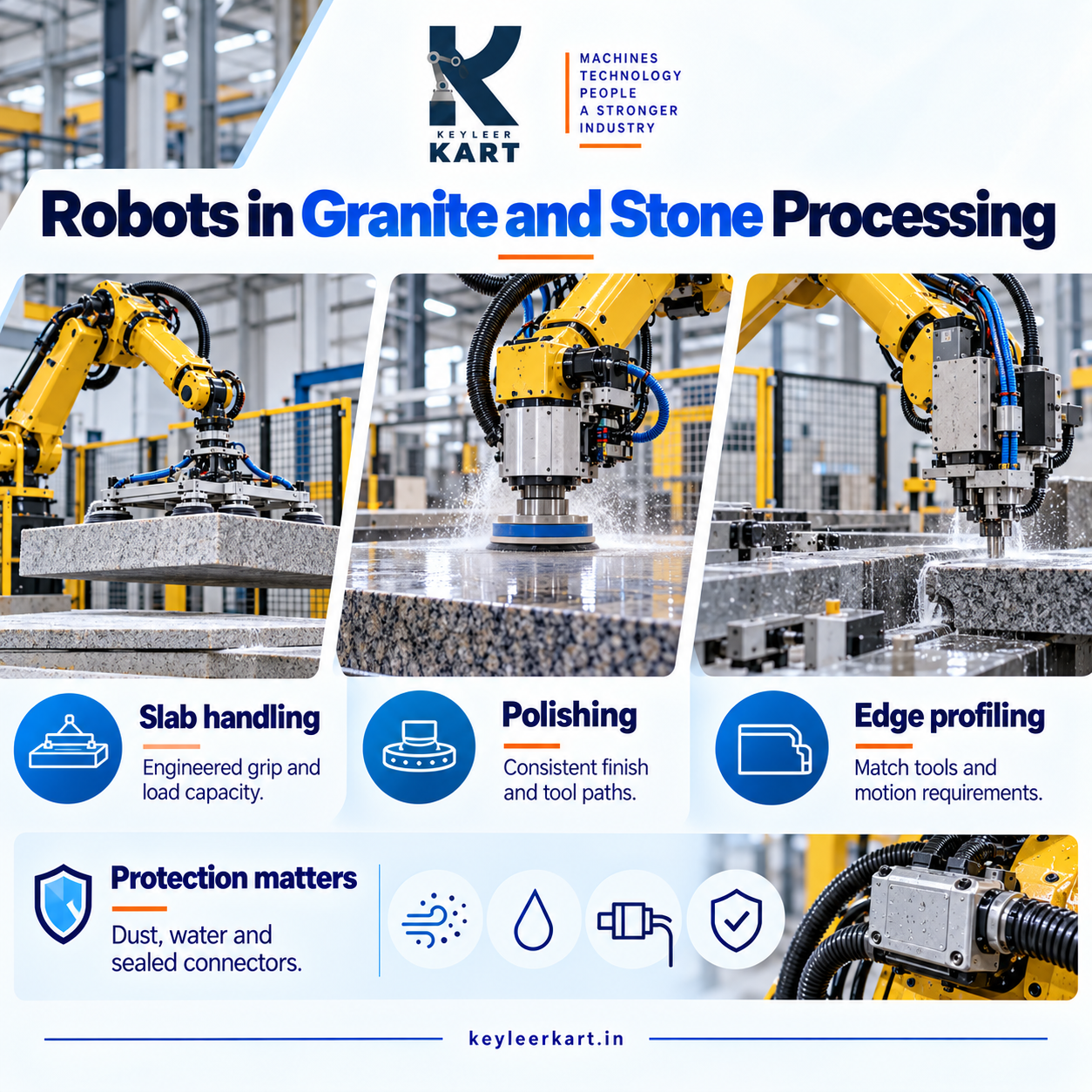
Granite dust kills machines slowly and workers' lungs faster. A used robot with the right protection can fix both problems at once.
India's granite and natural stone processing hubs — from Rajasthan to Andhra Pradesh and Tamil Nadu — run some of the dustiest, most physically demanding production floors in Indian manufacturing. Polishing, edge-profiling, and heavy slab handling are exactly the kind of repetitive, hazardous work robotic automation was built to take over, and used robots are opening this up to smaller processors who could never justify new equipment.
Overview
Stone processing automation typically covers slab and block handling (moving multi-hundred-kilogram pieces safely), polishing and edge-profiling (consistent finish quality), and cutting-line material handling. Each of these has a different robot profile, and getting the match right matters more than in cleaner industries because the dust and weight involved punish the wrong choice quickly.
What Stone Processing Demands From a Robot
Payload for Slab and Block Handling
Granite slabs and blocks are heavy and awkwardly shaped. Handling applications need high payload capacity, often with vacuum or mechanical gripper end-effectors engineered specifically for stone, and a robust base-axis reducer since block handling stresses the largest joints hardest.
Dust and Particulate Protection
Fine stone dust is highly abrasive and pervasive in a way that rivals foundry sand. Joint sealing and IP rating matter enormously here — an unprotected robot pulled from a clean industry and dropped into a stone yard will see its reducers and encoders fail far faster than the OEM's rated service life would suggest.
Wash-Down and Wet Processing Compatibility
Many polishing and cutting processes use water for cooling and dust suppression. A robot deployed in these areas needs a wash-down-rated enclosure and properly sealed connectors, not a standard dry-factory-floor specification.
Consistent Path Accuracy for Profiling
Edge-profiling and polishing quality depends on consistent tool-path accuracy over long duty cycles — this is where a well-maintained used robot with intact mastering data genuinely earns its price over a poorly documented one.
Benefits
Worker Safety
Automating heavy slab handling removes workers from the highest-injury-risk task in stone processing — manual handling of multi-hundred-kilogram pieces.
Consistent Finish Quality
Robotic polishing and profiling delivers uniform results regardless of operator fatigue, directly affecting the export-grade finish quality that commands premium pricing.
Access to Automation at MSME Scale
Used robots bring this capability within reach of small and mid-size stone processors who could never justify a new robot's cost against their margins.
Industrial Applications
Slab and block transfer between cutting, polishing, and finishing stations.
Automated edge-profiling and chamfering of processed slabs.
Robotic polishing head manipulation for consistent surface finish.
Palletizing and crating of finished stone pieces for export.
Buying Guide
Prioritize robots with documented history in dusty or abrasive environments (foundry, ceramics, or stone) over ones with purely clean-room histories, since the former have already proven their sealing holds up.
Inspect joint seals and cable protection closely, and budget for upgraded protective boots if the robot's prior application was cleaner than stone processing.
Confirm payload rating against your actual heaviest slab or block weight plus gripper weight, not a generic industrial rating.
Ask whether wash-down protection is present if the robot will work near wet cutting or polishing stations.
Maintenance Tips
Increase the frequency of joint seal and reducer grease inspection well beyond standard intervals given the abrasive dust exposure.
Clean dust buildup from cable runs and connectors on a fixed schedule rather than waiting for a visible fault.
Monitor for water ingress at connectors in wash-down areas, since corrosion here can cause intermittent faults that are hard to diagnose later.
Industry Trends
As Indian granite and stone exporters face rising quality expectations from international buyers, automation of polishing and profiling is increasingly seen as a competitiveness requirement rather than a luxury — and the used robot market is the practical route for processors below the largest scale to get there.
Frequently Asked Questions
Q: Can a standard industrial robot handle granite dust without modification? A: Not reliably long-term — expect accelerated wear on joint seals, reducers, and encoders unless the robot has adequate ingress protection or is retrofitted with additional sealing and protective boots.
Q: What payload range is typical for slab-handling robots? A: It depends heavily on your slab and gripper size — always size to your heaviest actual piece plus end-effector weight, with margin, rather than a generic industry figure.
Q: Does KeyLeer Kart source robots specifically suited to stone and granite processing? A: Yes — we help stone processors evaluate payload, dust protection, and prior application history to find a used robot genuinely fit for this environment.
Conclusion
Stone processing punishes the wrong robot fast, but rewards the right one with better worker safety, consistent finish quality, and real competitiveness for export-grade production. Payload sizing and dust protection are the two decisions that matter most.
KeyLeer Kart helps granite and stone processors find used robots genuinely suited to this environment — reach out before you commit to a purchase.
#GraniteIndustry #StoneProcessing #IndustrialRobots #UsedRobots #KeyLeerKart #MakeInIndia #ExportQuality



