
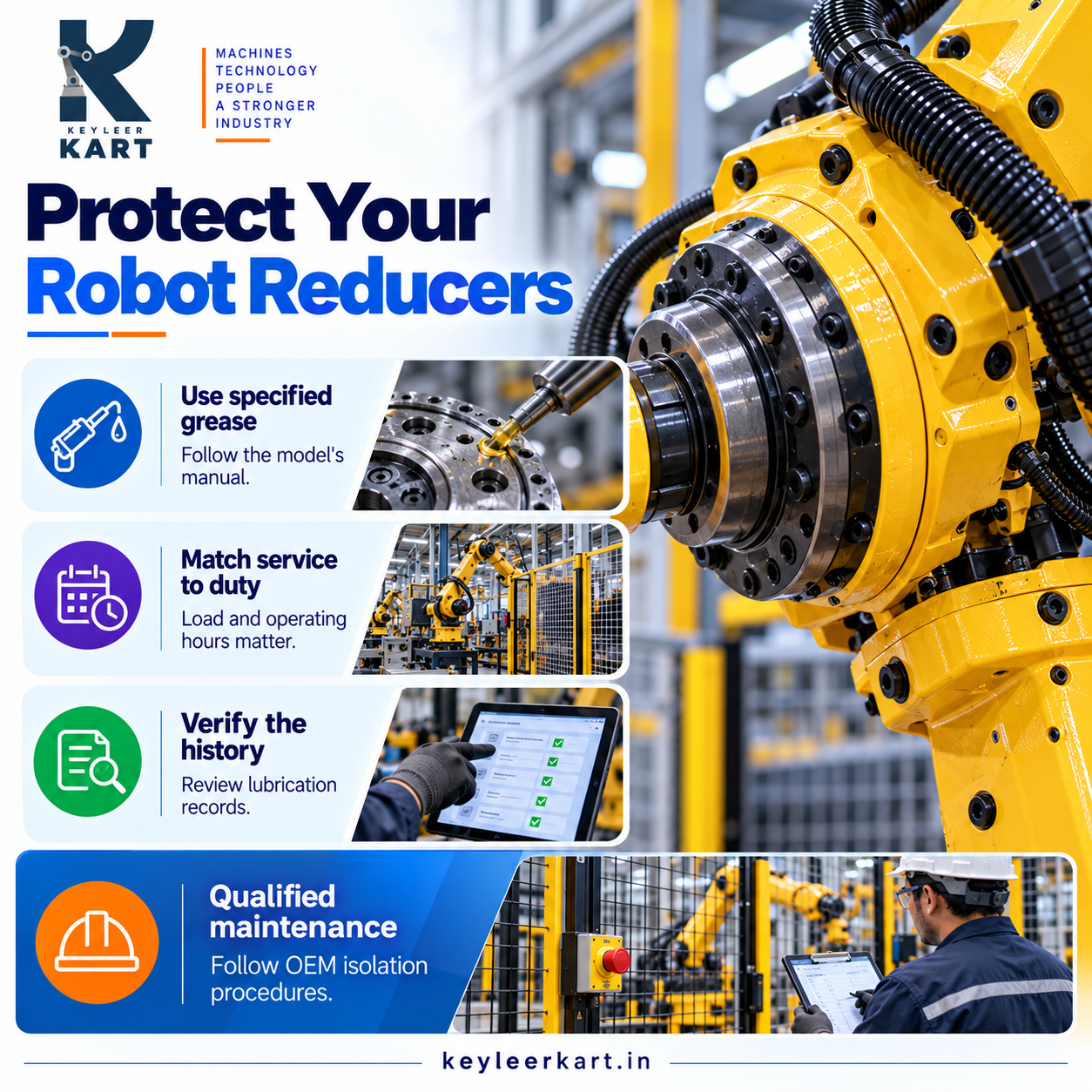
A grease change costs a few thousand rupees. The reducer it protects costs more than most SMEs' entire first robot budget.
Ask any robot maintenance technician what single overlooked task causes the most expensive avoidable failures, and reducer damage from poor lubrication tops the list almost every time. A robot's reducers — the precision gearboxes at each joint that make accurate, repeatable motion possible — are among the most expensive components to replace, and among the cheapest to protect, provided lubrication is taken seriously rather than treated as an afterthought.
This post explains why grease matters so much more than its cost suggests, and how to build a simple, effective lubrication routine for any industrial robot, new or used.
Overview
Robot reducers, whether RV-type or harmonic drive designs, rely on a precise internal lubrication film to prevent metal-on-metal wear under the high torque and repeated motion cycles a working robot experiences daily. Degraded, contaminated, or simply depleted grease breaks down that protective film, and the resulting wear is often invisible until backlash or noise symptoms appear — by which point meaningful, expensive damage has frequently already occurred inside the reducer.
Key Factors to Consider
Manufacturer-Specified Intervals Exist for a Reason
Each robot manufacturer specifies grease type and replacement intervals based on the specific reducer design and expected duty cycle — following these specifications, not a generic schedule, is essential.
Duty Cycle Changes the Real-World Interval
A robot running high-cycle, heavy-load duty (like spot welding or foundry material handling) needs more frequent attention than the same model in light, occasional-use service.
Using the Wrong Grease Type Can Be as Bad as No Grease
Incompatible grease chemistry can degrade seals or fail to provide adequate protection under the specific pressure and temperature conditions inside a given reducer design — always use the manufacturer-specified type.
Used Robots Need Verified Lubrication History
When buying a used robot, treat lubrication history as seriously as any other maintenance record — unknown or neglected grease history is a genuine red flag for hidden reducer wear.
Benefits
Prevents the Single Most Expensive Common Failure
Reducer replacement or rebuild is one of the costliest repairs a robot owner can face — proper lubrication is the cheapest, most effective prevention available.
Extends Overall Robot Service Life
A well-lubricated robot experiences less cumulative wear across all its joints, extending useful life well beyond what neglect would allow.
Maintains Positioning Accuracy
Reducer wear directly causes backlash and reduced positioning accuracy — proper lubrication protects the precision your production process depends on.
A Genuinely Low-Cost, High-Impact Maintenance Task
Compared to almost any other maintenance intervention, grease replacement offers an exceptionally strong ratio of cost to risk reduction.
Industrial Applications
Any articulated industrial robot, regardless of brand or application
High-cycle applications like spot welding and palletizing (shorter intervals)
Foundry and heavy-duty material handling (shorter intervals, contamination risk)
Used robots entering a new plant (verify or reset lubrication history)
Robots in dusty or high-temperature environments (more frequent inspection)
General assembly and machine tending (standard manufacturer intervals)
Buying Guide
When buying a used robot, always ask specifically about lubrication history — not just general maintenance records — and budget for a full grease change as standard practice for any used unit with an unclear or undocumented history, regardless of the seller's other assurances. Confirm the correct manufacturer-specified grease type for your specific model before any maintenance work begins, since substituting an incompatible grease can cause damage rather than prevent it.
Maintenance Tips
Build a documented lubrication schedule keyed to your robot's actual duty cycle, not a generic annual reminder, and log every grease change with date, technician, and grease type used. Watch for early warning signs — unusual noise, increased backlash, or slight positioning drift — as signals to inspect lubrication status ahead of schedule rather than waiting for the next planned interval.
Industry Trends
As predictive maintenance technology matures, more manufacturers are adding vibration and temperature sensors that can flag early reducer wear before it becomes catastrophic, but even the most advanced sensor systems don't replace the basic discipline of following manufacturer-specified lubrication intervals in the first place.
Frequently Asked Questions
Q: How often should robot reducer grease be changed? A: This varies by manufacturer, model, and duty cycle — always follow the specific manufacturer's recommended interval for your robot, adjusted for heavier or lighter than typical usage.
Q: Can I use any grease brand as long as the type matches? A: It's safest to use the manufacturer-specified grease exactly, since even grease of a similar general type can have chemistry differences that affect seal compatibility and performance under specific operating conditions.
Q: How do I know if a used robot's reducers have already been damaged by poor lubrication? A: Jog each axis and watch for backlash or lost motion, listen for unusual noise during operation, and ask directly about the robot's lubrication history — persistent neglect often leaves detectable symptoms even before full failure.
Conclusion
A grease change is one of the cheapest, most consequential maintenance tasks in industrial robotics — the gap between a few thousand rupees spent on schedule and a reducer rebuild or replacement is enormous, and entirely avoidable with basic discipline. For maintenance guidance, spare parts, and expertly serviced used robots, contact KeyLeer Kart.
#RobotMaintenance #FANUC #IndustrialRobots #KeyLeerKart #ManufacturingIndia #PreventiveMaintenance



