
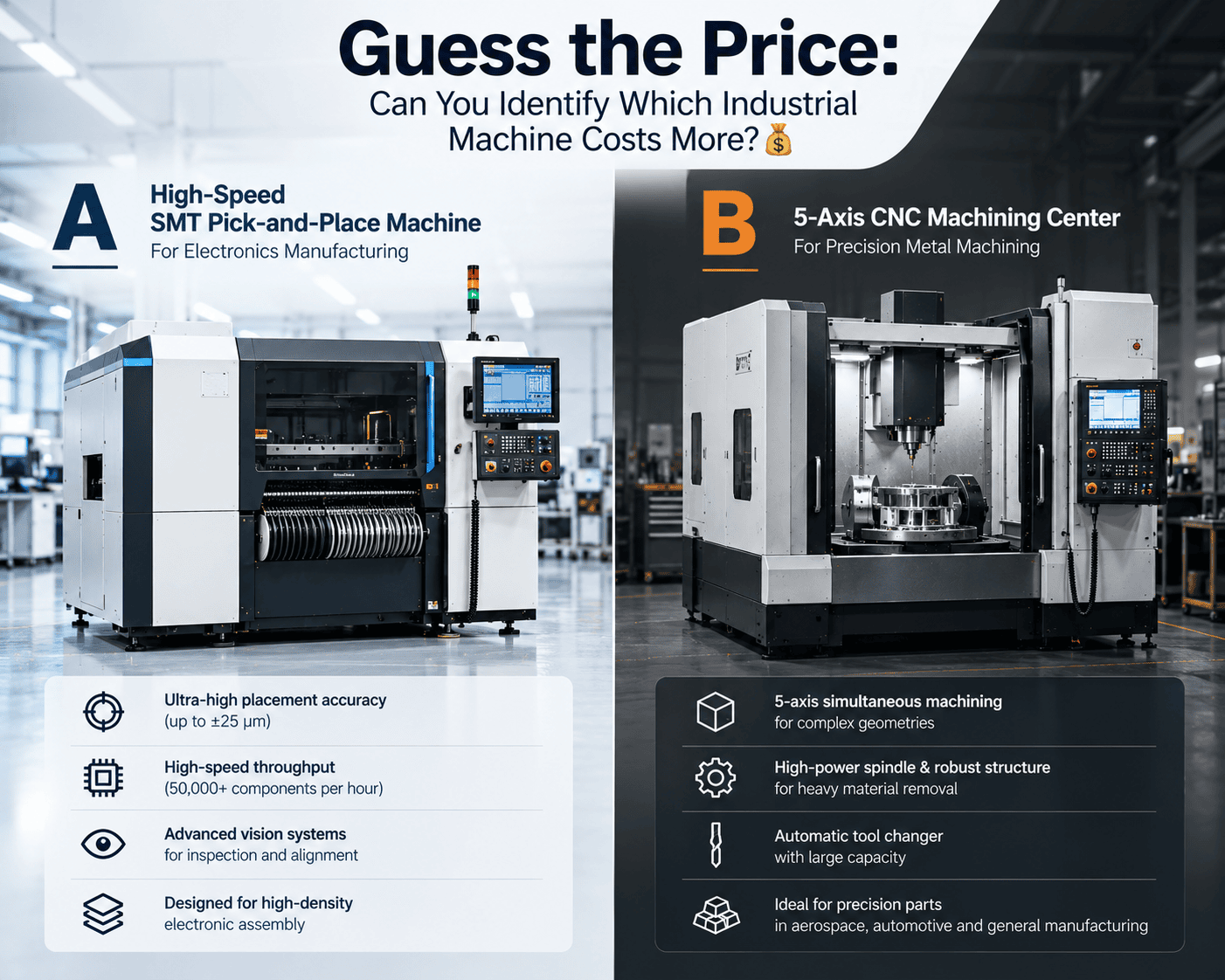
In the dynamic world of modern manufacturing and industrial automation, understanding the value and cost drivers behind sophisticated machinery is paramount. From the intricate assembly of electronics to the heavy-duty shaping of metals, industrial machines represent significant investments that directly impact productivity, quality, and ultimately, a company's bottom line. This blog delves into the distinguishing characteristics and value propositions of two distinct types of industrial equipment, challenging you to consider which one typically demands a higher price tag.
Overview
Industrial manufacturing encompasses a vast array of specialized machinery, each engineered for specific tasks with varying degrees of complexity, precision, and power. Consider two archetypes: one dedicated to the ultra-precise, high-speed assembly of miniature electronic components, demanding microscopic accuracy and rapid throughput; and another built for robust, multi-axis material removal from solid blocks of metal, requiring immense rigidity, force, and versatility. The former operates in the microns, meticulously placing thousands of parts per hour, while the latter sculpts complex geometries from tough materials using powerful tools. Both are critical for their respective industries, driving innovation and efficiency, yet their underlying technologies, operational demands, and cost structures differ significantly. They are commonly found in advanced manufacturing facilities globally, forming the backbone of product creation.
Key Factors to Consider / Key Features
1. Precision and Throughput
Machines designed for high-density electronic assembly feature advanced vision systems and motion control for sub-micron placement accuracy at incredibly high speeds (e.g., 50,000+ components per hour). This level of precision and speed for miniature parts is achieved through sophisticated optics, linear motors, and real-time feedback loops, driving up the engineering and manufacturing costs.
2. Multi-Axis Capability and Power
Heavy-duty machining centers offer multiple axes of motion (e.g., 5-axis simultaneous) combined with powerful spindles and robust machine structures. This enables complex part geometries, faster material removal rates, and processing of hard metals, requiring substantial mechanical engineering, powerful drives, and vibration damping, which are major cost factors.
3. Automation and Vision Systems
Automated electronics assembly equipment integrates advanced cameras, laser sensors, and AI-driven algorithms for component inspection, fiducial recognition, and placement correction. These intelligent automation features minimize human intervention, ensure defect-free production, and contribute significantly to the machine's overall cost and technological sophistication.
4. Tooling and Material Handling Systems
High-end CNC machinery often includes automated tool changers with large capacities, pallet changers for continuous operation, and sophisticated chip management systems. The engineering of robust, precise tooling interfaces and seamless material flow mechanisms adds considerable expense due to their complexity and impact on overall productivity.
5. Software and Integration Complexity
Both types of machines rely heavily on advanced software for programming, simulation, optimization, and integration into broader factory automation systems (MES, ERP). However, software for complex multi-axis interpolation or micro-assembly path optimization, combined with seamless data exchange capabilities for Industry 4.0, represents a significant portion of their development and licensing costs.
Benefits
Enhanced Productivity
Investing in advanced industrial machines dramatically increases production throughput and efficiency, enabling manufacturers to meet high-demand targets and accelerate time-to-market for new products.
Superior Quality and Accuracy
Cutting-edge equipment delivers unparalleled precision and repeatability, ensuring consistent product quality, reducing defects, and minimizing rework, which translates into significant cost savings.
Cost Reduction
While the initial investment can be substantial, modern machines reduce labor costs, minimize material waste, and optimize energy consumption over their operational lifespan, leading to long-term cost efficiencies and improved ROI.
Increased Flexibility and Innovation
Advanced machinery offers greater versatility to produce complex parts or assemble diverse product lines, empowering manufacturers to adapt to market changes, customize offerings, and innovate with new designs and materials.
Industrial Applications
Electronics Manufacturing (PCB Assembly, Semiconductor Packaging)
Aerospace and Defense (Precision Component Machining)
Medical Devices (Micro-assembly, Implants Machining)
Automotive Manufacturing (Engine Parts, Electronic Control Units)
Consumer Goods (High-volume assembly, Mold & Die Making)
Buying Guide
Before purchasing any industrial machine, buyers must meticulously evaluate several critical factors. Beyond the machine's core specifications and features, assess its overall condition, especially for pre-owned equipment. Crucially, scrutinize the warranty offered, understanding its scope and duration. The supplier's reputation for service and support, along with the readily available supply of spare parts, are paramount for ensuring long-term operational reliability. Finally, verify the machine's compatibility with existing factory infrastructure, software, and automation systems to ensure seamless integration and optimal performance.
Maintenance Tips
Effective maintenance is the cornerstone of maximizing the lifespan and performance of industrial machinery. Implement a rigorous preventive maintenance schedule that includes regular cleaning of critical components, precise lubrication of moving parts, and routine inspections for wear and tear. Calibration of sensors and motion systems is vital for maintaining accuracy, particularly for high-precision equipment. Furthermore, ensure operators receive comprehensive and ongoing training on proper machine operation, routine checks, and basic troubleshooting to proactively identify and address potential issues.
Industry Trends
The industrial landscape is rapidly evolving with Industry 4.0 driving profound transformations. Integration of Artificial Intelligence (AI) and Internet of Things (IoT) sensors enables Smart Manufacturing environments, offering real-time data for Predictive Maintenance, minimizing downtime. Automation continues to expand, leveraging advanced robotics and Digital Twin technologies for optimized process simulation and control. Manufacturers are also increasingly prioritizing Sustainability, seeking energy-efficient machinery and processes to reduce environmental impact and operational costs, aligning with global eco-friendly initiatives.
Frequently Asked Questions
What drives the significant cost differences in industrial machinery?
The primary drivers of cost differences stem from the machine's inherent complexity, the level of precision and speed it offers, the sophistication of its automation and vision systems, the power and rigidity of its mechanical structure, and the advanced software required for its operation and integration. Specialized engineering for niche applications, research and development costs, and the quality of components also play a substantial role in the final price.
How important is precision versus raw power in determining machine value?
The importance of precision versus raw power is entirely dependent on the application. For electronics manufacturing, ultra-high precision and speed are paramount, justifying significant investment in advanced motion control and vision. In heavy manufacturing, raw power, rigidity, and the ability to process hard materials efficiently dictate value. Both attributes contribute to value in their respective domains, with machines excelling in either area demanding premium prices due to the specialized engineering required.
Can investing in a more expensive machine really lead to better ROI?
Absolutely. While the upfront cost of advanced industrial machinery can be high, the return on investment often outweighs cheaper alternatives in the long run. Higher precision, faster throughput, reduced material waste, lower energy consumption, minimized downtime through predictive maintenance, and the ability to produce higher-quality or more complex products all contribute to a superior ROI by boosting efficiency, reducing operational costs, and expanding market opportunities.
Conclusion
Understanding the intricate factors that determine the price of industrial machinery is crucial for strategic investment in manufacturing and automation. From the microscopic precision of electronics assembly to the brute force of heavy-duty machining, each machine category presents unique technological challenges and value propositions. Making an informed decision requires a deep dive into specifications, capabilities, and the long-term operational benefits. For expert guidance and unparalleled industrial solutions tailored to your specific needs, we recommend contacting KeyLeer Kart.



