
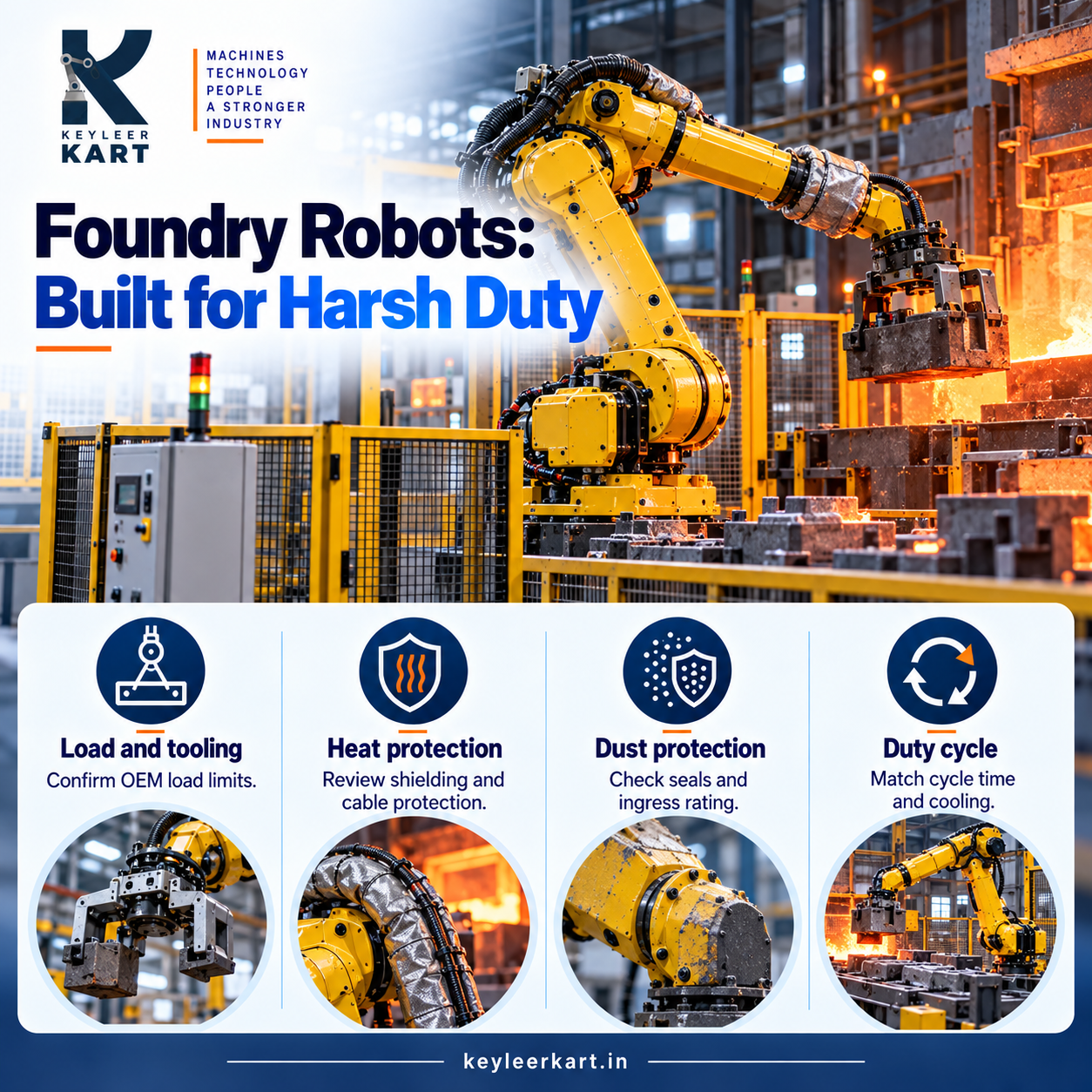
Foundries destroy ordinary machines. Here's what it actually takes for a robot to survive molten metal, sand, and heat cycle after heat cycle.
Foundry environments are among the harshest an industrial robot ever operates in — extreme ambient heat, abrasive sand and dust, thermal shock, and payloads that regularly exceed what a typical automotive-line robot is built for. Sourcing the right heavy-payload robot for this environment (used or new) is a very different exercise from sourcing one for light assembly.
Overview
Foundry robotic applications typically involve pouring, ladling, die-casting part extraction, and heavy fettling or deburring — all of which demand high payload capacity at extended reach, protective measures against heat and particulate, and mechanical robustness well beyond a general-purpose arm.
What Separates a Foundry-Capable Robot
Payload at Full Reach, Not Nameplate
A robot rated for 165kg or more near its base may carry significantly less at full arm extension. Foundry tasks like die-cast part extraction from a fixed die position often need full-reach capacity, so always check the payload-versus-reach curve, not just the headline number.
Thermal and Environmental Protection
Robots deployed near furnaces or die-cast machines typically need heat shielding, protective boots on cabling, and sometimes water- or air-cooled options depending on proximity to the heat source. Check what protective measures a used robot's prior installation included and whether they transfer with it.
IP Rating for Sand and Dust
Foundry sand is abrasive and pervasive. A robot without adequate ingress protection at joint seals will see accelerated wear on reducers and encoders — this is one of the fastest ways a robot's working life gets shortened in this environment.
Duty Cycle and Cooling
High-payload, high-cycle foundry work pushes servo motors harder. Confirm the robot's duty cycle rating matches your intended cycle time, not just its peak payload spec.
Benefits
Consistent Output in Hazardous Work
Automating pouring, ladling, and part extraction removes operators from the most dangerous proximity to molten metal and hot dies.
Reduced Cycle Variability
A properly specified robot maintains consistent cycle times regardless of operator fatigue, which matters heavily in high-volume die-casting.
Cost-Effective Capacity Upgrade
A well-inspected used heavy-payload arm can bring foundry-grade automation within reach of MSME foundries that could not justify a new robot's price.
Industrial Applications
Die-cast part extraction from horizontal and vertical die-casting machines.
Ladling and pouring automation near induction furnaces.
Heavy fettling, gate-cutting, and deburring of cast parts.
Palletizing and stacking of heavy cast components post-cooling.
Buying Guide
Verify the robot's actual prior application — a robot pulled from a foundry or die-cast line has already proven it can survive that environment, which is valuable evidence in itself.
Inspect cabling and connector boots closely for heat damage or brittleness, a common failure point in thermally stressed installations.
Confirm payload rating at your specific required reach, using the OEM's payload-reach chart, not the nameplate figure alone.
Ask about any history of encoder or reducer replacement, since abrasive environments accelerate wear on exactly these components.
Maintenance Tips
Increase inspection frequency for joint seals and cable boots in sand or dust-heavy environments compared to a clean-room or electronics-assembly schedule.
Monitor servo motor temperatures under actual duty cycle to confirm the installation's cooling is adequate for your cycle time.
Keep a stock of consumable protective boots and heat shields on hand, since these wear faster than the robot's core mechanical components.
Industry Trends
India's foundry and die-casting sector continues to invest in automation to address labour safety concerns around molten-metal handling, and the used heavy-payload robot market is a practical entry point for MSME foundries pursuing this without new-robot capital budgets.
Frequently Asked Questions
Q: What payload range is typical for foundry pouring and extraction robots? A: It varies widely by part size and ladle capacity, but heavy-duty foundry applications commonly call for robots rated well above typical assembly-line payloads — always size against your specific ladle or part weight, including tooling, not a generic figure.
Q: Can a used robot from a clean assembly-line application be repurposed for foundry work? A: It can, but expect to add environmental protection (heat shielding, cable boots, improved sealing) that a clean-room-origin robot likely never had, and budget for that retrofit.
Q: Does KeyLeer Kart source heavy-payload robots specifically for foundry use? A: Yes — we help foundries evaluate payload-at-reach, prior application history, and environmental protection needs before sourcing the right used arm.
Conclusion
A foundry is not a forgiving environment, and not every heavy-payload robot that looks capable on paper will actually survive it. The right choice comes down to payload at true reach, environmental protection, and honest history of the unit's prior application.
KeyLeer Kart helps foundries source and inspect heavy-payload robots with exactly this environment in mind — talk to us before you commit.
#FoundryAutomation #DieCasting #IndustrialRobots #UsedRobots #KeyLeerKart #MakeInIndia #FactorySafety



