
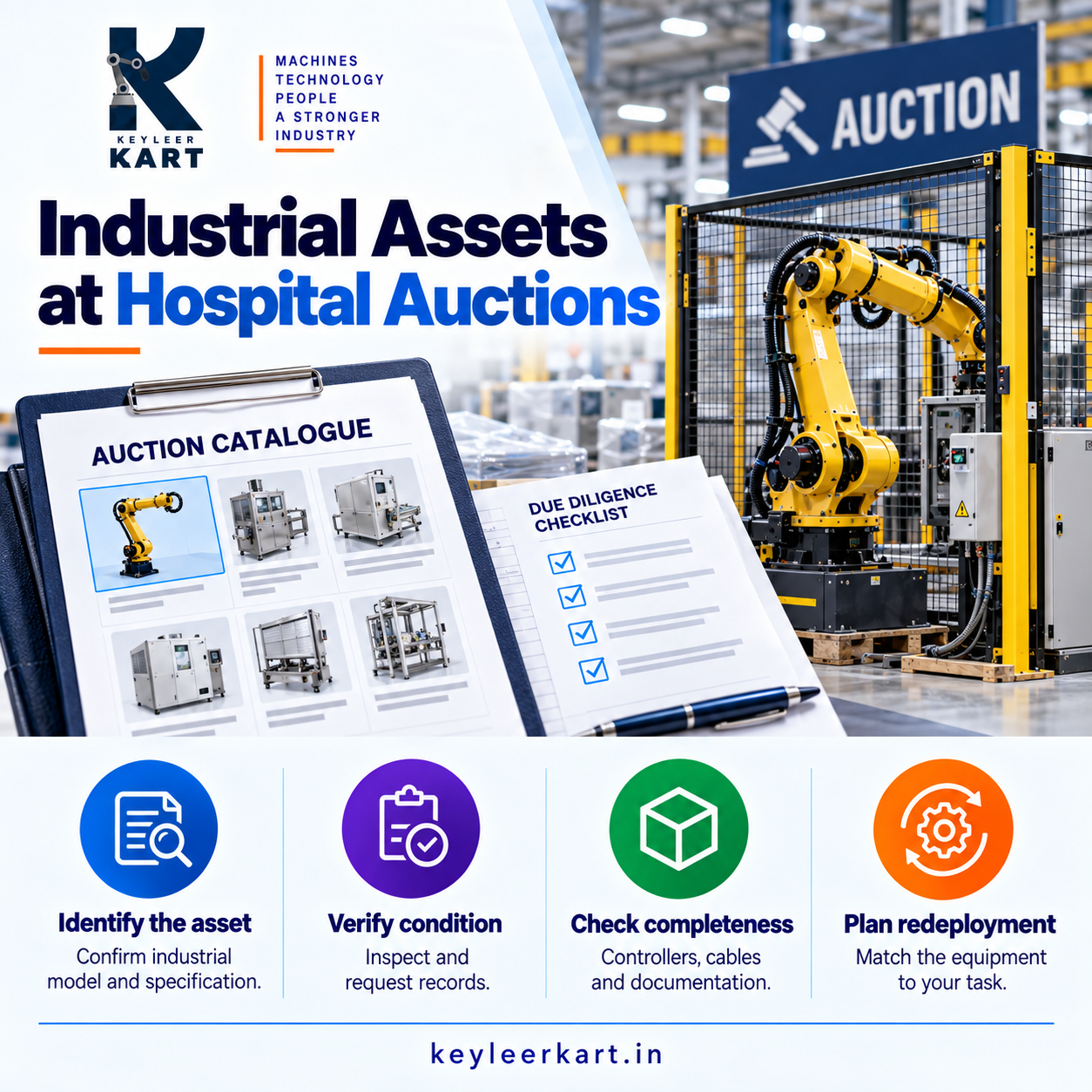
Everyone watches automotive plant closures for used robots. Almost nobody watches hospital and pharma equipment auctions — and that's exactly why they're worth watching.
When people picture where used industrial robots come from, they picture car factories. But hospitals, diagnostic labs, and pharmaceutical manufacturing sites also decommission significant automation — packaging robots, material handling arms, and precision motion systems — during equipment upgrades, facility closures, and consolidations. These auctions are a quieter, less-competed channel that savvy buyers are starting to pay attention to.
Overview
Pharmaceutical and medical device manufacturing uses industrial robots for tasks like sterile packaging, vial and syringe handling, palletizing of packaged goods, and precision assembly — often to a higher cleanliness and documentation standard than general industrial use, which can actually work in a buyer's favour.
Why This Channel Is Different
Higher Documentation Standards
Pharma and medical facilities operate under strict regulatory compliance (often including validated equipment records), which means robots decommissioned from this sector frequently come with more complete maintenance and calibration history than a typical general-manufacturing arm — a genuine advantage for a buyer doing due diligence.
Lower Duty Cycle Wear
Many pharma packaging and handling applications run at gentler duty cycles and lighter payloads than automotive spot-welding or heavy palletizing, meaning mechanical wear on reducers and servo motors can be lower relative to the robot's age — though this should always be verified, not assumed.
Cleanroom-Grade Components
Robots built or retrofitted for cleanroom pharma use sometimes include enhanced sealing and low-particulate-generation features that are a bonus, not a requirement, for many general industrial applications they get redeployed into.
Less Buyer Competition
Because fewer industrial buyers actively monitor hospital and pharma equipment auctions compared to automotive plant liquidations, pricing can be more favourable for an informed buyer willing to look in this channel.
Benefits
Access to Well-Documented Used Assets
Regulatory-grade documentation habits in this sector can mean better provenance than typical general-industrial used robots.
Competitive Pricing
A less-crowded buyer pool can mean better deals for buyers willing to look beyond the obvious automotive-plant channel.
Diverse Asset Types
Beyond robots, these auctions often include precision motion stages, conveyors, and material handling equipment relevant to light industrial automation.
Industrial Applications
Light packaging automation for consumer goods or food processing repurposed from pharma packaging robots.
Precision assembly tasks benefiting from cleanroom-grade component conditions.
General material handling and palletizing using lower-duty-cycle, well-maintained arms.
Buying Guide
Request whatever validated maintenance or calibration records exist — this sector's documentation habits are often better than general industry, so ask specifically for them.
Verify the robot's actual application and duty cycle history rather than assuming 'pharma' automatically means 'lightly used.'
Confirm compatibility of any specialized end-effectors or cleanroom features with your intended, likely different, application.
Treat controller software licensing the same as any other used robot purchase — confirm what transfers and what needs renewal.
Maintenance Tips
Re-verify mastering and calibration after relocation, exactly as with any other used robot — a clean history does not exempt it from this step.
Assess whether cleanroom-specific features (like special sealing) need adjustment for a dustier general-industrial environment.
Budget for end-effector replacement if the original gripper or tooling was highly specialized to a pharma packaging task.
Industry Trends
As India's pharmaceutical and medical device manufacturing sector modernizes its own automation, older-generation robots and motion systems are entering the secondary market through auctions and equipment liquidators — a channel that remains underexplored by general industrial buyers relative to its potential value.
Frequently Asked Questions
Q: Are robots from hospital or pharma auctions harder to repurpose for general industry? A: Not usually — the core robot and controller are generally the same models used across industries; the main adjustments are typically end-effector tooling and re-verifying calibration for your specific application.
Q: Is documentation really better in this sector? A: Often yes, due to regulatory compliance requirements, though this should always be verified per listing rather than assumed as a blanket rule.
Q: Does KeyLeer Kart source from pharma and medical equipment auctions? A: We track multiple sourcing channels, including less obvious ones like this, to find well-documented used robotics assets for our buyers.
Conclusion
The best deals often live in the channels other buyers aren't watching. Hospital, diagnostic, and pharma equipment auctions are exactly that kind of overlooked source for genuinely well-documented used industrial robots.
KeyLeer Kart keeps an eye on these less-obvious channels so our buyers get access to assets most of the market never sees.
#UsedRobots #IndustrialRobotics #KeyLeerKart #MakeInIndia #Manufacturing #SmartSourcing #PharmaAutomation



