
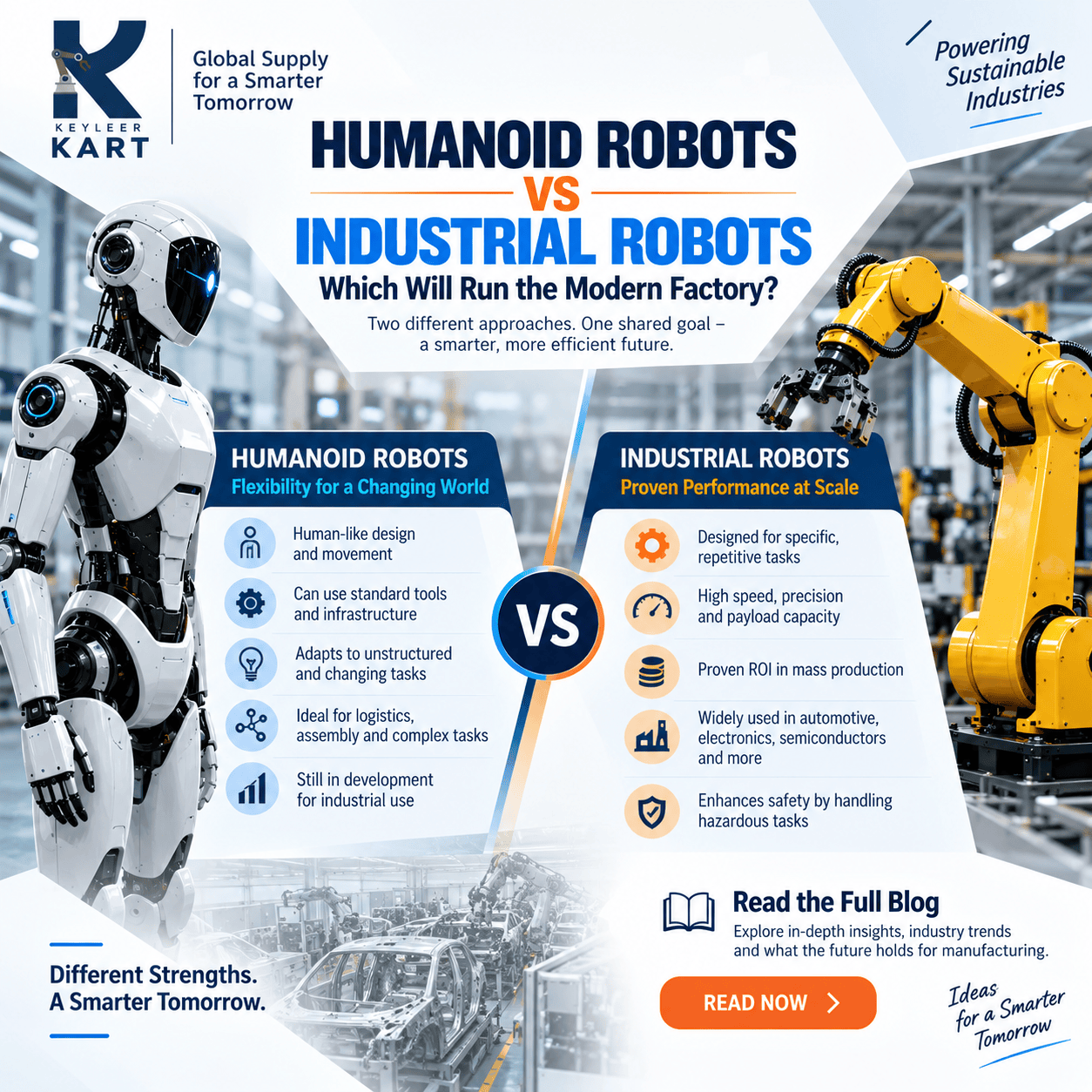
The landscape of modern manufacturing is undergoing a profound transformation, driven by advancements in robotics and industrial automation. As factories strive for unprecedented levels of efficiency, precision, and flexibility, the debate intensifies: will purpose-built industrial robots continue to dominate, or are humanoid robots poised to become the new workforce running our factories? Understanding their respective strengths and limitations is crucial for any business navigating the future of industrial production.
Overview
Industrial robots are automated, programmable, multi-axis machines designed for specific, repetitive tasks within structured environments. They typically consist of a mechanical arm, a controller, and an end effector (gripper, welder, paint gun, etc.). These robots operate with extreme precision, speed, and strength, performing tasks like assembly, welding, material handling, and SMT pick-and-place with unwavering consistency. Their importance lies in their ability to boost productivity, reduce labor costs, and enhance product quality and safety by handling hazardous or strenuous tasks. They are predominantly used in automotive manufacturing, electronics assembly, food processing, semiconductor fabrication, and CNC machining operations.
Humanoid robots, conversely, are designed to mimic human form and movement, often featuring two arms, two legs, and a torso. While still largely in development for industrial applications, they are envisioned to operate in human-centric environments, interact with standard tools and infrastructure, and adapt to unstructured or changing tasks. Their potential importance lies in their versatility and ability to perform complex, cognitive tasks requiring fine motor skills, perception, and decision-making in environments not explicitly designed for automation. They are currently being explored for applications in logistics, healthcare, and research, with nascent trials in general factory assistance and collaborative assembly tasks.
Key Factors to Consider
1. Design and Dexterity
Industrial robots are optimized for specialized, repetitive tasks, offering unparalleled precision, speed, and payload capacity within their defined workspace. Humanoid robots, by design, aim for human-level dexterity and adaptability, enabling them to navigate complex environments and manipulate diverse objects using standard tools, but often at lower speeds and with less force than their industrial counterparts.
2. Speed and Throughput
For high-volume, high-speed production lines like those in SMT or automotive assembly, industrial robots are the undisputed champions. Their specialized design allows for rapid, consistent cycle times. Humanoid robots, while offering adaptability, generally cannot match the raw speed and throughput of dedicated industrial robotic arms for repetitive manufacturing tasks.
3. Cost and ROI
The initial investment for advanced humanoid robots is currently significantly higher than for most industrial robots, especially when considering the complexity of their control systems and sensory perception. Industrial robots offer a clear and often faster return on investment through increased throughput, reduced labor, and consistent quality in mass production settings.
4. Safety and Collaboration
Traditional industrial robots operate within fenced-off safety cells, minimizing human interaction for safety. Collaborative industrial robots (cobots) are designed to work alongside humans safely, but still have limitations. Humanoid robots are being developed with advanced perception and AI to work seamlessly and safely in human-occupied spaces, potentially revolutionizing human-robot collaboration in flexible manufacturing.
5. Integration and Programming
Industrial robots typically require expert programming and integration into existing factory automation systems, often via proprietary interfaces. Humanoid robots, with their advanced AI and learning capabilities, aim for more intuitive programming and the ability to adapt to new tasks and environments with less specialized input, potentially lowering integration barriers for diverse tasks.
Benefits
1. Enhanced Flexibility and Adaptability
Humanoid robots promise unprecedented flexibility, capable of performing a wide array of tasks in dynamic environments without extensive retooling, making them ideal for high-mix, low-volume production or unexpected changes in manufacturing requirements.
2. Optimized Throughput and Precision
Industrial robots deliver unmatched speed, accuracy, and repeatability for dedicated tasks, ensuring high throughput and consistent product quality essential for mass production in electronics manufacturing and semiconductor equipment industries.
3. Improved Safety in Hazardous Environments
Both robot types contribute to safety by taking over dangerous or ergonomically challenging tasks. Industrial robots excel in high-risk, repetitive operations, while humanoids could handle complex hazardous tasks requiring human-like navigation or tool usage.
4. Reduced Operational Costs
Industrial robots significantly reduce labor costs and waste by optimizing processes and minimizing errors, leading to substantial long-term savings. Humanoid robots, while having higher initial costs, could offer cost reductions in situations requiring high adaptability or specialized human-like skills.
Industrial Applications
Automotive Assembly Lines
Electronics Manufacturing & PCB Assembly
Semiconductor Wafer Handling & Inspection
CNC Machine Tending & Metal Fabrication
Logistics & Warehouse Automation
Buying Guide
When considering robotic solutions for your factory, buyers should meticulously evaluate the machine condition, ensuring it meets performance benchmarks and safety standards. Critical specifications like payload capacity, reach, speed, and repeatability must align with intended applications. A comprehensive warranty and a strong supplier reputation are paramount for long-term support, spare parts availability, and reliable service. Crucially, ensure the robot's compatibility with existing industrial automation systems and infrastructure to facilitate seamless integration and maximize operational efficiency.
Maintenance Tips
Optimal robot performance relies on diligent maintenance. Implement a robust preventive maintenance schedule including regular cleaning to prevent dust and debris accumulation, lubrication of all moving parts, and thorough inspections for wear, tear, or damage. Periodic calibration of axes and sensors ensures continued accuracy and precision. Comprehensive operator training is also essential, empowering staff to perform routine checks, troubleshoot minor issues, and operate the machinery safely and efficiently.
Industry Trends
The future of robotics in manufacturing is deeply intertwined with Industry 4.0, integrating AI, IoT, and smart manufacturing principles. AI-powered vision systems and machine learning are enabling robots to perform more complex, adaptive tasks, while IoT connectivity facilitates real-time data exchange for predictive maintenance and optimized performance. The rise of digital twins allows for virtual commissioning and process optimization, enhancing efficiency and sustainability. Collaborative automation continues to grow, and as humanoid robots mature, they are poised to complement traditional industrial robots, ushering in an era of highly flexible and adaptive factories.
Frequently Asked Questions
What is the primary difference between industrial and humanoid robots for factory use?
The primary difference lies in their design philosophy and application focus. Industrial robots are purpose-built for high-speed, high-precision, repetitive tasks in structured environments, prioritizing performance metrics like speed, payload, and repeatability. Humanoid robots, conversely, are designed for versatility and operating in human-centric, less structured environments, mimicking human form and dexterity to perform a broader range of complex, cognitive tasks.
Can humanoid robots replace all industrial robots in the future?
It is highly unlikely that humanoid robots will completely replace industrial robots. Each type excels in different areas. Industrial robots will continue to dominate applications requiring extreme speed, strength, and unwavering precision for repetitive tasks. Humanoid robots are more likely to complement them, filling roles that require flexibility, interaction with human-designed tools and infrastructure, or tasks that are currently difficult to automate with traditional robotic arms.
How will AI impact the development and deployment of both robot types?
AI is a critical enabler for both industrial and humanoid robots. For industrial robots, AI enhances capabilities like intelligent vision systems for quality control, adaptive path planning, and predictive maintenance. For humanoid robots, AI is fundamental to their ability to perceive, learn, make decisions, and adapt to unstructured environments, enabling sophisticated human-robot interaction, complex task execution, and robust navigation, pushing them closer to viable factory deployment.



