
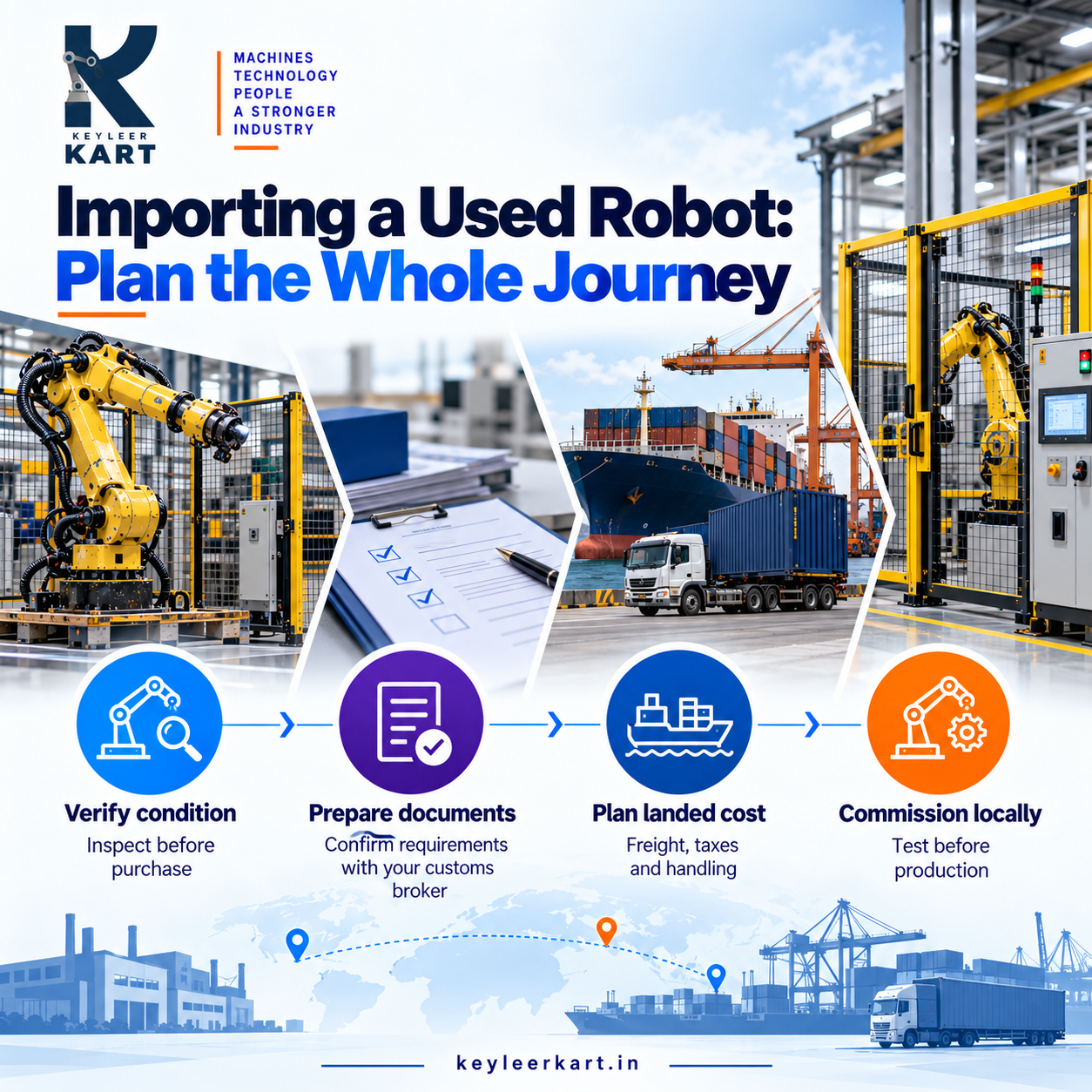
Most first-time importers don't lose money on the robot. They lose it on the one document they didn't know they needed.
Importing a used robot from Germany is genuinely straightforward once you know the specific rules — and genuinely frustrating if you find out about them one at a time, mid-shipment. India's used-machinery import framework has clear requirements around age, documentation, and duty that determine both your total cost and your timeline, and getting them right upfront is the difference between a smooth six-week process and a container sitting at port for months.
This post walks through exactly what's required, what it costs, and how long it genuinely takes.
Overview
Indian customs treats used industrial machinery differently from new equipment, primarily through age and residual-life requirements plus a mandatory Chartered Engineer Certificate (CEC) issued overseas before shipment. Duty is calculated on depreciated value rather than original purchase price, following a defined quarterly depreciation scale, which is actually good news for buyers — but only if the valuation and certification paperwork is done correctly from the start.
Key Factors to Consider
Age and Residual Life Requirements
Used machinery must generally be under 10 years old with a certified minimum residual life of five years; equipment older than 10 years requires a DGFT Restricted Import Licence, adding meaningful time to the process.
The Chartered Engineer Certificate Is Non-Negotiable
An accredited overseas chartered engineer must certify the machine's year of manufacture, condition, depreciation status, and valuation before shipment — this single document underpins the entire customs process.
Duty Is Based on Depreciated Value
Basic Customs Duty of roughly 7.5-10%, plus a 10% social welfare surcharge on that duty, plus IGST of 12-18%, is calculated against depreciated valuation following a quarterly depreciation scale — not the robot's original price.
Realistic Timeline Is 4-8 Weeks
CEC issuance typically takes one to two weeks, sea transit two to four weeks, and customs clearance a few days — but any missing document or licence requirement can extend this considerably.
Benefits
Depreciated Valuation Reduces Duty Burden
Because duty is assessed on depreciated value rather than original cost, a well-documented used robot typically carries a meaningfully lower total duty burden than an equivalent new import.
Predictable Process When Done Correctly
With the right documentation prepared upfront, the import timeline is genuinely predictable, allowing manufacturers to plan installation and production schedules with confidence.
Access to European Equipment Otherwise Out of Reach
A properly managed import process opens up genuine access to the premium European used-equipment supply discussed elsewhere in this month's coverage.
Reduced Risk with Experienced Partners
Working with an experienced importer who manages CEC issuance, licensing, and customs filing removes most of the risk of costly delays or documentation errors.
Industrial Applications
Importing individual robots for factory automation projects
Complete production line imports from restructuring European plants
CNC and SMT equipment imports alongside robotics
Foundry and heavy machinery imports
Medical and specialised equipment imports (separate compliance considerations apply)
Multi-unit fleet imports for larger manufacturing expansions
Buying Guide
Confirm the robot's exact age and arrange the Chartered Engineer Certificate before finalising a purchase agreement, not after — this certificate directly affects both duty calculation and whether a DGFT licence is required. Budget the full landed cost — duty, surcharge, IGST, freight, and any required licensing — into your purchase decision from the outset, since these can add 30-40% or more to the machine's purchase price depending on age and valuation.
Maintenance Tips
Keep the complete import documentation package — CEC, invoice, bill of entry, and any licences — permanently on file alongside the robot's maintenance records, since this paperwork is often required again for future resale, insurance, or compliance purposes. Plan for a post-import inspection and re-commissioning process immediately upon arrival, rather than treating customs clearance as the finish line.
Industry Trends
As Indian manufacturers continue sourcing more heavily from Europe amid the regional supply dynamics covered elsewhere this month, demand for experienced import partners who can navigate CEC, DGFT licensing, and customs efficiently is growing accordingly — buyers increasingly prefer partners who handle this complexity end-to-end rather than managing it piecemeal themselves.
Frequently Asked Questions
Q: Can I import a used robot older than 10 years? A: Yes, but it requires a DGFT Restricted Import Licence in addition to the standard Chartered Engineer Certificate, which adds meaningful time — typically two to four additional weeks — to the process.
Q: Is customs duty on used robots higher or lower than on new ones? A: The duty rate itself is similar, but because it's calculated on depreciated value rather than original cost, the total duty amount is typically lower for a well-documented used machine.
Q: Does KeyLeer Kart handle the full import process for buyers? A: Yes — we manage CEC issuance, documentation, freight, and customs clearance as part of our service, so buyers don't have to navigate this process piecemeal on their own.
Conclusion
Importing a used robot from Germany is a well-defined, predictable process once you understand the age requirements, the Chartered Engineer Certificate, and the depreciated duty calculation — the risk lies almost entirely in discovering these requirements too late rather than in the process itself. For end-to-end import management on your next used robot purchase, contact KeyLeer Kart.
#ImportMachinery #UsedRobots #GermanMachinery #KeyLeerKart #ManufacturingIndia #CustomsIndia



