
In the rapidly evolving landscape of modern manufacturing and industrial automation, safety is not merely a compliance requirement but a fundamental pillar of operational excellence. Ensuring a secure working environment protects personnel, safeguards valuable machinery, and maintains production continuity, making the strategic integration of robust industrial safety components absolutely critical for any plant aiming for sustainable success.
Overview
Industrial safety components are specialized devices and systems engineered to prevent accidents, minimize risks, and protect personnel working with machinery and hazardous processes. These range from simple lockout devices to complex integrated safety control systems. They work by detecting unsafe conditions, initiating immediate protective actions like stopping machinery or isolating power, or alerting operators to potential dangers. Their importance lies in fulfilling stringent safety regulations, reducing injuries and equipment damage, preventing costly downtime, and mitigating associated financial and reputational risks. They are commonly employed across diverse sectors, including electronics manufacturing, semiconductor fabrication, automotive, and any facility utilizing robotics, CNC machines, or automated production lines.
Key Factors to Consider / Key Features
Safety Light Curtains & Scanners
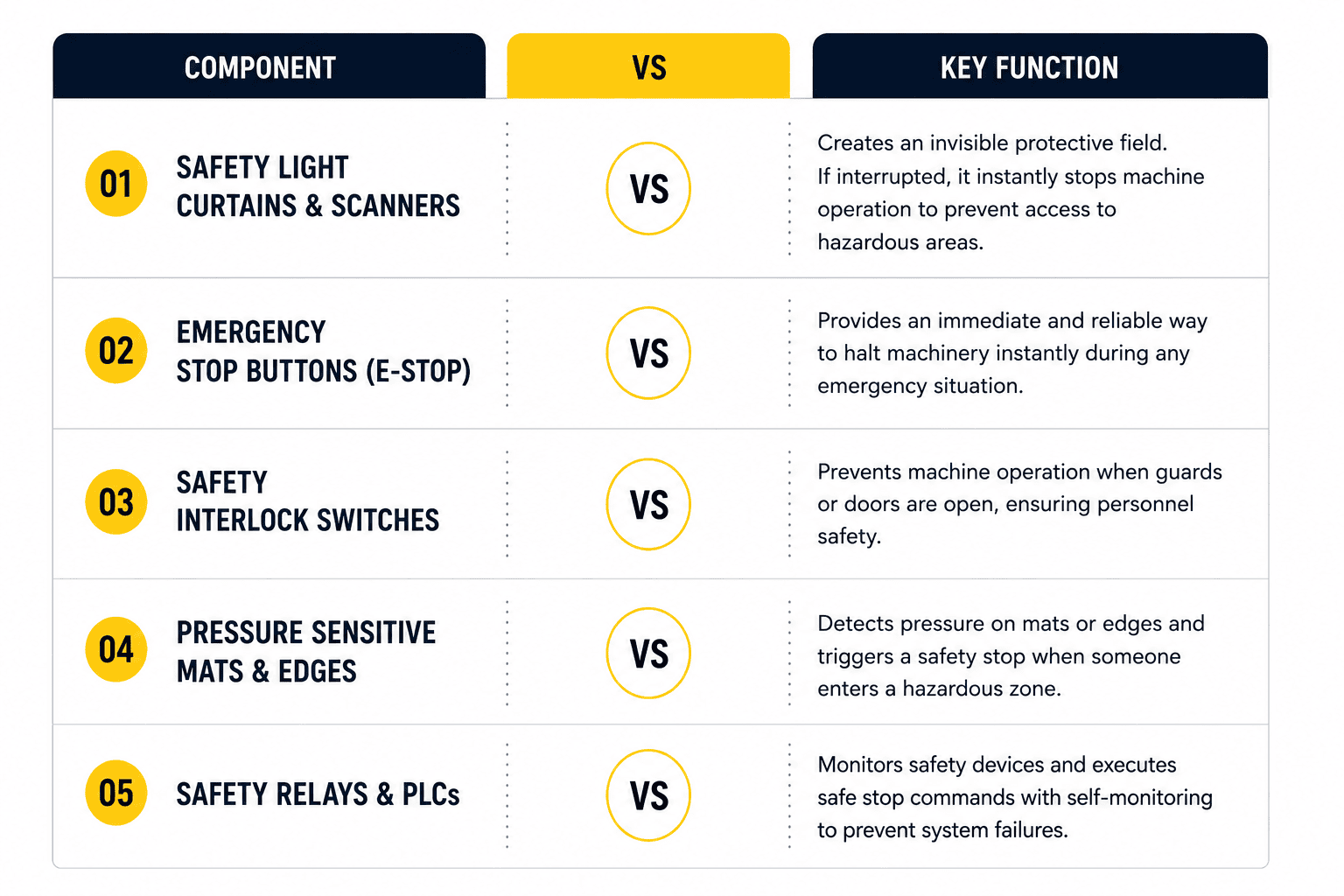
These optoelectronic devices create invisible protective fields around hazardous areas. If the beam is interrupted by a person or object, they immediately stop machine operation, preventing access to dangerous moving parts. Essential for safeguarding robotic cells and automated assembly lines.
Emergency Stop Buttons (E-Stop)
Prominently placed, highly visible pushbuttons designed to instantaneously halt machinery operation in emergency situations. E-stops provide operators with a direct, failsafe method to stop processes when unforeseen dangers arise, crucial for immediate risk mitigation.
Safety Interlock Switches
Devices attached to machine guards, gates, or doors that prevent machine operation if the guard is not in its safe position or if the access point is open. They ensure personnel cannot access hazardous areas while machinery is running, commonly used on CNC enclosures.
Pressure Sensitive Mats & Edges
These detection devices are placed on the floor or edges of moving parts, activating a safety stop when pressure is applied. They create defined safe zones around machinery, ensuring operation ceases immediately if a worker steps into a hazardous area or makes contact.
Safety Relays & PLCs
Dedicated control modules that monitor safety circuits from various input devices (e.g., E-stops, light curtains, interlocks) and safely execute stop commands. Unlike standard relays, they feature redundant internal architectures and self-monitoring to prevent failures and form the brain of robust safety systems.
Benefits
Enhanced Worker Protection
Significantly reduces workplace injuries and fatalities by actively preventing access to dangerous machine movements or instantly stopping operations during unsafe conditions. This fosters a safer, more confident workforce.
Reduced Downtime and Costs
By preventing accidents, safety components minimize unplanned production halts, equipment damage, and the substantial costs associated with worker compensation, legal liabilities, and regulatory fines. Proactive safety increases operational uptime.
Regulatory Compliance
Integrating certified safety components ensures adherence to stringent national and international safety standards and regulations (e.g., OSHA, ISO 13849). This avoids penalties, maintains operational licenses, and demonstrates responsible manufacturing.
Improved Operational Efficiency
A safer environment reduces worker apprehension, allowing operators to work more confidently and efficiently. Well-designed safety systems can streamline machine interaction, paradoxically improving throughput by minimizing manual interventions caused by preventable incidents.
Industrial Applications
Electronics Manufacturing (SMT, PCB Assembly)
Robotics and Automation Cells
Semiconductor Fabrication Plants
CNC Machining and Metalworking
Automotive and Aerospace Assembly Lines
Buying Guide
Before investing in industrial safety components, buyers must thoroughly evaluate several crucial aspects. Assess the specific machine condition and operational risks they are intended for, ensure component specifications meet required safety performance levels (PL/SIL), and always confirm warranty terms. Prioritize reputable suppliers known for quality and post-sales support, verify spare parts availability, and meticulously check compatibility with existing machinery and control systems to ensure seamless integration and optimal safety.
Maintenance Tips
Effective maintenance is paramount for ensuring the continuous reliability of industrial safety components. Implement a rigorous preventive maintenance schedule that includes regular cleaning of sensors and lenses, routine lubrication of mechanical safety interlocks, and thorough visual inspections for wear or damage. Crucially, periodic calibration of detection devices and thorough operator training on the proper use and testing of safety systems are essential to maintain peak performance and compliance.
Industry Trends
The landscape of industrial safety is rapidly evolving with Industry 4.0. The integration of IoT sensors enables real-time monitoring of safety component status, while AI and machine learning are powering predictive maintenance for safety systems, anticipating failures. Smart manufacturing environments leverage digital twins to simulate safety scenarios. Automation, while introducing new hazards, also facilitates advanced safety features like collaborative robot safety, driving a future where sustainability includes not only environmental impact but also robust, intelligent worker protection.
Frequently Asked Questions
What is the difference between a standard relay and a safety relay?
Standard relays are general-purpose switching devices, whereas safety relays are specifically designed for critical safety functions. Safety relays incorporate redundant internal circuitry, self-monitoring, and fault detection mechanisms to ensure that even in the event of an internal failure, the safety function is reliably maintained, preventing dangerous machine states.
How do industrial safety components contribute to Industry 4.0?
In Industry 4.0, industrial safety components are becoming 'smart' and connected. They integrate with IoT platforms for real-time data on their status, contributing to predictive maintenance strategies. Advanced safety PLCs communicate with higher-level manufacturing execution systems (MES), enabling dynamic risk assessment and adaptive safety protocols for highly automated environments.
Are safety components legally required in all industrial settings?
Yes, in most jurisdictions worldwide, regulatory bodies like OSHA (USA), CE (Europe), and various national standards mandate the implementation of appropriate safety components to protect workers from machinery hazards. These requirements specify performance levels, installation guidelines, and periodic inspection criteria, making certified industrial safety components a legal necessity for operational compliance.