In the relentless pursuit of efficiency, precision, and reliability, industrial sensors have emerged as the foundational elements of modern manufacturing and industrial automation. These critical components provide the real-time data necessary for intelligent decision-making, process optimization, and ensuring the seamless operation of complex machinery across diverse industrial landscapes.
Overview of Industrial Sensors
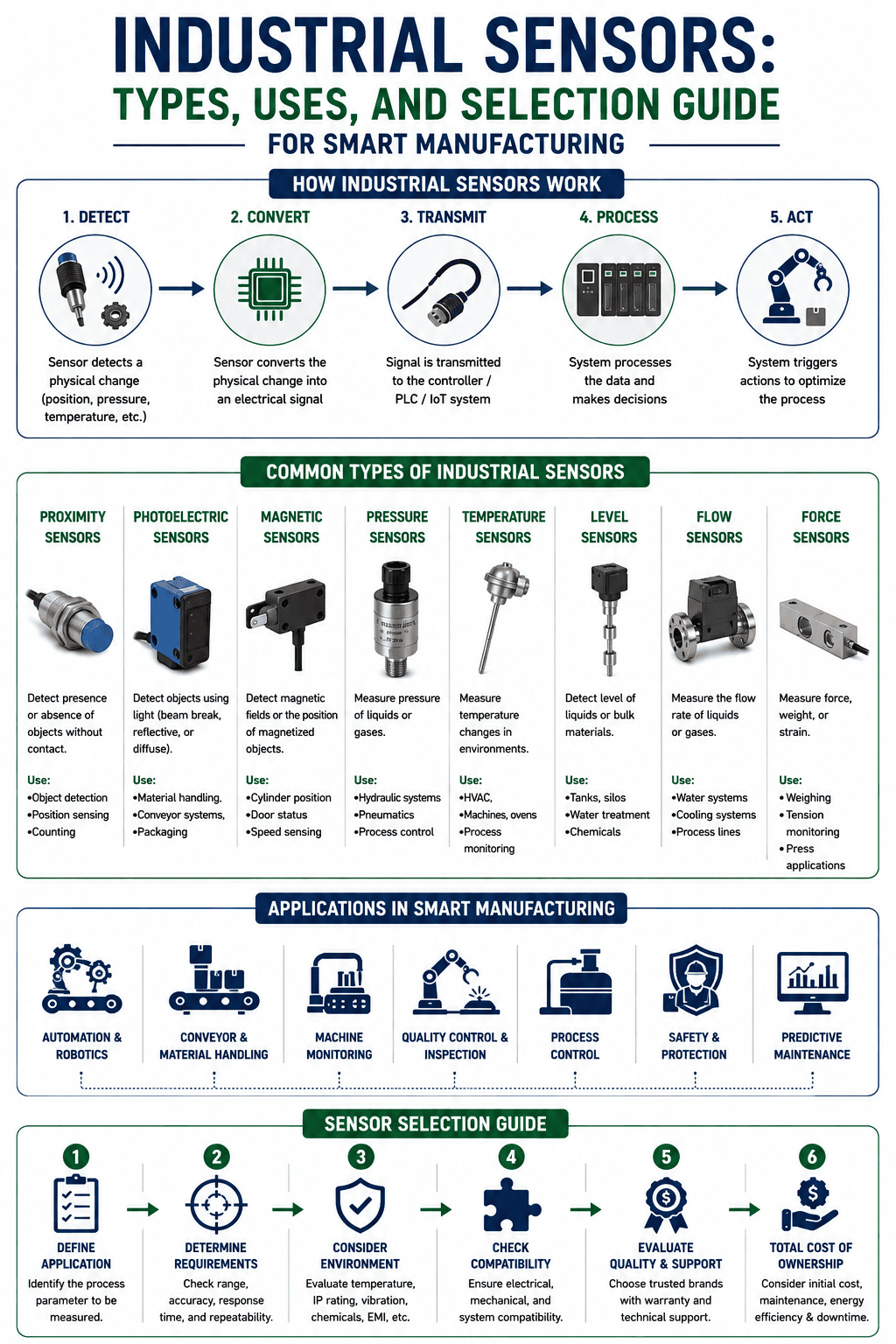
Industrial sensors are sophisticated devices designed to detect and measure physical quantities, such as temperature, pressure, proximity, light, motion, chemical composition, or level, and convert them into electrical signals. This transformation allows machines, control systems, and human operators to interpret and act upon changes in the operational environment. At their core, sensors work by interacting with a physical phenomenon and producing a measurable output, often an analog voltage or current, or a digital signal. This output is then transmitted to a Programmable Logic Controller (PLC), Human-Machine Interface (HMI), or other control systems for processing. They are indispensable because they enable automation by providing the 'eyes and ears' of a system, crucial for monitoring, controlling, and safeguarding processes. Industrial sensors are commonly integrated into factory automation lines, CNC machinery, robotics, semiconductor equipment, SMT assembly lines, and various electronics manufacturing processes, where precise control and data acquisition are paramount.
Key Factors to Consider for Sensor Selection
1. Sensing Principle and Technology
Understanding the fundamental operating principle (e.g., inductive for metal detection, capacitive for various materials, photoelectric for range, ultrasonic for distance) is crucial. Selecting the right technology ensures accurate and reliable detection for specific target materials, distances, and environmental conditions.
2. Accuracy, Repeatability, and Resolution
These parameters define a sensor's precision. Accuracy refers to how close a measurement is to the true value, repeatability ensures consistent readings under identical conditions, and resolution is the smallest change the sensor can detect. High-precision applications like semiconductor manufacturing or robotics require sensors with superior specifications in these areas.
3. Environmental Resilience
Industrial environments can be harsh, involving extreme temperatures, humidity, dust, vibrations, or chemical exposure. Sensors must possess appropriate IP ratings (Ingress Protection), robust housing materials, and operational temperature ranges to ensure long-term reliability and performance in challenging conditions.
4. Connectivity and Integration
Modern industrial sensors offer various communication protocols, including analog (4-20mA, 0-10V), digital (PNP, NPN), IO-Link, Ethernet/IP, Profinet, and Modbus. Seamless integration with existing PLCs, SCADA systems, and IoT platforms is vital for data acquisition, remote monitoring, and enabling Industry 4.0 capabilities.
5. Cost-Effectiveness and Lifecycle
Beyond the initial purchase price, consider the total cost of ownership, including installation, calibration, maintenance, and potential replacement frequency. A sensor offering high reliability and a long service life, even with a higher upfront cost, can prove more cost-effective over its operational lifecycle by minimizing downtime and maximizing productivity.
Benefits of Integrating Industrial Sensors
Enhanced Process Control and Automation
Industrial sensors provide real-time data, enabling precise control over manufacturing processes. This leads to automated adjustments, reduced human error, and consistent output quality, especially vital in SMT and CNC operations where micron-level precision is often required.
Optimized Efficiency and Productivity
By monitoring machine status, material flow, and environmental conditions, sensors help identify bottlenecks and inefficiencies. This data empowers operators and systems to optimize production schedules, minimize waste, and increase overall throughput in electronics manufacturing and assembly lines.
Predictive Maintenance Capabilities
Sensors can continuously monitor the health and performance of machinery, detecting subtle changes in vibration, temperature, or current draw. This allows for predictive maintenance, preventing costly breakdowns, extending equipment lifespan, and reducing unscheduled downtime.
Improved Safety and Compliance
In hazardous industrial environments, sensors play a crucial role in detecting unsafe conditions, such as gas leaks, excessive temperatures, or unauthorized access. They trigger alarms or emergency shutdowns, protecting personnel, equipment, and ensuring compliance with safety regulations.
Industrial Applications
Robotics and Cobots for automated assembly and material handling.
SMT (Surface Mount Technology) lines for precise component placement and quality inspection.
Semiconductor equipment for wafer processing, inspection, and contamination control.
CNC Machinery for tool breakage detection, positional accuracy, and temperature monitoring.
Electronics Manufacturing for quality control, inventory management, and process monitoring.
Buying Guide
When sourcing industrial sensors, buyers must meticulously evaluate several critical factors. Prioritize the machine condition, ensuring it meets industrial standards for robustness and reliability. Scrutinize technical specifications to guarantee compatibility with your existing systems and specific application requirements. Always confirm warranty terms for protection against defects, and opt for suppliers with a strong reputation for quality and customer service. Verify the availability of spare parts for long-term support and confirm seamless compatibility with your current automation infrastructure and communication protocols.
Maintenance Tips
Effective maintenance of industrial sensors is key to their longevity and accuracy. Implement a rigorous preventive maintenance schedule that includes regular cleaning to remove dust and contaminants that can impair performance. Ensure proper lubrication of moving parts, where applicable, and conduct routine visual inspections for wear, damage, or loose connections. Periodic calibration is essential to maintain measurement accuracy, especially for precision applications. Finally, invest in comprehensive operator training to ensure correct handling, troubleshooting, and daily monitoring practices.
Industry Trends
The industrial sensor landscape is rapidly evolving, driven by Industry 4.0 initiatives. Integration with Artificial Intelligence (AI) and the Internet of Things (IoT) is leading to smarter sensors capable of self-diagnosis and edge computing. This shift towards smart manufacturing enables predictive maintenance, where sensors feed data to AI algorithms to forecast potential failures. The proliferation of digital twins, virtual replicas of physical assets, relies heavily on sensor data for accurate real-time modeling. Automation continues to expand, demanding more precise and versatile sensors, while sustainability drives the development of energy-efficient and wirelessly networked sensor solutions for optimized resource management.
Frequently Asked Questions
What is the primary role of industrial sensors in factory automation?
The primary role of industrial sensors in factory automation is to act as the "eyes and ears" of a system, providing real-time data on physical parameters such as presence, position, temperature, or pressure. This data is crucial for PLCs and control systems to monitor processes, make automated decisions, ensure safety, maintain quality, and optimize operational efficiency across manufacturing lines.
How do different types of industrial sensors contribute to product quality in electronics manufacturing?
In electronics manufacturing, various sensors contribute significantly to product quality. Vision sensors inspect PCB assembly for component placement and solder joint integrity, proximity sensors ensure correct part feeding, and temperature sensors monitor reflow oven profiles. These sensors collectively ensure precise manufacturing, detect defects early, and maintain consistent product standards, minimizing rework and waste.
Why is IO-Link connectivity becoming so important for modern industrial sensors?
IO-Link connectivity is gaining importance because it offers a standardized, point-to-point communication technology for connecting sensors and actuators to control systems. It enables bidirectional communication, allowing for remote configuration, parameter setting, diagnostics, and monitoring of sensor health. This simplifies installation, reduces wiring complexity, provides richer data for predictive maintenance, and facilitates faster commissioning and troubleshooting in smart factories.