In the dynamic landscape of modern manufacturing and industrial automation, the fundamental choice between a Programmable Logic Controller (PLC) and an Industrial PC (IPC) stands as a critical decision. This choice directly impacts system efficiency, precision, scalability, and the overall success of automation projects, making it a cornerstone discussion for engineers and decision-makers across various industrial sectors.
Overview
Both PLCs and Industrial PCs serve as the brains behind automated operations, yet they are designed with distinct philosophies and capabilities. A **Programmable Logic Controller (PLC)** is a rugged, specialized industrial computer primarily used for automating electromechanical processes, often found in discrete manufacturing, process control, and factory automation. It works by monitoring input devices, executing a user-programmed logic (typically in ladder logic, structured text, or function block diagrams), and controlling output devices to automate a process or machine. PLCs are crucial for their deterministic real-time operation, exceptional reliability, and robust construction, making them ideal for repetitive, time-sensitive tasks in harsh industrial environments.
An **Industrial PC (IPC)**, on the other hand, is a computer system engineered to operate reliably in harsh industrial settings, offering enhanced durability compared to commercial PCs. IPCs leverage standard PC architectures but are built with reinforced components, fanless designs, and specialized cooling, often running operating systems like Windows or Linux. They function by executing complex software applications for control, data acquisition, human-machine interface (HMI), and vision systems. IPCs are vital for applications requiring high processing power, advanced data handling, intricate algorithms, and extensive connectivity to enterprise systems. They are commonly used in semiconductor equipment, SMT lines, robotics, CNC machinery, and advanced electronics manufacturing where flexibility and computational intensity are paramount.
Key Factors to Consider
1. Environmental Robustness
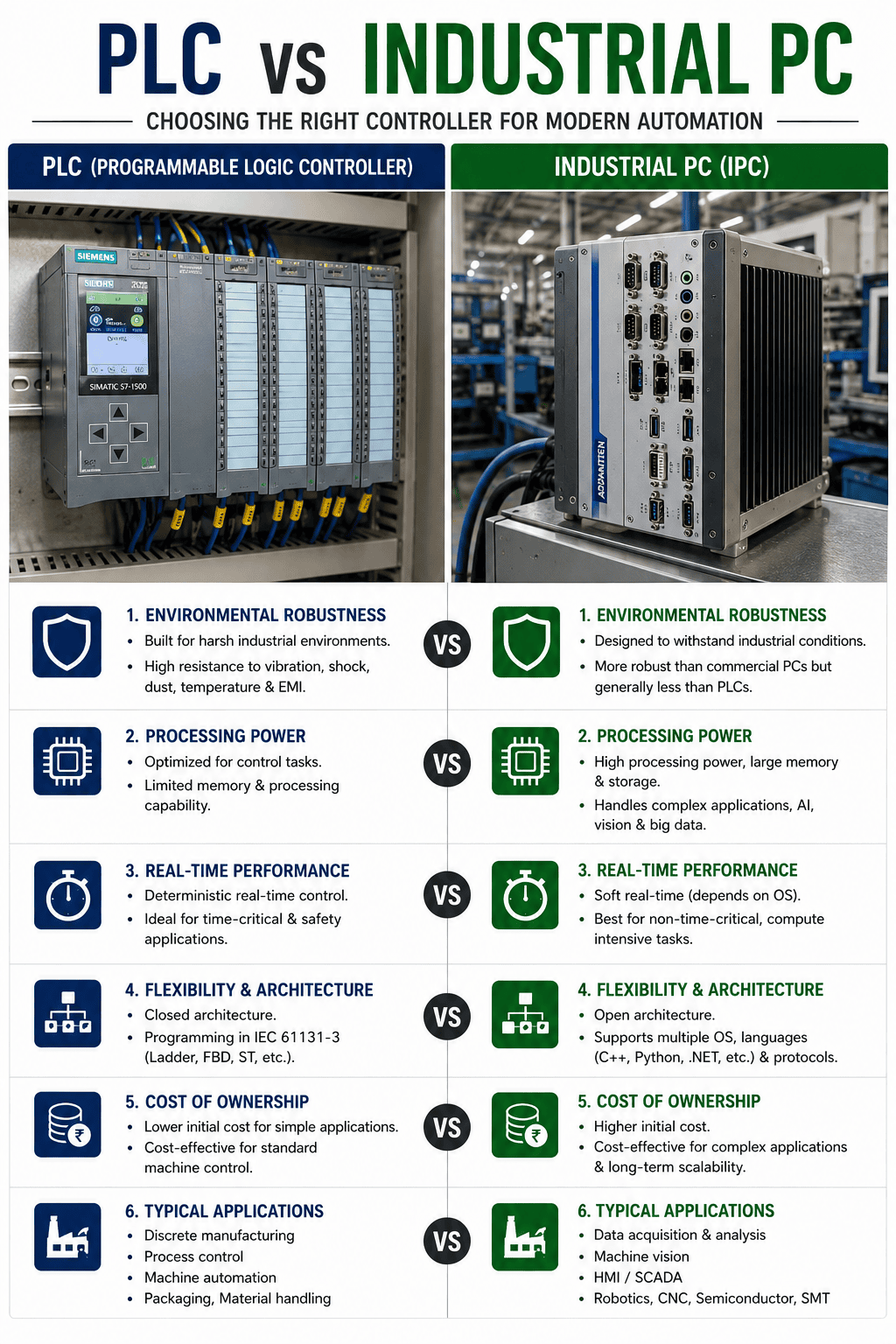
PLCs are purpose-built for extreme industrial conditions, offering superior resistance to vibration, shock, dust, temperature fluctuations, and electromagnetic interference. While Industrial PCs are designed to be more robust than commercial PCs, PLCs generally hold an advantage in the harshest environments due to their streamlined design and lack of moving parts like fans or hard drives in many models.
2. Processing Power and Data Handling
Industrial PCs typically offer significantly higher processing power, memory, and storage capacity, enabling them to handle complex algorithms, large datasets, advanced vision systems, and intricate computations. PLCs, while highly efficient for their core control tasks, have more limited computational resources, making IPCs better suited for big data analytics, AI integration, and demanding HMI applications.
3. Real-Time Performance and Determinism
PLCs excel in deterministic real-time control, meaning their execution times are highly predictable and consistent, critical for safety-related functions and high-speed motion control. They operate on dedicated operating systems designed for control. While IPCs can achieve soft real-time performance with specialized operating systems or hypervisors, standard IPCs running general-purpose OS may struggle to match the hard real-time guarantees of a PLC.
4. Flexibility and Open Architecture
Industrial PCs offer greater flexibility and an open architecture, allowing integration with a vast array of software applications, programming languages (e.g., C++, Python), and communication protocols. This facilitates easier integration with MES/ERP systems, cloud platforms, and third-party software. PLCs are generally more proprietary, with programming typically confined to IEC 61131-3 languages and specific vendor ecosystems, though modern PLCs are increasingly open.
5. Cost of Ownership and Programming
The initial hardware cost of a PLC can sometimes be lower for simpler applications, and their programming environments are often less complex for basic control, potentially reducing engineering time for straightforward tasks. However, for applications requiring extensive data processing, advanced HMI, or integration with IT infrastructure, the total cost of ownership for an IPC solution might be more favorable due to its versatility and standard component availability.
Benefits
Enhanced System Reliability
Choosing the appropriate controller, whether a robust PLC for critical real-time control or an IPC for complex data processing, significantly enhances the overall reliability and uptime of industrial systems. This minimizes unexpected downtime and ensures continuous operation in demanding manufacturing environments.Optimized Performance
Leveraging the strengths of each platform—PLCs for deterministic, high-speed discrete control and IPCs for sophisticated data management, vision, and advanced algorithms—leads to highly optimized machine and process performance, boosting productivity and product quality.
Scalability and Future-Proofing
Strategic selection allows for better scalability. IPCs offer inherent flexibility for future upgrades in software and processing power, while modern PLCs are also evolving with modular designs and enhanced connectivity, ensuring that automation investments remain viable as technological demands grow and integrate with Industry 4.0 initiatives.
Improved Data Integration
Industrial PCs excel at bridging the gap between operational technology (OT) and information technology (IT) layers, enabling seamless data flow from the shop floor to enterprise-level systems for analytics, reporting, and predictive maintenance. This capability is vital for smart manufacturing and data-driven decision-making.
Industrial Applications
Discrete Manufacturing (e.g., Automotive Assembly, Packaging Lines)
Process Control (e.g., Chemical Plants, Food & Beverage Processing)
Semiconductor Fabrication (Precise motion, vision, and data management)
Robotics and CNC Machining (Complex kinematics, tool path generation, safety control)
Electronics Assembly (SMT lines, PCB testing, quality inspection systems)
Buying Guide
Before investing in a PLC or Industrial PC, buyers must meticulously evaluate several factors. Prioritize machine condition, examining specifications to ensure they meet current and future operational demands. A comprehensive warranty is crucial for safeguarding your investment, while selecting a reputable supplier guarantees access to genuine products and reliable support. Ensure the availability of spare parts and assess compatibility with existing infrastructure to facilitate seamless integration and long-term serviceability.
Maintenance Tips
Effective maintenance is paramount for extending the lifespan and ensuring the continuous performance of both PLCs and Industrial PCs. Implement a robust preventive maintenance schedule that includes regular cleaning to prevent dust buildup, especially in fanless IPCs, and periodic inspection of connections and wiring for wear or damage. For IPCs, ensure software and firmware are updated, and data backups are performed consistently. Calibration of connected sensors and actuators is vital for accuracy, complemented by ongoing operator training to ensure proper system interaction and minor troubleshooting capabilities.
Industry Trends
The convergence of PLCs and Industrial PCs is accelerating within Industry 4.0, driven by advancements in AI, IoT, and smart manufacturing. We are witnessing a trend towards hybrid control systems, where PLCs handle critical real-time tasks while IPCs manage complex data analytics, HMI, and connectivity to cloud platforms. Predictive maintenance strategies, powered by IoT sensors and AI algorithms, are becoming standard, relying on data collected and processed by these controllers. The emphasis on automation, digital twins, and sustainability is pushing manufacturers to adopt more integrated and intelligent control solutions for enhanced efficiency and reduced environmental impact.
Frequently Asked Questions
Can PLCs and Industrial PCs be used together in a single automation system?
Absolutely. Many modern industrial automation systems adopt a hybrid approach, leveraging the strengths of both. PLCs often handle the core, deterministic machine control and safety functions, while Industrial PCs manage higher-level tasks such as advanced HMI, SCADA, data logging, vision systems, complex motion control, and integration with MES/ERP systems, communicating seamlessly via industrial Ethernet protocols.
Which option is more suitable for applications requiring extensive data logging and analytics?
Industrial PCs are generally better suited for extensive data logging, processing, and analytics due to their superior computational power, larger storage capacities, and compatibility with standard database and analytical software. They can efficiently collect vast amounts of data from various sources, process it using complex algorithms, and integrate directly with cloud-based analytics platforms for advanced insights into manufacturing processes.
Is one technology destined to completely replace the other in the future?
It is highly unlikely that one will entirely replace the other. Instead, their roles are evolving and converging. While Industrial PCs gain real-time capabilities and PLCs become more open and powerful, their fundamental design philosophies and optimal use cases remain distinct. They are increasingly viewed as complementary technologies, forming powerful, integrated solutions for the complex demands of smart manufacturing and Industry 4.0.