
A robot is not one machine. It is a bag of a dozen expensive parts wearing one nameplate — and the reducer alone can be worth more than the rest of the arm combined.
Ask a first-time buyer what a used industrial robot is worth and they will look at the whole arm. Ask a rebuilder and they will mentally break it into a reducer, six servo motors, six encoders, a wire harness, and a controller — and price each one separately, because that is how the resale and repair market actually works.
If you are buying used, selling a teardown unit, or budgeting a repair, understanding component-level pricing is the difference between a fair deal and an expensive surprise.
Overview
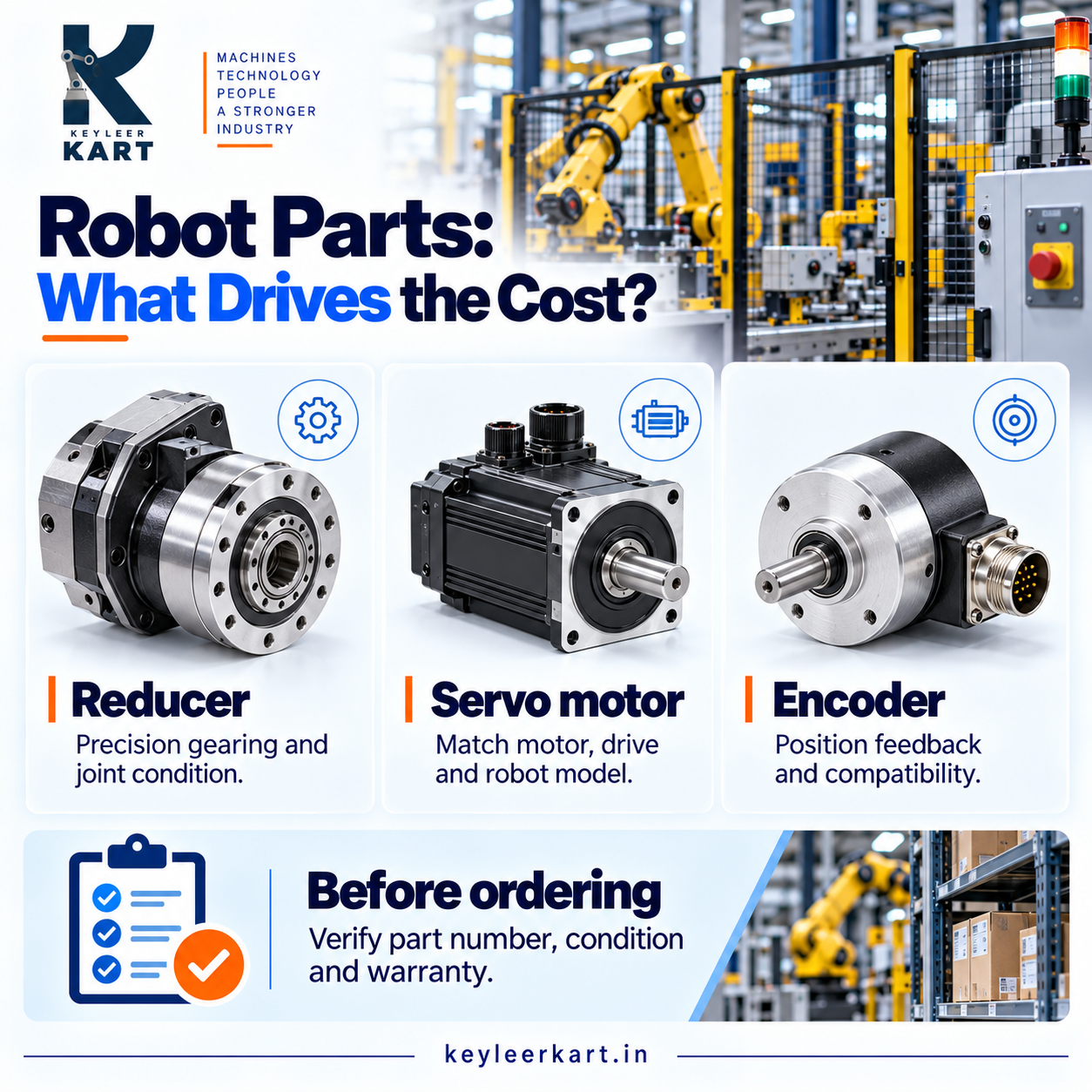
The three components that dominate a robot's internal value are the precision reducer (RV or harmonic drive) at each joint, the servo motor driving that joint, and the encoder that tells the controller exactly where the joint is. All three are precision parts made to tight tolerances, all three wear over the robot's life, and all three are commonly the reason a 'cheap' used robot turns into an expensive rebuild.
What Drives the Price of Each Component
RV and Harmonic Drive Reducers
Reducers (commonly Nabtesco RV-series for larger joints, or harmonic-drive units for smaller wrist axes) are the single most expensive mechanical component in a robot arm. They are made to very tight backlash tolerances and cannot be improvised with a generic gearbox. A reconditioned reducer for a mid-size industrial arm typically runs into five figures in Indian rupees per unit when sourced through the aftermarket, and a brand-new OEM reducer costs meaningfully more. Backlash, play, and unusual noise at a joint are the classic symptoms that a reducer needs attention — and this is exactly the kind of finding a pre-purchase inspection should surface before you agree on price.
Servo Motors
Servo motor pricing depends heavily on whether it is brand-specific (matched to a particular controller's drive electronics) or a more generic AC servo. Brand-matched motors for FANUC, ABB, KUKA, and Yaskawa arms are not simple swaps — the motor, encoder, and drive amplifier are usually paired, so a failed motor on an older arm can mean sourcing a compatible used unit rather than buying new. Budget accordingly and always ask a seller whether spare motors for that exact model are still available before you commit.
Encoders (Absolute and Incremental)
The encoder tells the controller where the joint physically is. Absolute encoders (which retain position through a power cycle, backed by a battery) are more expensive than incremental ones and are the more common style on modern arms. A failed encoder battery that is caught late can force a full re-mastering of the axis — a labour cost on top of the part cost. This is why 'mastering data present' is one of the six questions a good listing should answer up front.
Benefits
Buying Smarter
Once you know component pricing, a 'too good to be true' robot price makes more sense — the seller may be pricing it as a parts machine, not a working one. Ask directly.
Negotiating From Data
A buyer who can say 'this joint's play suggests reducer wear, and that's a five-figure repair' negotiates from strength, not guesswork.
Budgeting Realistically
Component pricing lets you build an honest total cost of ownership instead of being surprised six months after installation.
Industrial Applications
Pre-purchase inspection: checking joint play and encoder battery status before agreeing a price.
Repair budgeting: deciding whether a faulty arm is worth fixing or better parted out.
Refurbishment planning: sequencing which components to replace first for the best condition-per-rupee.
Buying Guide
Always ask for servo-on hours and whether any axis has been re-geared or had a reducer replaced — a replaced reducer is often a positive sign, not a negative one, if documented.
Test every joint through its full range during inspection, listening for grinding or clicking, which points to reducer wear.
Confirm mastering data is present and current; missing mastering data means a re-mastering procedure will be needed, which costs time and money.
Ask whether the seller has spare motors or reducers included — bundled spares can materially change the value proposition.
Maintenance Tips
Replace encoder backup batteries on a fixed schedule rather than waiting for a failure and losing mastering data.
Monitor reducer grease intervals per the OEM manual — under-greased reducers wear faster and fail sooner.
Log any unusual noise or vibration at a joint immediately; early reducer wear is far cheaper to address than a seized joint.
Industry Trends
As more 2005-2015 vintage robots come off Indian production lines for automation upgrades, the used component market (not just whole-robot resale) is growing — reducers and servo motors pulled from decommissioned arms are increasingly sourced by MSMEs for repair rather than buying new parts from the OEM.
Frequently Asked Questions
Q: Which wears out first on a robot, the reducer or the servo motor? A: It varies by application and axis, but base and shoulder-axis reducers on heavy-duty or high-cycle applications (like spot welding or palletizing) tend to show wear before servo motors, which are generally more durable if kept within duty cycle.
Q: Can I fit a generic servo motor instead of the OEM-matched one? A: Generally no, without significant re-engineering — the drive amplifier, encoder feedback protocol, and motor are usually matched as a set by the controller manufacturer.
Q: Is a robot with a known reducer issue worth buying cheap? A: Sometimes, if the price reflects the repair cost and you have a rebuild plan — but always get the repair quoted first, not after purchase.
Conclusion
A robot's price tag is really a bundle of component prices wearing one badge. Buyers who understand reducers, servo motors, and encoders negotiate better, budget better, and avoid the classic mistake of buying a 'bargain' arm that turns into a five-figure repair bill.
KeyLeer Kart inspects joint condition, mastering data, and component history on every listing, so you know exactly what you are buying before you pay for it.
#UsedRobots #IndustrialRobots #RoboticsMaintenance #KeyLeerKart #MakeInIndia #FactoryAutomation #RoboticsIndia



