
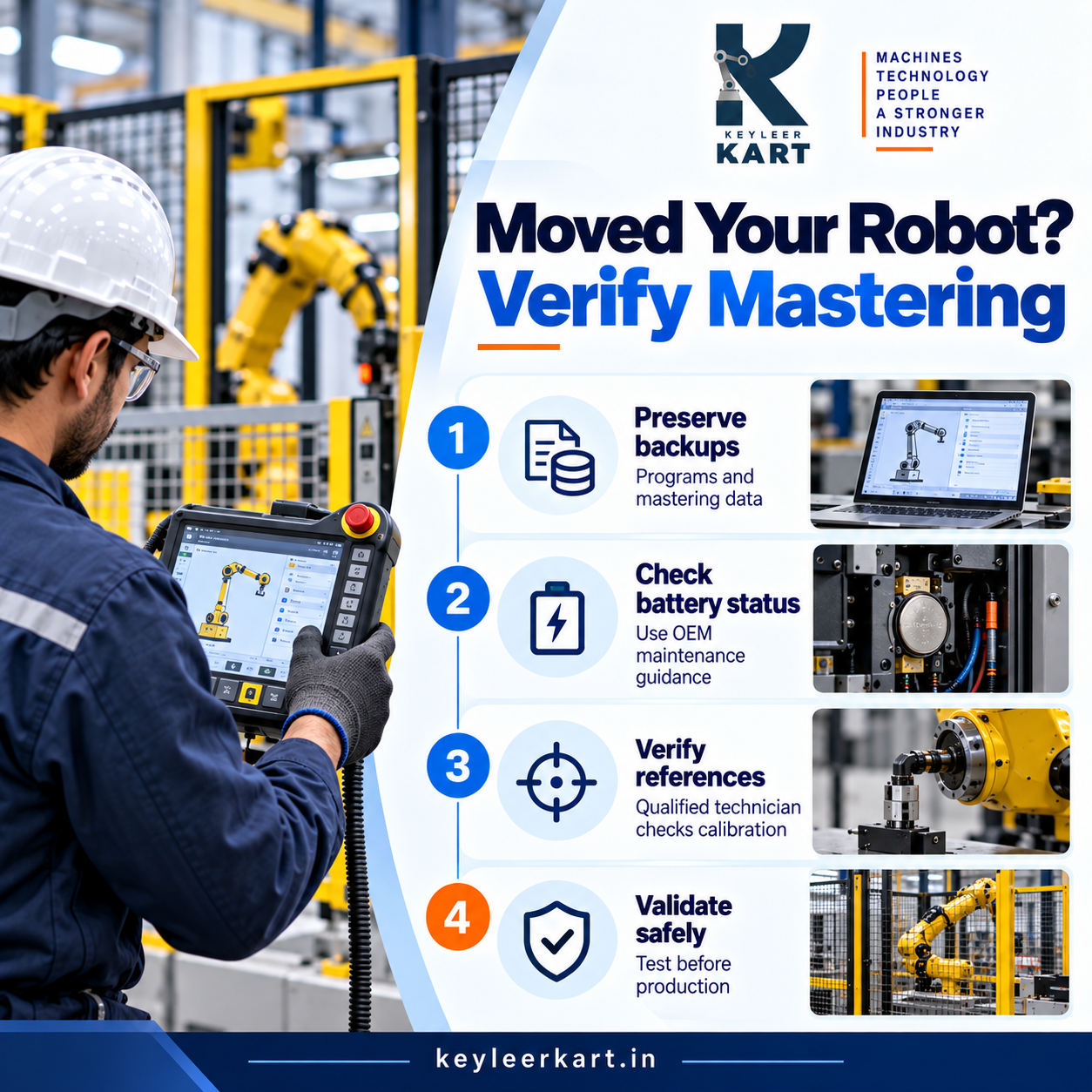
You moved the robot. You bolted it down. You powered it on. It's still pointing at the wrong spot on the floor — because nobody re-mastered it.
Mastering is the process that tells a robot's controller exactly where each joint is in absolute terms — the reference point every subsequent motion is calculated from. It is set at the factory, and it is the single most commonly skipped step when a used robot changes hands or changes location.
Skip it, and a robot that looks perfectly healthy on power-up can be subtly, dangerously wrong the moment it starts moving toward a programmed point.
Overview
Mastering data links the encoder's reading at each joint to the robot's true physical zero position. If that data is lost, corrupted, or was never transferred properly, the controller's internal model of 'where the arm is' no longer matches reality — even though the robot may power up, jog, and appear to move normally.
Why Mastering Gets Lost
Encoder Battery Failure
Absolute encoders retain position through a battery. If that battery dies while the robot is powered off — which is common during storage, transport, or a long changeover — the positional memory is lost and the robot needs to be re-mastered from a known reference.
Physical Disturbance During Transport
Even with battery backup intact, a hard jolt during rigging or transport can shift a joint slightly relative to its resolver reading, especially at gearbox-to-motor couplings. This is one reason a used robot should always be treated as needing a mastering check after any relocation, not assumed fine.
Incomplete Documentation Handover
Some sellers do not provide the original mastering data file, and some buyers do not ask for it. Without it, the buyer's integrator has to perform a full mastering procedure from scratch using calibration fixtures or a known jig — extra time and cost that should be planned for, not discovered.
Benefits
Positional Accuracy
Correct mastering is what makes a taught point actually land where it was taught — critical for anything involving tight tolerances, like machine tending or precision assembly.
Safety
A robot with incorrect mastering can move unpredictably relative to its programmed path, creating a genuine collision risk with fixtures, operators, or safety fencing.
Avoiding Repeat Work
Getting mastering right the first time after relocation avoids the far more expensive scenario of discovering the error mid-production, after tooling has already been damaged.
Industrial Applications
Any used robot purchase involving relocation from the seller's facility to yours.
Robots that have sat in storage for an extended period before re-commissioning.
Post-repair re-commissioning after a motor, encoder, or gearbox replacement on any axis.
Buying Guide
Ask the seller directly whether mastering data will be provided and in what form (a data file, a physical mastering fixture, or neither).
If mastering data is not available, budget for a full re-mastering procedure by a qualified technician as part of your total cost, not as an afterthought.
Never assume a robot that jogs smoothly on power-up is correctly mastered — request a verification check against known reference points before production use.
Ask whether the robot has an OEM-specific mastering method (zero-position mastering, calibration mastering using a jig, or quick mastering) so your integrator arrives prepared with the right procedure.
Maintenance Tips
Replace encoder backup batteries proactively on a calendar schedule — do not wait for a low-battery alarm, which can appear after data is already at risk.
Record and store mastering data offline (not only inside the controller) so it survives even if the controller's battery fails.
Re-verify mastering after any maintenance event that involves disconnecting a motor or encoder cable, even briefly.
Industry Trends
As more used robots move between facilities and across state lines within India — and as import volumes from overseas rise — mastering verification is becoming a standard line item in professional re-commissioning checklists rather than an optional extra, reflecting the market's growing sophistication.
Frequently Asked Questions
Q: How do I know if my robot needs to be re-mastered? A: Signs include position errors after transport, encoder battery alarms, or simply the absence of documented mastering data from the seller — when in doubt, verify against a known reference point before relying on it in production.
Q: Can mastering be done without special tools? A: Some methods (like using known mechanical stops) require minimal tooling, but precision applications typically need a proper mastering fixture or jig appropriate to the robot model — a qualified technician should make this call.
Q: Does KeyLeer Kart provide mastering data with used robots? A: We disclose mastering data status honestly on every listing — present, absent, or unconfirmed — so you can budget for re-commissioning correctly from day one.
Conclusion
Mastering is invisible until it's wrong — and by then it's usually already cost someone a scrapped part, a damaged fixture, or a safety scare. Treat it as a mandatory checklist item on every used robot relocation, not an optional nice-to-have.
KeyLeer Kart flags mastering data status clearly on every listing, so there are no surprises after the trucks arrive.
#RobotMastering #IndustrialRobots #UsedRobots #KeyLeerKart #FactoryAutomation #RoboticsIndia #MakeInIndia



