Servo Motors Explained: Working, Types & Industrial Applications
In the rapidly evolving landscape of modern manufacturing and industrial automation, precision, speed, and reliability are paramount. Servo motors stand as a cornerstone technology, enabling the sophisticated control and accurate motion required across a multitude of applications, from intricate PCB assembly to heavy-duty CNC machining, driving the efficiency and innovation that define contemporary factory floors.
Overview
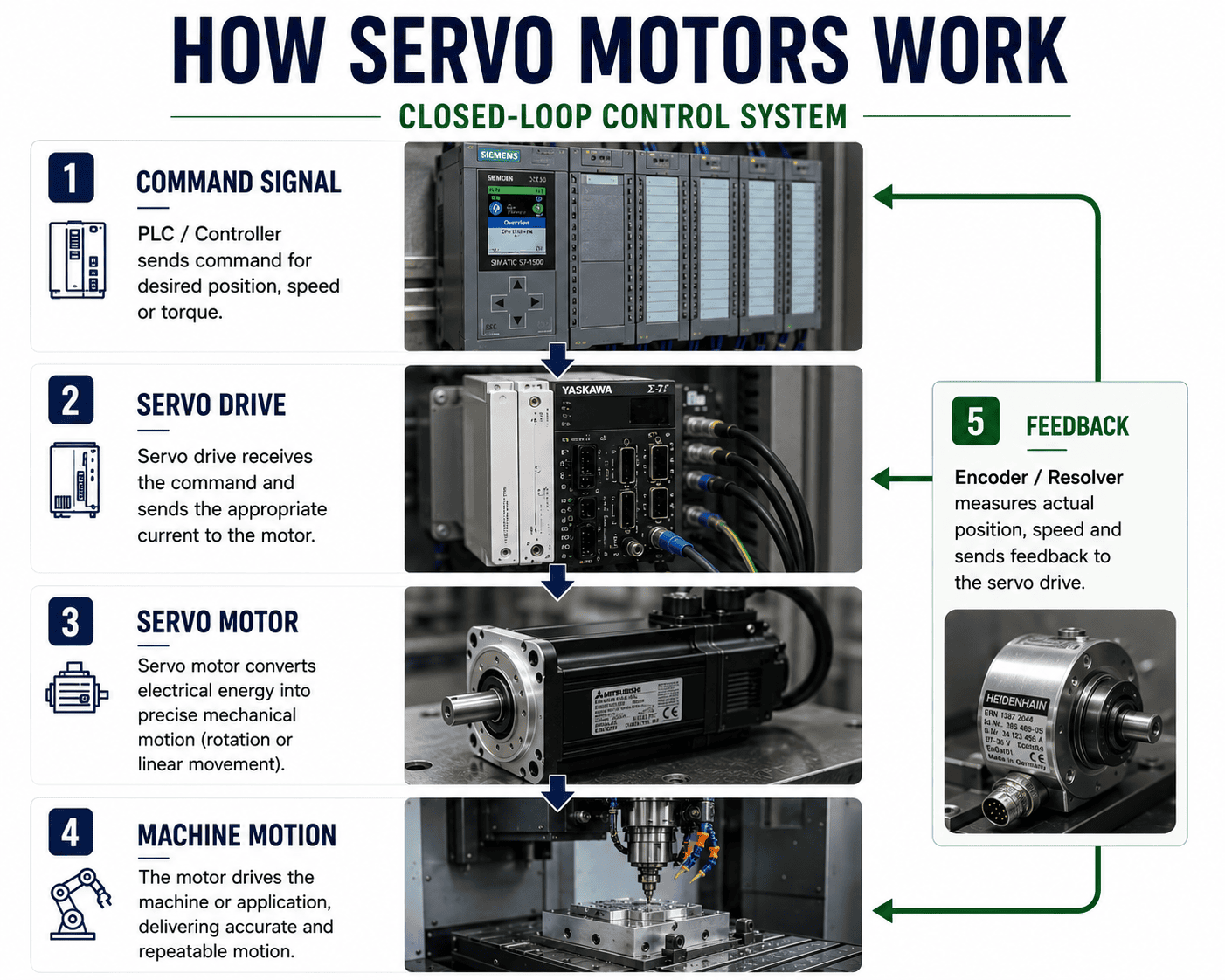
A servo motor is an electromechanical device that provides precise control over angular or linear position, velocity, and acceleration. Unlike standard motors, it operates as part of a closed-loop system, which typically includes the motor itself, a sensor (encoder or resolver) for feedback, and a servo drive/controller. The controller receives a command signal for the desired position or speed and drives the motor. The sensor continuously monitors the motor's actual output and sends this feedback to the controller. The controller then compares the actual output with the desired command and adjusts the power to the motor to correct any deviation, ensuring extremely accurate and repeatable motion. This closed-loop mechanism is critical for applications demanding high levels of accuracy, rapid acceleration and deceleration, and the ability to maintain specific positions under varying loads. Servo motors are indispensable in high-tech manufacturing environments where precision and dynamic performance directly impact product quality and operational efficiency.
Key Features
1. Closed-Loop Control System
Servo motors utilize a feedback device, typically an encoder or resolver, to continuously monitor the motor's actual position and speed. This feedback is compared against the desired setpoint by the servo drive, allowing for real-time error correction and ensuring extremely accurate and repeatable motion performance, even under changing load conditions.
2. High Torque-to-Inertia Ratio
Designed for dynamic performance, servo motors often possess a high torque-to-inertia ratio. This characteristic enables them to achieve very fast acceleration and deceleration rates, making them ideal for applications requiring quick start-stop cycles and rapid changes in motion, such as pick-and-place robots or indexing tables.
3. Precise Position, Velocity, and Torque Control
Unlike stepper motors that move in discrete steps, servo motors offer continuous and highly precise control over their output shaft's position, speed (velocity), and the force they apply (torque). This flexibility allows for complex motion profiles and fine-tuned adjustments crucial for delicate operations in electronics manufacturing or robotics.
4. Wide Speed Range
Servo motors are capable of operating efficiently across a broad spectrum of speeds, from very slow, precise movements to high-speed rotations. This versatility allows them to be deployed in diverse applications where varying operational speeds are required without sacrificing performance or control accuracy.
5. Energy Efficiency
Due to their closed-loop nature, servo motors only draw the necessary current to maintain their commanded position or speed. This demand-based power consumption, particularly in brushless AC servo designs, translates into higher energy efficiency compared to open-loop systems, reducing operational costs and supporting sustainable manufacturing practices.
Benefits
High Precision and Accuracy
Servo motors deliver unparalleled precision in motion control, crucial for intricate tasks in SMT assembly, semiconductor manufacturing, and CNC machining where positional accuracy determines product quality and yield rates.
Dynamic Performance
With their ability to accelerate and decelerate rapidly, servo motors offer exceptional dynamic response, making them ideal for applications requiring quick movements, short cycle times, and agile robotic operations.
Energy Efficiency
By only consuming the power required to meet the demanded load and position, servo motors contribute to significant energy savings, especially in applications with varying load conditions, aligning with modern green manufacturing initiatives.
Enhanced Repeatability and Reliability
The closed-loop feedback system ensures that servo motors perform consistently over long periods, delivering high repeatability that is vital for automated processes and reducing the risk of errors and downtime in continuous production.
Industrial Applications
Robotics and Automation
CNC Machinery (Milling, Lathes, Grinders)
SMT Pick & Place Machines
Semiconductor Wafer Handling and Inspection
Packaging and Labeling Machinery
Buying Guide
Before investing in servo motors, buyers should meticulously evaluate several critical factors. Assess the required specifications, including torque, speed, and accuracy, to ensure it meets application demands. Scrutinize the machine's condition, especially if purchasing used equipment, and prioritize suppliers offering robust warranties and readily available spare parts. Critically, verify the servo motor's compatibility with existing control systems and machinery, and always choose a supplier with a strong reputation for quality and reliable after-sales support like KeyLeer Kart.
Maintenance Tips
Effective maintenance of servo motors is crucial for longevity and peak performance. Implement a rigorous preventive maintenance schedule that includes regular cleaning to prevent dust and debris buildup. Ensure proper lubrication of moving parts according to manufacturer guidelines. Conduct periodic inspections of cables, connectors, and feedback devices for wear or damage. Crucially, calibrate the motor and drive system regularly to maintain positional accuracy and provide comprehensive operator training to ensure correct usage and early detection of potential issues.
Industry Trends
The integration of servo motors with Industry 4.0 paradigms is driving significant advancements. IoT connectivity enables real-time monitoring and data analytics, facilitating predictive maintenance strategies and reducing downtime. AI and machine learning algorithms are enhancing servo control, optimizing performance and energy consumption. Digital twins are being employed to simulate and refine servo-driven processes, while the push towards smart manufacturing emphasizes greater automation, flexibility, and sustainability, positioning advanced servo technology as a cornerstone of future factory automation.
Frequently Asked Questions
What is the fundamental difference between a servo motor and a stepper motor?
The fundamental difference lies in their control mechanism. Servo motors operate on a closed-loop system, using a feedback device like an encoder to continuously monitor and correct position, velocity, and torque errors, ensuring high precision and dynamic performance. Stepper motors, conversely, operate in an open-loop system, moving in discrete steps without direct feedback, which can lead to missed steps under heavy loads or high speeds, making them less precise for demanding applications.
What are the main components of a typical servo motor system?
A typical servo motor system consists of four primary components: the servo motor itself (AC or DC), a feedback device (usually an encoder or resolver) mounted to the motor shaft, a servo drive (amplifier) that powers and controls the motor based on input signals, and a controller (PLC or dedicated motion controller) that generates the command signals for the desired motion profile.
What are the primary types of servo motors and their applications?
Servo motors are broadly categorized into AC and DC types. AC servo motors, particularly brushless AC servos, are dominant in industrial applications due to their high power density, reliability, and maintenance-free operation, commonly found in robotics, CNC machinery, and high-speed SMT equipment. DC servo motors, both brushed and brushless, are often used in lower power applications, portable devices, or where cost is a major factor, though brushless DC servos are increasingly competitive in higher power industrial uses.