
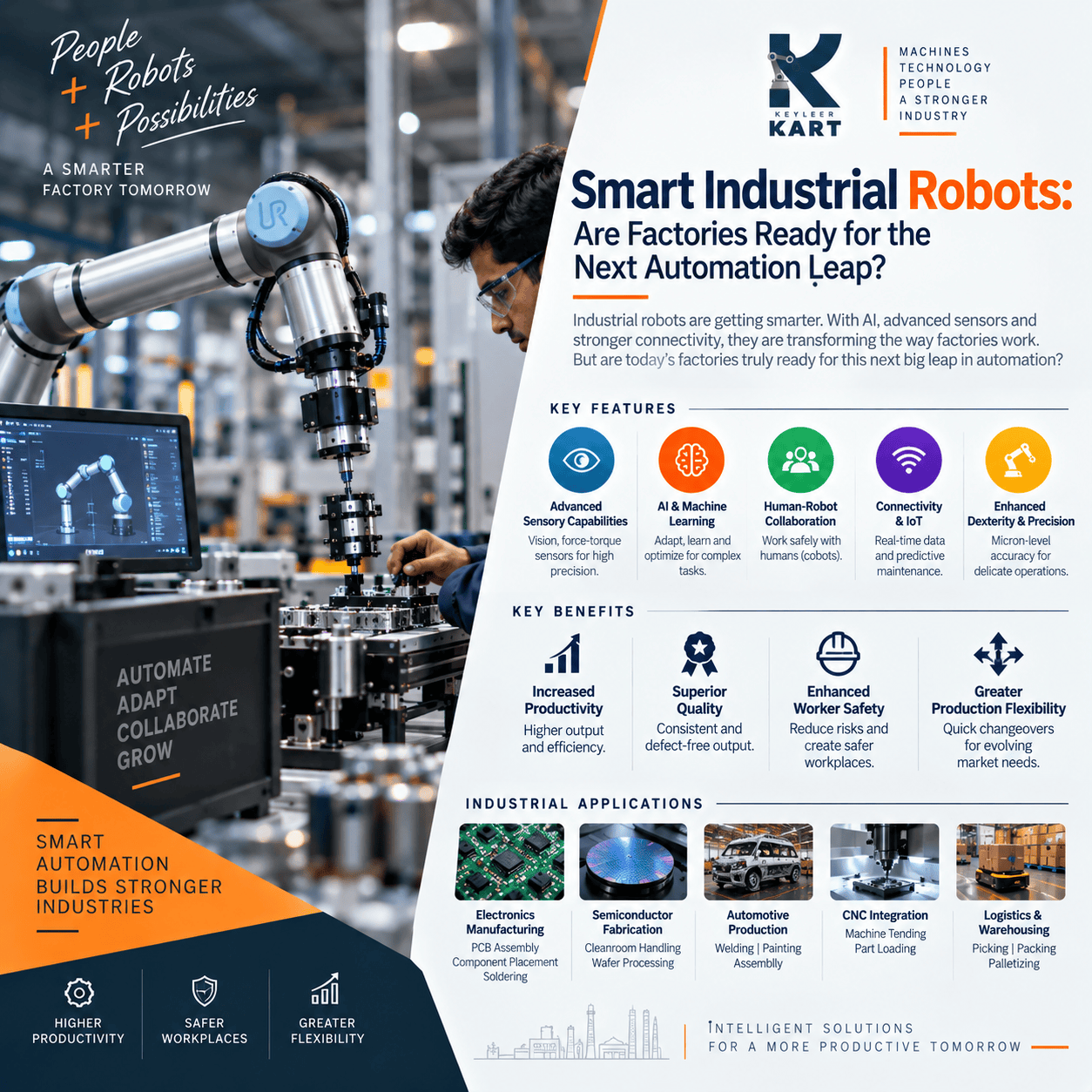
The manufacturing landscape is undergoing a profound transformation, driven by advancements in industrial automation. At the forefront of this evolution are industrial robots, rapidly gaining intelligence and adaptability. This article delves into how these smarter robots are reshaping production lines, from enhanced precision to collaborative capabilities, and critically examines whether current factory infrastructures and operational paradigms are truly prepared to harness their full potential.
Overview
Industrial robots are programmable manipulators engineered to perform diverse tasks in manufacturing. The latest generation, often termed "smart" or "intelligent" robots, integrate advanced sensors, AI, machine learning, and sophisticated control systems to perceive, reason, and act in complex, dynamic settings, moving beyond traditional pre-programmed repetitive tasks.
Smart industrial robots function by collecting real-time environmental data via vision systems, force-torque sensors, and other embedded technologies. Onboard AI algorithms process this data, enabling the robot to adapt to variations, learn new tasks, collaborate with humans, and self-optimize. They interpret complex instructions, make decisions, and execute precise movements with minimal human intervention, often communicating seamlessly with other machines and enterprise systems.
Their importance stems from their ability to boost productivity, enhance quality consistency, reduce operational costs, and improve worker safety. Their adaptability allows for greater flexibility in production, enabling rapid changeovers and handling diverse product lines, which is crucial for high-mix, low-volume manufacturing in sectors like electronics manufacturing and semiconductor production.
These intelligent systems are increasingly deployed across industries such as automotive for assembly and welding, electronics manufacturing for PCB assembly, semiconductor fabrication for cleanroom handling, and logistics for material handling. CNC machining and general factory automation are major beneficiaries.
Key Factors to Consider / Key Features
Advanced Sensory Capabilities
Modern smart robots are equipped with high-resolution vision systems, force-torque sensors, and haptic feedback. This enables precise object recognition, intricate assembly tasks, and dynamic obstacle avoidance, critical for delicate operations in electronics manufacturing and precise SMT processes.
AI and Machine Learning Integration
The core of smart robotics is their ability to learn and adapt. Integrated AI and machine learning algorithms allow robots to optimize movements, predict issues, and learn new tasks through demonstration, significantly reducing programming time and enhancing operational efficiency in complex production lines.
Human-Robot Collaboration (Cobots)
Cobots are designed to work safely alongside human operators without traditional safety caging. Equipped with advanced safety features and intuitive programming, they assist with strenuous or repetitive tasks, augmenting human capabilities and improving workstation ergonomics and productivity in assembly and quality control.
Connectivity and IoT Integration
Smart robots are integral components of the Industrial Internet of Things (IIoT), seamlessly connecting to other machines and enterprise systems. This connectivity facilitates real-time data exchange, remote monitoring, and predictive maintenance, central to the Industry 4.0 paradigm and overall factory optimization.
Enhanced Dexterity and Precision
With multi-axis articulation and advanced control, smart robots offer superior dexterity and repeatability. This is vital for micro-assembly in semiconductor equipment, intricate wiring in electronics, or precise pick-and-place operations in SMT lines, where micron-level accuracy ensures product quality and reliability.
Benefits
Increased Productivity and Throughput
Smart industrial robots operate continuously with high speed and consistency, significantly increasing production rates. Their ability to handle complex, repetitive tasks frees human workers for higher-value activities, optimizing resource allocation and boosting overall factory throughput.
Superior Quality and Consistency
By executing tasks with exceptional precision and repeatability, smart robots minimize human error and ensure uniform product quality across batches. This is particularly crucial in electronics manufacturing and semiconductor production where even minor defects can be extremely costly.
Enhanced Worker Safety
Deploying robots for hazardous, repetitive, or ergonomically challenging tasks significantly reduces the risk of workplace injuries. Cobots further enhance safety by intelligently sensing and adapting to human presence, creating a safer, collaborative environment on the factory floor.
Greater Production Flexibility
The adaptability and reprogrammability of smart robots allow manufacturers to quickly reconfigure production lines for new products or design changes. This agility is essential for responding efficiently to market demands and custom orders, supporting high-mix, low-volume production.
Industrial Applications
Electronics Manufacturing (PCB Assembly, Component Placement, Soldering)
Semiconductor Equipment Fabrication (Cleanroom Handling, Wafer Processing)
Automotive Production (Welding, Painting, Assembly, Material Handling)
CNC Machinery Integration (Machine Tending, Part Loading/Unloading)
Logistics and Warehousing (Picking, Packing, Palletizing, Sortation)
Buying Guide
Before investing in smart industrial robots, prospective buyers must conduct a thorough evaluation. Key considerations include assessing the robot's physical condition and performance specifications to ensure it meets operational demands. A comprehensive warranty and strong supplier reputation are crucial for long-term support. Availability of spare parts and service contracts are vital for minimizing downtime. Crucially, verify compatibility with existing factory infrastructure, software systems, and current manufacturing processes to ensure seamless integration and optimal return on investment.
Maintenance Tips
Maintaining smart industrial robots requires a proactive and structured approach to ensure longevity and consistent performance. Implementing a robust preventive maintenance schedule, including regular cleaning of sensors and mechanical parts, precise lubrication of joints, and detailed inspection of cables and connectors, is paramount. Routine calibration of vision systems and end-effectors guarantees accuracy. Furthermore, continuous operator and maintenance staff training on diagnostic tools and safety protocols is essential for maximizing uptime and operational efficiency.
Industry Trends
The evolution of smart industrial robots is intrinsically linked to broader Industry 4.0 trends. Integration with Artificial Intelligence (AI) and the Internet of Things (IoT) enables predictive maintenance and real-time process optimization. The rise of Smart Manufacturing paradigms leverages these intelligent systems to create highly autonomous and adaptive factories. Digital Twins are increasingly used for simulation and optimization before physical deployment. Moreover, there is a growing focus on sustainability, with robots designed for energy efficiency and resource optimization, contributing to greener manufacturing processes.
Frequently Asked Questions
What makes an industrial robot "smart" compared to a traditional one?
A "smart" industrial robot distinguishes itself through its advanced sensory perception, AI-driven decision-making, and ability to learn and adapt. Unlike traditional robots that follow pre-programmed paths, smart robots can perceive changes in their environment, adjust their actions in real-time, interact safely with humans, and optimize their performance autonomously, often leveraging machine learning for continuous improvement and greater flexibility.
What are the biggest challenges factories face when implementing smart robots?
Factories often encounter several challenges, including the need for significant capital investment, integrating new robotic systems with legacy equipment, and developing the necessary IT infrastructure for data processing and connectivity. Additionally, upskilling the workforce to manage, program, and maintain these advanced robots is crucial, as is establishing robust cybersecurity measures to protect connected systems from vulnerabilities.
How do smart robots contribute to sustainable manufacturing?
Smart robots contribute to sustainability by optimizing resource consumption through precise material handling and reduced waste. Their efficiency lowers energy usage in manufacturing processes, and by improving product quality, they decrease the need for rework and scrap. Their long operational lifespans and capacity for re-tasking also minimize the environmental impact associated with new equipment production and disposal, promoting a circular economy.



