
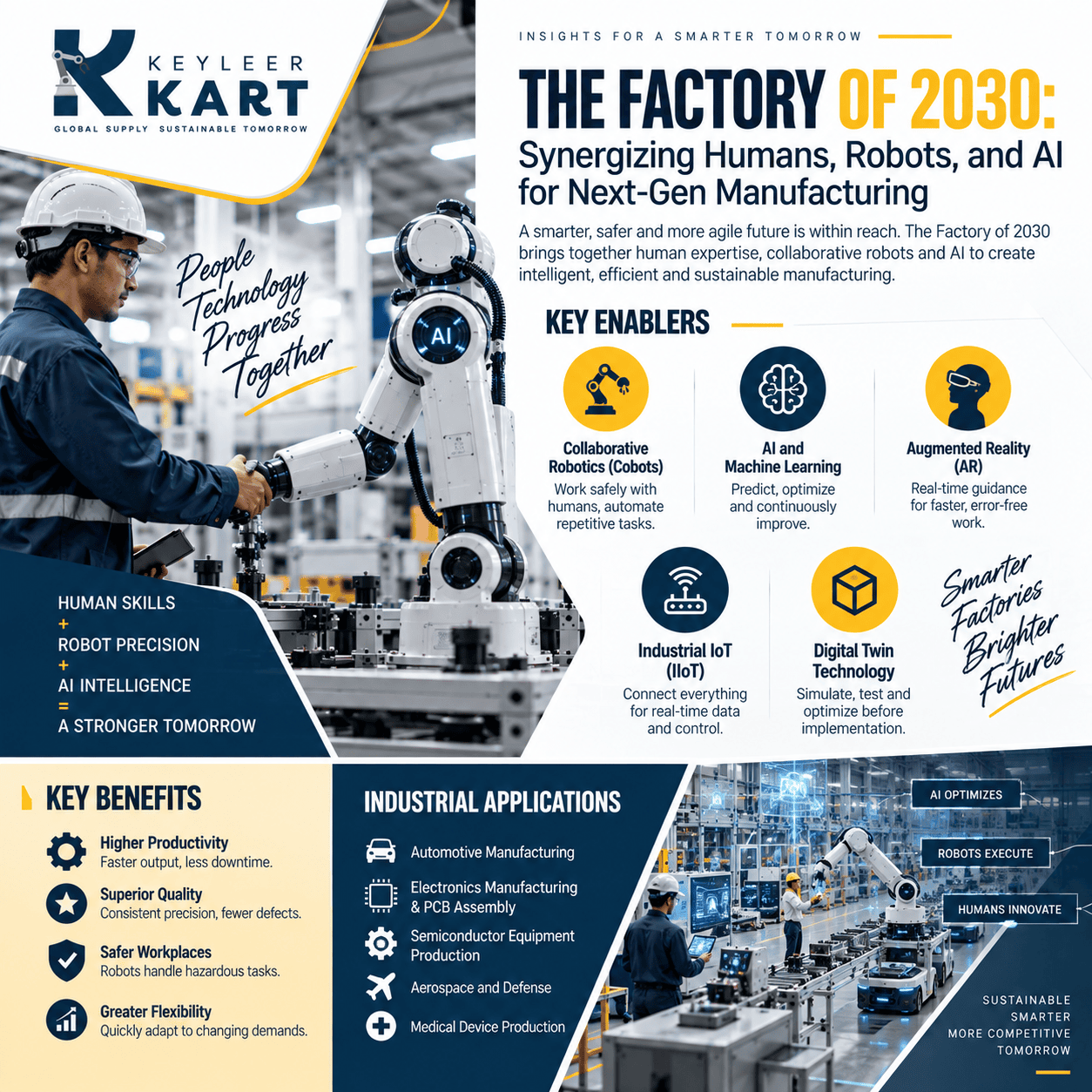
The manufacturing landscape is undergoing a profound transformation, moving towards an era where advanced technology and human ingenuity converge. The concept of "The Factory of 2030" is at the forefront of this evolution, proposing an intelligent ecosystem where humans, collaborative robots (cobots), and artificial intelligence (AI) work in seamless harmony. This synergistic approach is crucial for modern manufacturing, industrial automation, and the global competitiveness of industries striving for unparalleled efficiency, flexibility, and innovation.
Overview
The Factory of 2030 is not merely an automated facility; it is a hyper-connected, intelligent ecosystem where humans, robots, and AI operate collaboratively to optimize production processes. This involves the integration of advanced robotics, AI-driven analytics, machine learning algorithms, and human expertise within a digitally interconnected environment. The core principle is intelligent collaboration: AI provides predictive insights and decision support, robots handle repetitive or hazardous tasks, and humans focus on complex problem-solving, creativity, and supervision, leveraging their cognitive abilities. This integrated approach enhances productivity, reduces errors, accelerates time-to-market, and allows for unprecedented customization and agility in response to market demands. This advanced manufacturing model is becoming increasingly prevalent across various high-tech sectors, including electronics manufacturing, semiconductor equipment production, automotive assembly, and precision CNC machining, where precision, speed, and adaptability are paramount.
Key Factors to Consider
Collaborative Robotics (Cobots)
Cobots are designed to work safely alongside human operators without traditional safety cages. They automate repetitive tasks, assist with heavy lifting, and provide precision in assembly, significantly augmenting human capabilities and improving ergonomics on the factory floor.
Advanced AI and Machine Learning
AI algorithms process vast amounts of data from the factory floor, enabling predictive maintenance, real-time quality control, dynamic production scheduling, and supply chain optimization. Machine learning continually refines processes, identifying patterns and making autonomous improvements.
Augmented Reality (AR) for Human Workers
AR overlays digital information onto the real world, assisting human technicians with assembly instructions, complex maintenance procedures, and quality inspections. This technology enhances training, reduces human error, and speeds up intricate tasks, boosting human efficiency.
Industrial Internet of Things (IIoT) Connectivity
IIoT forms the backbone of the Factory of 2030, connecting every machine, sensor, robot, and system. This pervasive connectivity ensures real-time data flow, enabling comprehensive monitoring, analysis, and control across the entire production network.
Digital Twin Technology
A digital twin is a virtual replica of a physical asset, process, or system. In the Factory of 2030, digital twins allow for simulation, testing, and optimization of production lines, new product designs, and operational changes in a virtual environment before physical implementation, saving time and resources.
Benefits
Increased Productivity and Efficiency
By automating repetitive tasks and optimizing workflows through AI, the Factory of 2030 significantly boosts output, reduces cycle times, and minimizes downtime, leading to higher overall equipment effectiveness (OEE).
Enhanced Quality and Precision
Robots perform tasks with consistent accuracy, while AI-driven vision systems and sensors provide real-time quality inspection, drastically reducing defects and ensuring products meet stringent specifications, critical in SMT and semiconductor manufacturing.
Improved Worker Safety and Ergonomics
Robots handle hazardous, heavy, or ergonomically challenging tasks, safeguarding human workers from injuries and improving the overall working environment, allowing humans to focus on higher-value activities.
Greater Agility and Customization
The flexibility of integrated human-robot-AI systems enables rapid reconfiguration of production lines, facilitating quick responses to market changes, personalized product customization, and efficient production of small batches.
Industrial Applications
Automotive Manufacturing
Electronics Manufacturing & PCB Assembly
Semiconductor Equipment Production
Aerospace and Defense Industries
Medical Device Production
Buying Guide
When investing in the components for a Factory of 2030 ecosystem, buyers must meticulously evaluate machine condition, ensuring it meets required specifications and performance benchmarks. A comprehensive warranty and strong supplier reputation are crucial for long-term support. Availability of spare parts and guaranteed compatibility with existing industrial automation and IT infrastructure are paramount to ensure seamless integration and operational continuity.
Maintenance Tips
For optimal performance in an integrated factory environment, a robust maintenance strategy is essential. Implement proactive preventive maintenance schedules for all robotic and CNC machinery, coupled with regular cleaning and proper lubrication. Conduct routine inspections and precise calibration of sensors and AI-driven systems to maintain accuracy. Furthermore, continuous operator training is vital to ensure human teams can effectively monitor, troubleshoot, and interact with advanced automation.
Industry Trends
The Factory of 2030 is inherently intertwined with the advancements of Industry 4.0, leveraging AI and IoT to create truly Smart Manufacturing environments. Predictive Maintenance, driven by AI and data from connected sensors, minimizes downtime, while advanced Automation streamlines every process. Digital Twins enable virtual optimization and simulation, enhancing efficiency and sustainability by reducing material waste and energy consumption. This convergence leads to highly resilient and adaptable production systems.
Frequently Asked Questions
How does AI enhance human capabilities in the factory?
AI serves as an intelligent assistant, processing vast datasets to provide humans with predictive insights for decision-making, optimizing complex scheduling, and automating mundane data analysis. This frees human workers to focus on creative problem-solving, innovation, and strategic oversight, leveraging their unique cognitive strengths where AI excels at data processing and pattern recognition.
What is the role of cobots in a shared workspace?
Collaborative robots are designed with safety features that allow them to operate alongside human workers, sharing the same workspace. Their role is to assist with repetitive, physically demanding, or precision-critical tasks, augmenting human productivity and reducing strain, while humans handle more intricate assembly, quality checks, or supervisory roles, creating a symbiotic working relationship.
Is the Factory of 2030 accessible for SMEs?
Absolutely. While the full vision of the Factory of 2030 involves extensive integration, many foundational technologies like cobots, cloud-based AI, and modular IoT solutions are increasingly scalable and cost-effective. Small and medium-sized enterprises (SMEs) can adopt these technologies incrementally, focusing on specific pain points and gradually building towards a more integrated, intelligent manufacturing environment tailored to their budget and operational needs.



