
In the high-speed world of modern manufacturing and industrial automation, unforeseen equipment breakdowns can lead to crippling production halts, significant financial losses, and missed deadlines. A meticulously prepared and regularly updated factory spare parts checklist is not merely an operational convenience but a critical strategic asset, ensuring resilience, optimizing uptime, and maintaining the competitive edge necessary for continuous operation in an Industry 4.0 landscape.
Overview: Strategic Spare Parts Management
A Complete Factory Spare Parts Checklist is a comprehensive, organized inventory and management strategy for all critical components and consumables required to maintain the operational continuity of industrial machinery, robotics, SMT equipment, semiconductor fabrication tools, CNC machines, and various automation systems. It encompasses identifying, categorizing, stocking, and tracking every part, from high-value proprietary components to standard fasteners, ensuring their availability when needed.
This systematic approach works by first conducting a thorough audit of all factory equipment to identify every component that could fail and halt production. Parts are then categorized by criticality, lead time, cost, and historical failure rate. An inventory management system tracks stock levels, reorder points, and supplier information, enabling proactive procurement rather than reactive emergency orders. This ensures that the right part is available at the right time, minimizing Mean Time To Repair (MTTR) and preventing prolonged downtime.
Its importance cannot be overstated. Without a robust spare parts strategy, factories face unpredictable disruptions, escalating repair costs, and a heightened risk of total production line failure. It directly impacts OEE (Overall Equipment Effectiveness), product quality, and operational profitability. By having critical spares on hand, manufacturers can quickly address issues, maintain production schedules, and protect their investment in high-value automation and manufacturing equipment.
A complete factory spare parts checklist is essential in virtually every sector involving complex machinery and continuous production. This includes electronics manufacturing, automotive assembly, aerospace component production, pharmaceutical processing, food and beverage, and especially in industries like semiconductor manufacturing and SMT where precision and uptime are paramount.
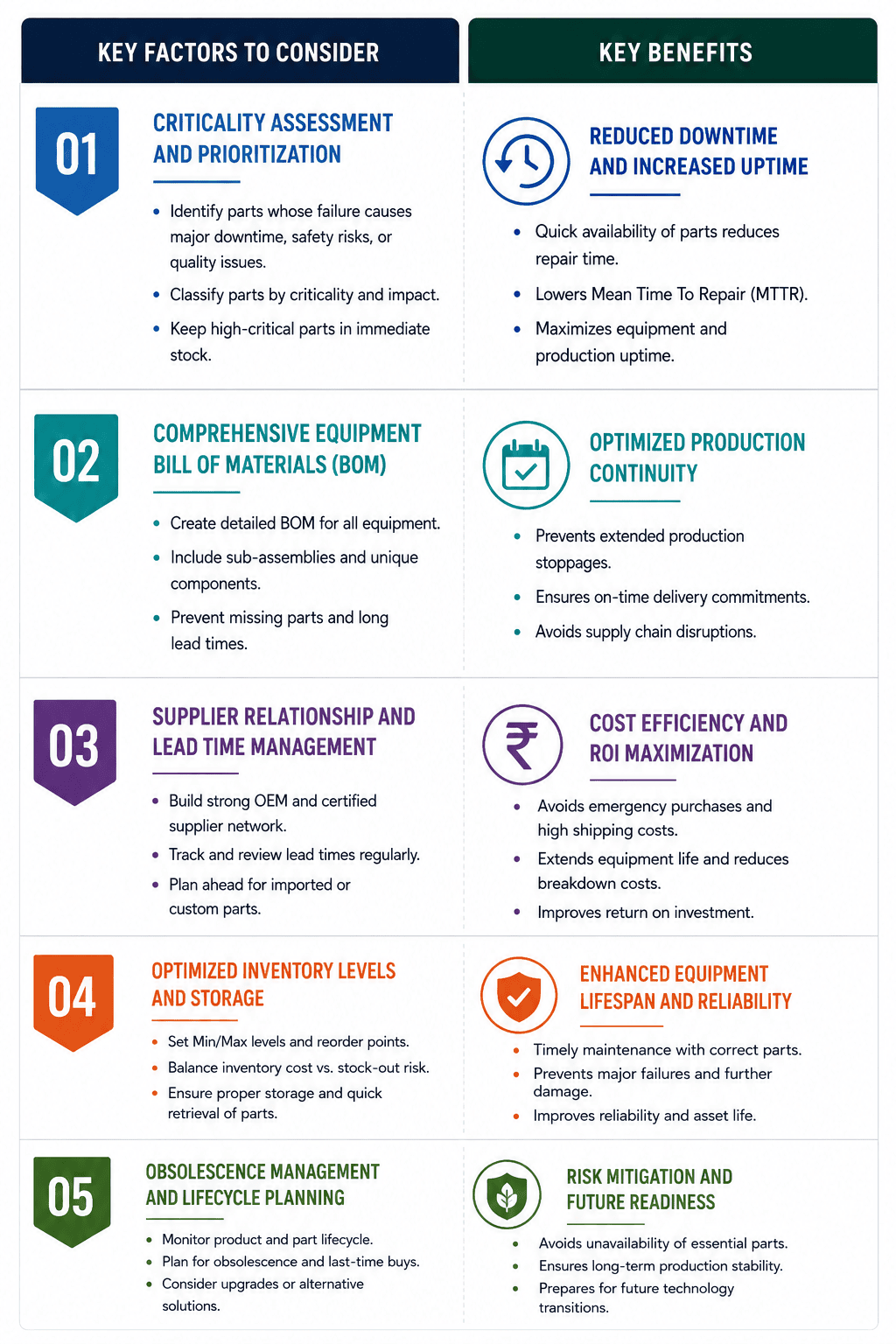
Key Factors to Consider
1. Criticality Assessment and Prioritization
Identify parts whose failure would lead to immediate and significant production stoppage, safety hazards, or quality deviations. Prioritize these "critical spares" for immediate availability, often requiring on-site stock, while less critical components might be ordered on demand with longer lead times.
2. Comprehensive Equipment Bill of Materials (BOM)
Develop or acquire detailed Bills of Materials for all machinery, including sub-assemblies and unique components. This ensures all potential spare parts are identified from the outset, preventing oversight of specialized items that may have long lead times or require specific sourcing.
3. Supplier Relationship and Lead Time Management
Establish robust relationships with original equipment manufacturers (OEMs) and certified third-party suppliers. Understand lead times for all critical parts, especially for imported or custom components, to factor into inventory planning and avoid last-minute crises.
4. Optimized Inventory Levels and Storage
Balance the cost of holding inventory against the risk of stock-outs. Implement strategies like Min/Max levels, reorder points, and dedicated, properly organized storage facilities to protect parts from damage, obsolescence, and facilitate quick retrieval.
5. Obsolescence Management and Lifecycle Planning
Actively monitor the lifecycle of critical equipment and its components. Plan for the eventual obsolescence of parts by identifying suitable replacements, considering last-time buys, or upgrading modules proactively to avoid being stranded without support for vital machinery.
Benefits
Reduced Downtime and Increased Uptime
A well-managed spare parts inventory ensures that components required for repairs are immediately accessible, drastically cutting down the Mean Time To Repair (MTTR) and keeping production lines running smoothly, thus maximizing operational uptime.
Optimized Production Continuity
By preventing extended stoppages caused by unavailable parts, factories can maintain consistent production schedules, meet delivery commitments, and avoid the cascading negative effects of unexpected delays on the supply chain and customer satisfaction.
Cost Efficiency and ROI Maximization
Strategic spare parts management reduces costly emergency purchases, minimizes expedited shipping fees, and extends the lifespan of expensive machinery by facilitating timely repairs, ultimately improving the return on investment for capital equipment.
Enhanced Equipment Lifespan and Reliability
Having the correct spare parts on hand enables timely preventive and corrective maintenance, ensuring components are replaced before catastrophic failure, thereby preserving the integrity and extending the operational life of valuable industrial assets.
Industrial Applications
Electronics Manufacturing & PCB Assembly (e.g., SMT pick-and-place nozzles, feeders, vision system components)
Semiconductor Fabrication Plants (e.g., vacuum pump seals, plasma etching chamber parts, robotic arm end-effectors)
Automotive Assembly Lines (e.g., robotic welder tips, conveyor belts, PLC modules, specialized sensors)
CNC Machining Centers (e.g., spindle bearings, tool changers, servo motors, control boards)
General Industrial Automation (e.g., pneumatic cylinders, sensors, actuators, safety relays, HMI screens)
Buying Guide for Spare Parts Sourcing
When procuring spare parts, buyers must evaluate several critical factors: the exact specifications and compatibility with existing machinery, the authenticity and quality of the part (preferably OEM or certified aftermarket), the supplier's reputation for reliability and timely delivery, the warranty offered on the part, and their capability to provide ongoing support. Always prioritize suppliers who can guarantee genuine parts and have proven track records in the industrial automation and manufacturing sectors to ensure optimal performance and longevity of your equipment.
Maintenance Tips for Equipment Utilizing Spare Parts
Effective maintenance is key to maximizing equipment lifespan and minimizing spare parts consumption. Implement a robust preventive maintenance schedule including regular cleaning, precise lubrication of moving parts, routine inspection for wear and tear, and calibration of sensitive instruments. Continuously train operators on proper equipment use and basic troubleshooting to identify issues early, ensuring that spare parts are only used when genuinely necessary, and that new parts are installed correctly.
Industry Trends: Smart Spare Parts Management
The landscape of spare parts management is rapidly evolving with Industry 4.0 principles. AI and IoT sensors are enabling predictive maintenance, where equipment anticipates component failure, triggering automated spare part reorders. Digital twins provide virtual testing grounds for part performance, while smart manufacturing integrates inventory systems directly with production schedules. Automation in warehousing and logistics for spares, coupled with a growing focus on sustainability and remanufactured parts, are shaping a more efficient, resilient, and environmentally conscious approach to factory spare parts management.
Frequently Asked Questions
What is the primary goal of a factory spare parts checklist?
The primary goal is to minimize costly downtime and maintain continuous production by ensuring that critical components for machinery repair and maintenance are readily available when needed. It acts as a proactive defense against unforeseen equipment failures, safeguarding operational efficiency and profitability.
How often should a factory's spare parts checklist be reviewed and updated?
A factory's spare parts checklist should ideally be reviewed and updated at least annually, or more frequently if there are significant changes to equipment, production processes, or supplier relationships. Regular updates ensure it accurately reflects current operational needs, equipment lifecycles, and addresses any emerging obsolescence issues.
What is the difference between critical and non-critical spare parts?
Critical spare parts are those components whose failure would immediately halt production, create safety risks, or significantly impact product quality. Non-critical spare parts are components whose failure allows continued, albeit possibly degraded, operation, or whose replacement can be deferred without immediate catastrophic consequences, often with longer lead times for procurement.