
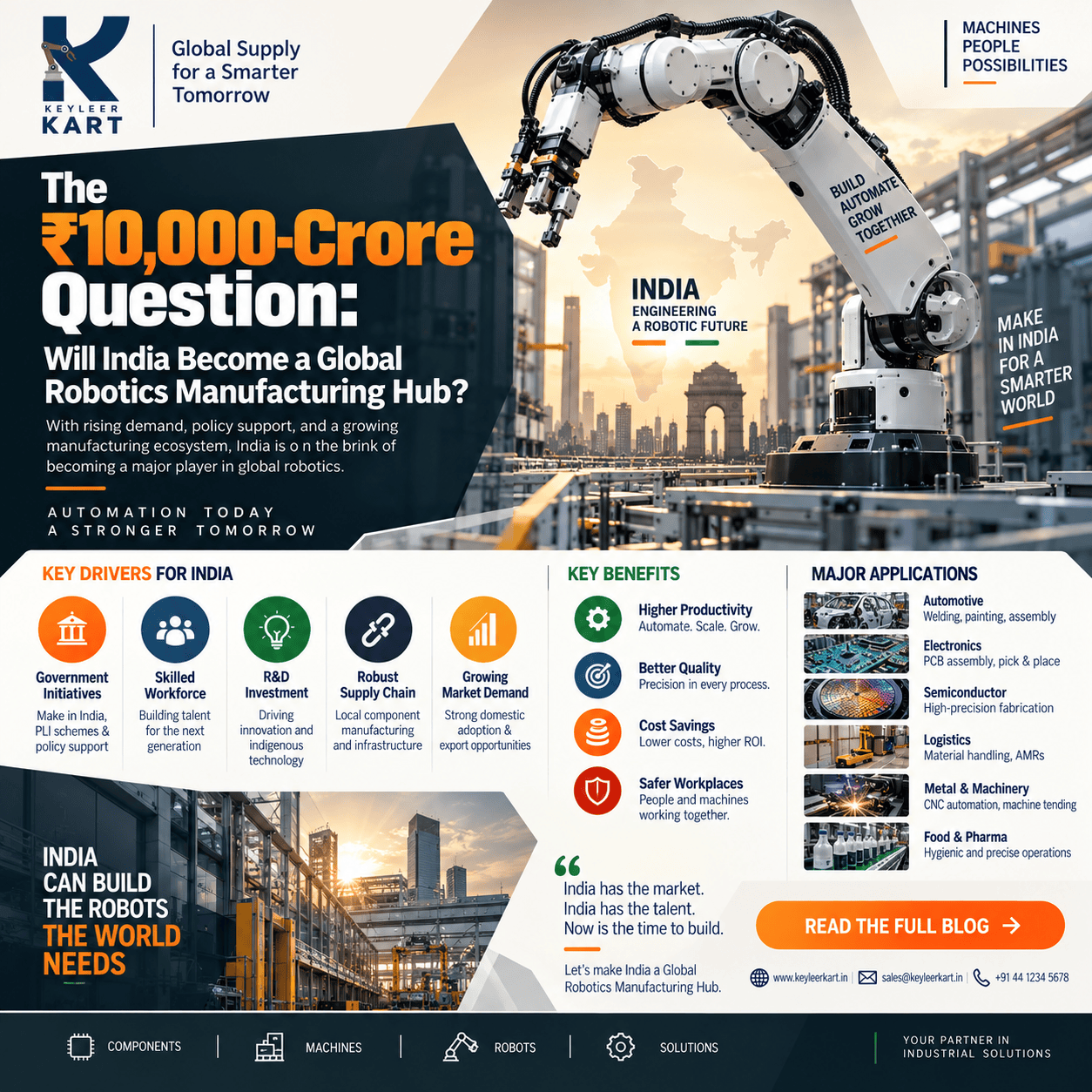
The global manufacturing landscape is undergoing a profound transformation, driven by the relentless pursuit of efficiency, precision, and scalability. At the heart of this revolution lies industrial robotics, a technology critical for enhancing productivity and competitive advantage in modern manufacturing and industrial automation. As India sets its sights on an ambitious manufacturing growth trajectory, the nation's potential to emerge as a global hub for robotics manufacturing presents a pivotal, multi-billion rupee question with far-reaching implications.
Overview: Understanding the Robotics Manufacturing Ecosystem
Robotics manufacturing encompasses the design, development, assembly, and integration of robotic systems, ranging from sophisticated industrial manipulators and collaborative robots (cobots) to autonomous mobile robots (AMRs). These advanced machines are engineered to perform a multitude of tasks with high accuracy, repeatability, and speed, often exceeding human capabilities in demanding environments. Operationally, robotics involves intricate mechanisms driven by sophisticated software, sensors, and actuators, enabling them to execute pre-programmed sequences or adapt to dynamic conditions through AI and machine learning. This technology is paramount for modern industry due to its ability to optimize production cycles, improve product quality, reduce operational costs, and enhance worker safety by taking over hazardous tasks. Robotics are extensively utilized across various sectors, most notably in automotive production lines, electronics assembly, semiconductor fabrication, precision machining, and logistics warehouses globally.
Key Factors to Consider
1. Government Initiatives and Policy Support
India's potential as a robotics manufacturing hub is heavily reliant on sustained government backing. Policies like "Make in India" and production-linked incentive (PLI) schemes must be specifically tailored to foster indigenous robotics development, attract foreign investment, and create a conducive regulatory environment for R&D and manufacturing.
2. Skilled Workforce Development
The intricate nature of robotics demands a highly skilled workforce proficient in areas such as mechatronics, AI, software engineering, and advanced manufacturing. Developing robust educational and vocational training programs is crucial to bridge the existing skill gap and cultivate a talent pool capable of designing, building, deploying, and maintaining advanced robotic systems.
3. Research and Development Investment
To compete on a global scale, substantial investment in robotics research and development is indispensable. This includes funding for university programs, establishing dedicated innovation centers, and encouraging collaboration between academia and industry to drive breakthroughs in robot capabilities, materials, and cost-effectiveness.
4. Robust Supply Chain and Infrastructure
Establishing a resilient domestic supply chain for critical robotic components, sensors, controllers, and specialized materials is vital. Furthermore, world-class manufacturing infrastructure, including advanced testing facilities and smart factory ecosystems, will be necessary to support high-volume, high-quality robotics production.
5. Domestic and Global Market Demand
While India’s burgeoning manufacturing sector presents a significant domestic market for robotics adoption, tapping into global export markets is key for sustainable growth. Understanding international standards, certifications, and competitive pricing strategies will be critical for India to become a leading global supplier of robotics solutions.
Benefits
Enhanced Productivity and Efficiency
Robotics integration drastically increases production throughput and operational efficiency by automating repetitive tasks, reducing cycle times, and allowing for continuous operation without human fatigue, thereby optimizing overall factory output.
Improved Quality and Precision
Robots execute tasks with unparalleled accuracy and repeatability, minimizing errors and ensuring consistent product quality. This precision is critical in industries like electronics manufacturing and semiconductor equipment production, where tolerances are extremely tight.
Cost Reduction and ROI
While initial investment can be significant, robotics lead to substantial long-term cost savings through reduced labor costs, lower material waste, minimized rework, and optimized energy consumption. This often results in a strong return on investment for manufacturers.
Increased Worker Safety
By deploying robots to handle dangerous, strenuous, or hazardous tasks, companies significantly improve workplace safety. This protects human workers from risks associated with heavy lifting, repetitive strain injuries, or exposure to toxic environments.
Industrial Applications
Automotive Manufacturing: Welding, painting, assembly, material handling.
Electronics Manufacturing & PCB Assembly: Pick-and-place, soldering, inspection, testing.
Semiconductor Equipment Manufacturing: Wafer handling, cleanroom assembly, precision inspection.
CNC Machining & Metal Fabrication: Machine tending, deburring, polishing, bending.
Logistics & Warehousing: Palletizing, depalletizing, autonomous material transport, order fulfillment.
Buying Guide
When considering the acquisition of industrial robots or related automation equipment, buyers must meticulously evaluate several crucial factors. Assess the machine's condition, detailed specifications to match application needs, and the warranty offered. Prioritize suppliers with a strong reputation for reliability and post-sales support, ensure the availability of spare parts, and verify compatibility with existing factory infrastructure and software systems for seamless integration.
Maintenance Tips
Effective maintenance is paramount for the longevity and performance of robotic systems. Implement a strict preventive maintenance schedule, including regular cleaning of components, meticulous lubrication of moving parts, thorough inspection for wear and tear, and periodic calibration of sensors and actuators. Crucially, invest in comprehensive operator training to ensure proper handling and immediate identification of potential issues.
Industry Trends
The robotics sector is rapidly evolving, driven by the principles of Industry 4.0. Integration with Artificial Intelligence (AI) and the Internet of Things (IoT) enables smarter, more autonomous robots capable of learning and real-time decision-making. Smart Manufacturing initiatives leverage Predictive Maintenance through digital twins to anticipate failures, minimizing downtime. This pervasive automation, coupled with a focus on sustainability and energy efficiency, is redefining manufacturing processes, pushing towards fully connected and highly adaptive factory environments.
Frequently Asked Questions
What specific government initiatives are supporting robotics manufacturing in India?
India's government is actively promoting indigenous manufacturing through programs like "Make in India" and Production-Linked Incentive (PLI) schemes. While not exclusively for robotics, these policies create a conducive environment for local production, offering incentives for investments in advanced manufacturing technologies, R&D, and skill development that directly benefit the robotics sector's growth.
How does India plan to address the skilled workforce gap in robotics?
Addressing the skilled workforce gap involves a multi-pronged approach, including strengthening engineering curricula in universities, introducing specialized vocational training programs in mechatronics, AI, and robotics, and fostering industry-academia collaborations. The goal is to create a talent pipeline equipped with the technical expertise needed for robotics design, deployment, and maintenance.
What are the primary challenges India faces in becoming a global robotics manufacturing hub?
Key challenges include developing a robust domestic supply chain for high-precision components, attracting significant foreign and domestic investment into R&D and production infrastructure, bridging the skills gap, and establishing competitive pricing strategies. Additionally, navigating international trade policies and quality standards will be crucial for global market penetration.



