The manufacturing landscape is undergoing a profound transformation, driven by rapid advancements in technology. In modern manufacturing, embracing industrial automation trends is no longer an option but a strategic imperative. These innovations are reshaping how industries operate, promising unprecedented levels of efficiency, productivity, and competitiveness in the years leading up to 2026 and beyond.
Overview
Industrial automation trends refer to the cutting-edge technological shifts and strategic methodologies that are revolutionizing factory floors, production lines, and overall industrial processes. These trends move beyond basic mechanization, focusing on integrating intelligence, connectivity, and autonomy into every facet of operations.
At their core, these trends work by combining sophisticated hardware—such as advanced robotics, intelligent sensors, and high-precision CNC machinery—with powerful software platforms incorporating Artificial Intelligence (AI), Machine Learning (ML), and the Internet of Things (IoT). This integration allows systems to monitor, analyze, control, and optimize processes in real-time, often adapting autonomously to changing conditions, predicting failures, and executing complex tasks with minimal human intervention.
The importance of these trends cannot be overstated. They are crucial for addressing global labor shortages, significantly improving product quality and consistency, drastically reducing waste, enhancing workplace safety, and enabling agile manufacturing responses to dynamic market demands. By adopting these advancements, businesses can achieve higher throughput, lower operational costs, and maintain a crucial competitive edge.
These advanced automation technologies are becoming ubiquitous across diverse sectors. They are commonly used in electronics manufacturing (SMT, PCB assembly), automotive production, semiconductor fabrication, pharmaceuticals, food & beverage processing, aerospace, and sophisticated logistics & warehousing operations.
Key Factors to Consider
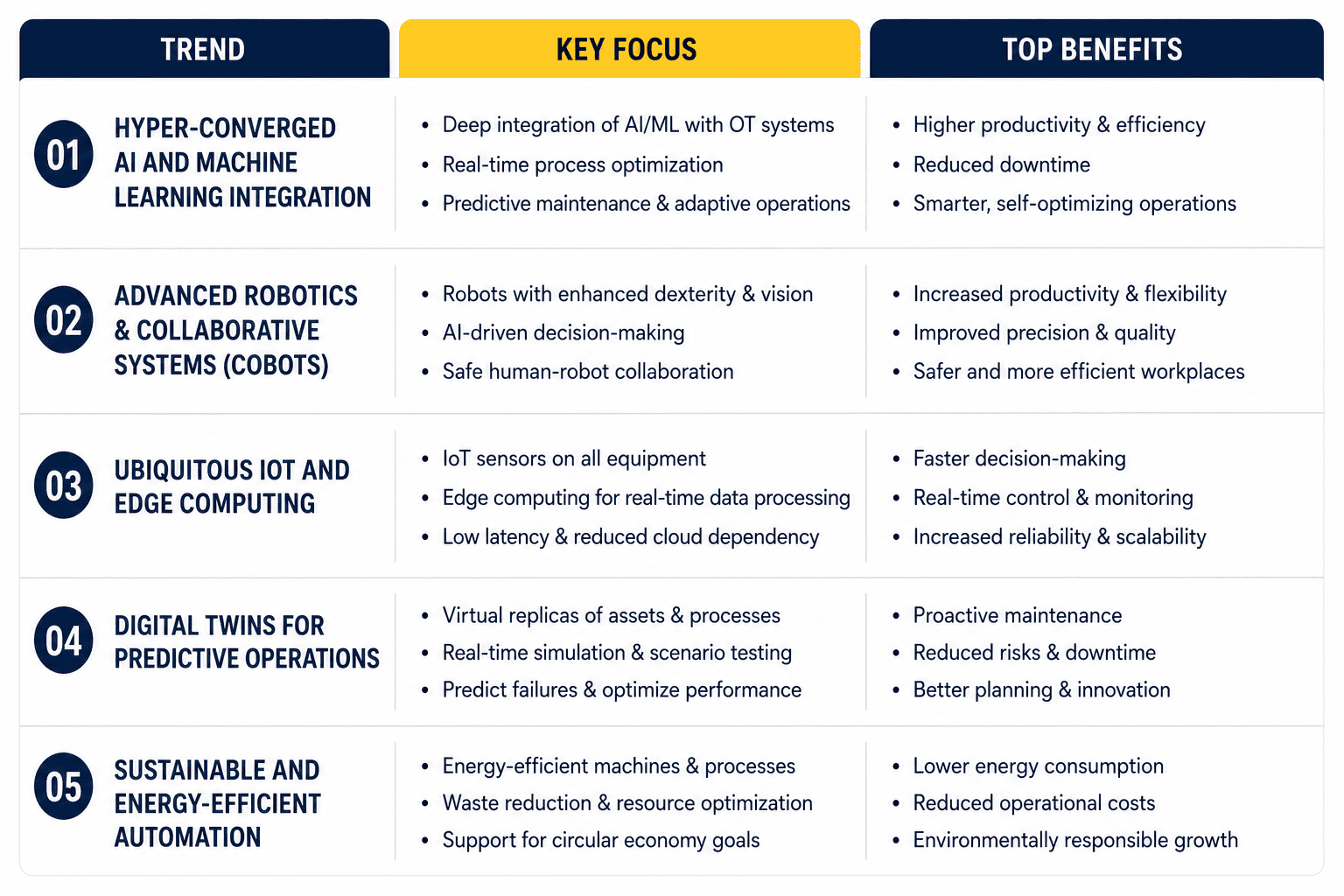
1. Hyper-Converged AI and Machine Learning Integration
AI and ML are moving beyond mere data analytics, becoming deeply embedded into operational technology (OT) layers. By 2026, these technologies will enable real-time process optimization, highly accurate predictive maintenance, autonomous quality control, and adaptive robotic behavior, leading to smarter, self-optimizing factory floors.
2. Advanced Robotics & Collaborative Systems (Cobots)
Robots are evolving with enhanced dexterity, advanced vision systems, and AI-driven decision-making capabilities, performing more complex tasks with greater precision. Collaborative robots (cobots) are also seeing increased adoption, safely working alongside human operators, thereby boosting flexibility and productivity in shared workspaces.
3. Ubiquitous IoT and Edge Computing
The proliferation of IoT sensors on every piece of equipment generates vast amounts of data. Edge computing solutions process this data locally at the source, enabling real-time control, faster decision-making, and significantly reducing latency and bandwidth dependency on centralized cloud infrastructure for critical operations.
4. Digital Twins for Predictive Operations
Digital Twins – virtual replicas of physical assets, processes, or entire factory layouts – are becoming indispensable. These virtual models are used for continuous real-time monitoring, simulating potential changes, predicting equipment failures, and optimizing operational strategies before any physical implementation, leading to proactive maintenance and innovation.
5. Sustainable and Energy-Efficient Automation
Sustainability is a core driver. Future automation solutions will prioritize reduced energy consumption through optimized processes and energy-efficient hardware. There's a growing emphasis on minimizing waste, supporting circular economy principles, and adopting eco-friendly manufacturing practices to meet environmental regulations and corporate social responsibility goals.
Benefits
Enhanced Productivity & Efficiency
Automation streamlines manufacturing processes, drastically reduces cycle times, and minimizes human errors, resulting in significantly higher output with fewer resources and improved throughput across the production line.
Improved Quality & Precision
Advanced robotic systems, coupled with AI-driven inspection and vision systems, ensure unparalleled product consistency and precision, significantly reducing defects, rework, and ensuring adherence to stringent quality standards.
Reduced Operational Costs
By lowering labor expenses, optimizing energy consumption, minimizing material waste, and extending equipment lifespan through predictive maintenance, automation delivers substantial long-term savings and a strong return on investment.
Increased Safety & Worker Satisfaction
Robots and automated systems take over hazardous, repetitive, or ergonomically challenging tasks, significantly improving workplace safety. This also frees human workers to focus on more complex, value-added, and cognitive roles, boosting job satisfaction.
Industrial Applications
Electronics Manufacturing (SMT, PCB Assembly)
Automotive Production
Semiconductor Fabrication
Pharmaceuticals & Medical Devices
Logistics & Warehousing
Buying Guide
When evaluating industrial automation solutions for purchase, buyers should thoroughly assess the machine's condition, review comprehensive specifications to ensure suitability for current and future needs, and scrutinize warranty terms for adequate coverage. Prioritize suppliers with a solid reputation for reliability and support, verify the availability of spare parts, and confirm seamless compatibility with your existing infrastructure and software systems for smooth integration.
Maintenance Tips
Optimal performance and longevity of industrial automation equipment hinge on rigorous maintenance practices. Implement a robust preventive maintenance schedule, adhere to detailed cleaning protocols, ensure precise lubrication of moving parts, conduct routine inspections for wear and tear, perform critical calibration regularly, and invest in ongoing operator training to maximize system uptime and operational efficiency.
Industry Trends
The industrial landscape for 2026 is defined by Industry 4.0 as its overarching framework, with Artificial Intelligence (AI) and the Internet of Things (IoT) serving as foundational enablers. This convergence is driving the era of Smart Manufacturing, where Predictive Maintenance becomes standard, powered by sensor data and AI algorithms. The increasing adoption of Automation, coupled with sophisticated Digital Twins, allows for virtual simulation and optimization of entire factory processes. All these trends are converging towards achieving greater Sustainability, optimizing resource utilization, and minimizing environmental impact in manufacturing operations.
Frequently Asked Questions
Q1: How will AI and Machine Learning transform industrial automation by 2026?
A: AI and ML will move beyond data analytics to enable truly intelligent automation, allowing systems to learn, adapt, and make real-time decisions. This includes predictive maintenance, adaptive process control, optimized resource allocation, and advanced quality inspection, leading to greater autonomy and efficiency in manufacturing operations.
Q2: What is the significance of Digital Twins in the future of industrial automation?
A: Digital Twins are critical for creating virtual replicas of physical assets, processes, or entire factory floors. By 2026, they will be extensively used for real-time monitoring, simulating changes, predicting potential failures, and optimizing operational strategies without disrupting live production. This allows for proactive decision-making, accelerated innovation, and improved asset lifecycle management.
Q3: How are sustainability considerations driving industrial automation trends for 2026?
A: Sustainability is a core driver. Automation trends for 2026 will focus on reducing energy consumption through optimized processes and energy-efficient hardware. Furthermore, automation will facilitate waste reduction, enable better resource utilization, and support circular economy principles by improving recycling and remanufacturing processes, aligning with environmental goals and corporate social responsibility.