
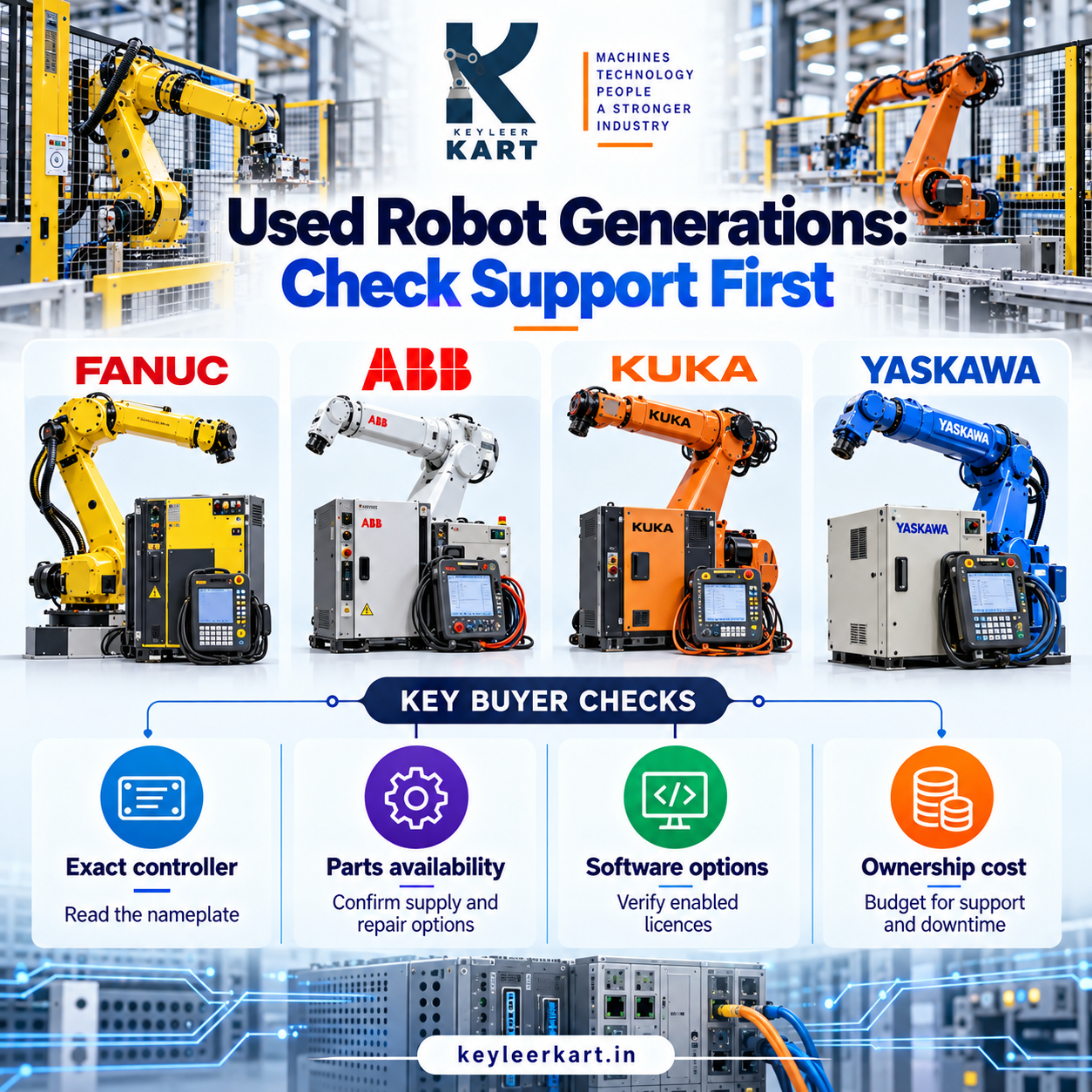
The robot runs perfectly today. The question that actually matters is whether anyone will still sell you a servo board for it in three years.
A robot's mechanical arm can run for decades. Its controller — the electronics — reaches end-of-service life far sooner, and once that happens, even a perfectly healthy arm becomes a slow-motion liability. Every major brand has a documented controller lineage, and knowing exactly where a specific generation sits on that timeline is the single most important technical question in any used-robot purchase.
This post lays out the controller generations across the major brands and gives you a practical way to judge what's genuinely safe to buy in 2026.
Overview
Controller generation, not arm age, is what determines a robot's real remaining service life, because it's the electronics — servo amplifiers, main CPU boards, backup batteries — that go end-of-service first. A robot's OEM support status for its specific controller generation should be the very first thing checked in any used purchase, before payload, reach, or even price.
Key Factors to Consider
FANUC: RJ-2 to R-50iA
FANUC's controller lineage runs RJ-2, RJ-3, R-J3iB, R-30iA, R-30iB, R-30iB Plus, and now R-50iA — anything at R-J3iB or older should be treated as a parts-risk purchase requiring extra caution.
ABB: S4 to OmniCore
ABB's lineage runs S4, S4C, S4C+, IRC5, and the current OmniCore — S4C+ era machines are priced attractively for a reason, and buyers should factor that support gap directly into their offer.
KUKA: KR C2 to KR C5
KUKA's KR C2 is now legacy, KR C4 remains the volume used generation with solid support, and KR C5 represents the current supported line.
Yaskawa: NX100 to YRC1000
Yaskawa's lineage runs NX100, DX100, DX200, and the current YRC1000 or YRC1000micro — DX100 remains the common mid-age used generation buyers encounter most often.
Benefits
Avoids Buying Into a Dead-End Generation
Checking controller generation before purchase prevents the costly mistake of acquiring a robot that becomes functionally unrepairable within a year or two.
Strengthens Your Negotiating Position
Knowing exactly where a specific unit sits in its brand's support lifecycle gives you objective, defensible grounds for price negotiation, rather than guesswork.
Clarifies Retrofit Economics Upfront
Understanding a controller's obsolescence status early lets you accurately price in a future retrofit if you plan to keep the robot long-term, rather than discovering the need later at a worse negotiating position.
A Healthy Third-Party Ecosystem Exists for the Big Four
FANUC, ABB, KUKA, and Yaskawa all benefit from active third-party parts and repair ecosystems even after OEM support ends — a real advantage over niche or less common brands.
Industrial Applications
Any used robot purchase across FANUC, ABB, KUKA, or Yaskawa
Long-term production line planning requiring multi-year equipment horizons
Fleet standardisation decisions across multiple robot generations
Controller retrofit and upgrade planning
Resale valuation and pricing decisions
First-time automation buyers seeking lower purchase risk
Buying Guide
Always ask for the exact controller model, not just the arm model, and independently verify it against the current published support status for that brand before finalising any purchase. Treat a robot on an obsolete controller generation as requiring either a meaningfully discounted price or a clear retrofit plan — never pay full 'good condition' pricing for a unit carrying real parts-obsolescence risk.
Maintenance Tips
For any robot on an ageing but still-supported controller generation, stock critical spares — servo amplifiers, backup batteries, key boards — proactively rather than waiting for a failure to discover they're hard to source. Monitor manufacturer announcements about support-window changes for your specific controller generation, since these timelines do shift and are worth tracking actively rather than assuming indefinitely.
Industry Trends
Every brand's controller lineage keeps advancing — FANUC's R-30iA, comfortably supported today, will eventually face the obsolescence questions the R-J3iB faces now — meaning this isn't a one-time check but an ongoing part of responsible robot fleet management for any manufacturer running equipment over a multi-year horizon.
Frequently Asked Questions
Q: Is an older controller generation always a bad purchase? A: Not always — for lower-criticality applications with a tight budget and full awareness of the parts-risk trade-off, an older but well-documented unit can still offer reasonable value at the right price.
Q: Which brand currently has the strongest used-market parts ecosystem? A: FANUC, ABB, KUKA, and Yaskawa — the industry's big four — all maintain healthy third-party parts and repair ecosystems even after OEM support windows close, a real advantage over smaller or niche brands.
Q: How can I check a specific controller's current support status? A: Ask the manufacturer or an authorised dealer directly, since support status can change; KeyLeer Kart verifies and discloses this for every unit we source and sell.
Conclusion
In 2026, the question 'is this robot still safe to buy' comes down almost entirely to one check: what controller generation is it running, and where does that sit on its brand's support timeline. Get that answer before you evaluate anything else. For verified controller generation status and expert guidance on every used robot we sell, contact KeyLeer Kart.
#UsedRobots #FANUC #ABBRobotics #KUKA #Yaskawa #KeyLeerKart #ManufacturingIndia



