
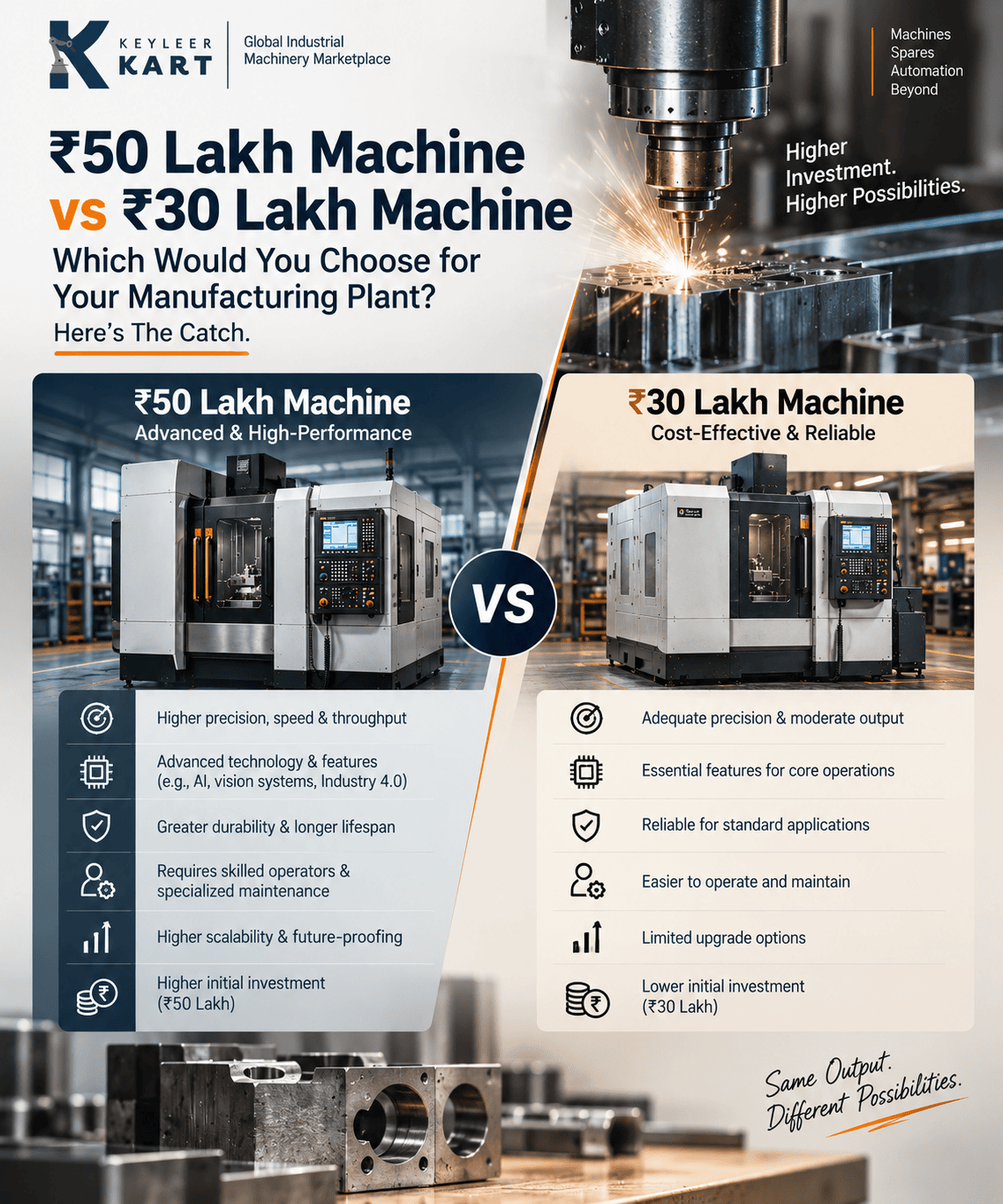
In the dynamic landscape of modern manufacturing and industrial automation, strategic equipment investment is paramount. The decision between a higher-priced, advanced machine and a more cost-effective alternative often goes beyond initial outlay, profoundly impacting long-term operational efficiency, productivity, and profitability. This article delves into the critical factors to consider when faced with a significant investment choice, such as a ₹50 Lakh machine versus a ₹30 Lakh machine, revealing the nuanced "catch" that savvy manufacturers must understand to optimize their production capabilities.
Overview
We are discussing advanced industrial automation machinery, which encompasses a wide range of equipment from high-precision CNC machining centers, state-of-the-art SMT pick-and-place robots, sophisticated semiconductor processing equipment, to complex assembly line robotics. These machines leverage electromechanical systems, programmable logic controllers (PLCs), sophisticated sensor arrays, and often AI-driven software to perform intricate tasks with high repeatability and accuracy, transforming raw materials or components into finished goods or sub-assemblies. They are crucial for enhancing production speed, ensuring product quality consistency, reducing labor costs, minimizing human error, and enabling complex manufacturing processes beyond human capabilities. Such equipment is commonly found in electronics manufacturing for PCB assembly, automotive industries for precision part fabrication, semiconductor foundries, medical device production, aerospace component manufacturing, and general industrial automation setups requiring high throughput and precision.
Key Factors to Consider
1. Precision, Speed, and Throughput
The ₹50 Lakh machine often boasts superior precision, significantly faster cycle times, and higher throughput, making it indispensable for high-volume production or intricate components. In contrast, the ₹30 Lakh machine might offer sufficient precision and moderate volumes for standard applications, but could become a bottleneck for demanding production schedules.
2. Technology Integration and Advanced Features
Premium models typically incorporate cutting-edge features like advanced vision systems, AI-powered predictive maintenance, wider material compatibility, and seamless Industry 4.0 integration. The lesser-priced option usually provides essential functionalities, focusing on core tasks without the latest, more complex advancements.
3. Durability and Longevity
Higher-priced equipment is often engineered with more robust components and superior build quality, leading to a longer operational lifespan and reduced wear and tear over extended periods. This translates into a potentially lower total cost of ownership (TCO) despite the elevated upfront investment, as downtime and replacement costs are minimized.
4. Operator Skill and Maintenance Complexity
A more advanced ₹50 Lakh machine might necessitate highly skilled operators and specialized maintenance technicians, incurring additional training and service costs. The ₹30 Lakh option could be simpler to operate and maintain, appealing to businesses with existing skill sets and less specialized personnel.
5. Scalability and Future-Proofing
The ₹50 Lakh machine frequently offers greater flexibility for future upgrades, reconfigurations, and integration with emerging technologies, ensuring its continued relevance as production demands evolve. The ₹30 Lakh machine might have limited upgrade paths, potentially leading to earlier obsolescence if business needs expand rapidly.
Benefits
Enhanced Productivity and Throughput
Both categories of machines boost output, but the premium machine significantly accelerates production cycles, crucially meeting high demand targets and improving overall factory efficiency.
Superior Product Quality and Consistency
Higher-end equipment delivers unparalleled precision and repeatability, drastically minimizing defects and ensuring uniform product quality across even the largest batches, which is vital for critical applications.
Reduced Long-term Operational Costs
While the initial outlay is higher, the ₹50 Lakh machine can lead to substantial long-term savings through optimized material usage, significantly reduced re-work, lower energy consumption per unit, and longer operational uptime.
Competitive Advantage
Investing in advanced technology positions a manufacturer at the forefront of their industry, enabling them to undertake complex projects, meet stringent client specifications, and offer superior products that attract premium clients and market share.
Industrial Applications
Electronics Manufacturing (PCB Assembly, Component Placement)
Semiconductor Device Fabrication and Packaging
Precision CNC Machining (Aerospace, Medical Devices)
Robotics Assembly and Automation Lines
Automotive Component Production and Electric Vehicle Manufacturing
Buying Guide
Before committing to either a ₹50 Lakh or ₹30 Lakh machine, buyers must rigorously evaluate several factors: the machine’s condition (new, refurbished, or used), detailed specifications aligned precisely with current and future production needs, comprehensive warranty terms, the supplier's reputation for reliability and robust after-sales support, the availability and cost of spare parts, and seamless compatibility with existing factory automation infrastructure. A thorough return on investment (ROI) analysis, considering both initial outlay and projected long-term operational costs, is absolutely essential for a well-informed decision.
Maintenance Tips
Optimal machine performance and longevity hinge on a robust maintenance strategy. Implement a strict preventive maintenance schedule, including regular cleaning of critical components, precise lubrication of all moving parts, routine inspection for wear and tear, periodic calibration of sensors and actuators for accuracy, and continuous operator training to ensure correct usage, enable minor troubleshooting, and facilitate early fault detection.
Industry Trends
The choice between industrial machines is increasingly influenced by Industry 4.0 paradigms. Advanced equipment often features built-in IoT connectivity for real-time data acquisition, enabling AI-driven predictive maintenance, smart manufacturing integration, and digital twin simulations for process optimization. The overarching trend towards greater automation, robotics, and sustainable production further emphasizes the long-term efficiency, adaptability, and resource optimization capabilities of modern industrial machinery.
Frequently Asked Questions
Is a ₹50 Lakh machine always a better investment than a ₹30 Lakh machine?
Not necessarily. The "better" investment depends entirely on your specific production requirements, budget constraints, expected ROI, and the long-term strategic goals of your manufacturing operation. While a ₹50 Lakh machine typically offers advanced features and higher capabilities, a ₹30 Lakh machine can be perfectly adequate and more cost-effective for certain applications with lower complexity or volume demands where over-specification would be inefficient.
How does the total cost of ownership (TCO) factor into this decision?
TCO is a crucial metric. It includes the initial purchase price, but also encompasses operational costs like energy consumption, routine maintenance, spare parts, consumables, labor, training, and potential downtime losses over the machine's entire lifespan. A ₹50 Lakh machine might have a higher upfront cost but could offer a lower TCO through superior efficiency, reduced material waste, extended lifespan, and less frequent servicing, while a ₹30 Lakh machine, though cheaper initially, might incur higher running costs or require earlier replacement.
What role does scalability play in choosing between these price points?
Scalability is a significant consideration for future growth and evolving market demands. A ₹50 Lakh machine often provides more headroom for increased production volumes, seamless integration with advanced automation systems, and adaptability to new product lines or complex processes. A ₹30 Lakh machine might have limited scalability, potentially requiring a complete replacement sooner if your production needs evolve substantially. Evaluating future business expansion plans and potential product diversification is vital.



